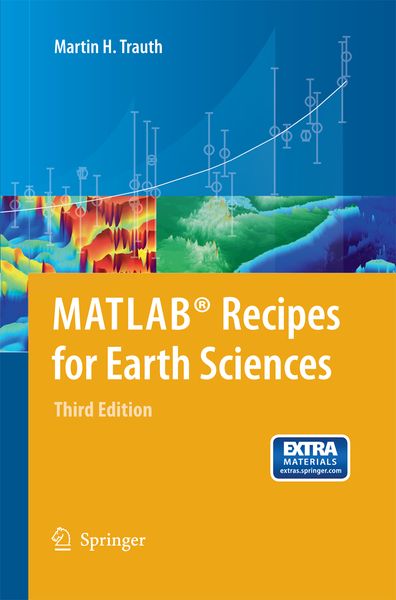
Produktbild: MATLAB® Recipes for Earth Sciences

MATLAB® Recipes for Earth Sciences

59,99 €

inkl. gesetzl. MwSt., Versandkostenfrei


Rezension

From the reviews of the third edition:

“The book introduces methods of data analysis in geosciences using MATLAB. … If you are tied to MATLAB, I don’t think you will be disappointed. If you have some familiarity with python then you will also be able to glean allot from the content. … The mathematical element flows nicely with the subject matter and I suspect that even an individual without a mathematics background could gain an appreciation for the math based on the context … .” (Amazon.com, February, 2013)

Produktdetails

Einband

Taschenbuch

Erscheinungsdatum

29.11.2014

Illustriert von

E. Sillmann

Verlag

Springer Berlin

Seitenzahl

336

Maße (L/B/H)

23,5/15,5/2 cm

Gewicht

539 g

Auflage

3rd edition 2010

Sprache

Englisch

ISBN

978-3-642-44716-7

Rezension

Produktdetails

Einband

Taschenbuch

Erscheinungsdatum

29.11.2014

Illustriert von

E. Sillmann

Verlag

Springer Berlin

Seitenzahl

336

Maße (L/B/H)

23,5/15,5/2 cm

Gewicht

539 g

Auflage

3rd edition 2010

Sprache

Englisch

ISBN

978-3-642-44716-7

Herstelleradresse

Springer-Verlag KG
Sachsenplatz 4-6
1201 Wien
AT

Email: GPSR Kontakt

Noch keine Bewertungen vorhanden

Verfassen Sie die erste Bewertung zu diesem Artikel

Helfen Sie anderen Kundinnen und Kunden durch Ihre Meinung.

Kundinnen und Kunden meinen

Bewertungen (0)

  • Produktbild: MATLAB® Recipes for Earth Sciences
  • Contents Preface 1 Data Analysis in Earth Sciences 1.1 Introduction 1.2 Data Collection 1.3 Types of Data 1.4 Methods of Data Analysis 2 Introduction to MATLAB 2.1 MATLAB in Earth Sciences 2.2 Getting Started 2.3 The Syntax 2.4 Data Storage and Handling 2.5 Data Structures and Classes of Objects 2.6 Scripts and Functions 2.7 Basic Visualization Tools 2.8 Generating M-Files to Regenerate Graphs 2.9 Publishing M-Files 3 Univariate Statistics 3.1 Introduction 3.2 Empirical Distributions 3.3 Example of Empirical Distributions 3.4 Theoretical Distributions 3.5 Example of Theoretical Distributions 3.6 The t-Test 3.7 The F-Test 3.8 The ?2-Test 3.9 Distribution Fitting 4 Bivariate Statistics 4.1 Introduction 4.2 Pearson’s Correlation Coefficient 4.3 Classical Linear Regression Analysis and Prediction 4.4 Analyzing the Residuals 4.5 Bootstrap Estimates of the Regression Coefficients 4.6 Jackknife Estimates of the Regression Coefficients 4.7 Cross Validation 4.8 Reduced Major Axis Regression 4.9 Curvilinear Regression 4.10 Nonlinear and Weighted Regression 5 Time-Series Analysis 5.1 Introduction 5.2 Generating Signals 5.3 Auto-Spectral and Cross-Spectral Analysis 5.4 Examples of Auto-Spectral and Cross-Spectral Analysis 5.5 Interpolating and Analyzing Unevenly-Spaced Data 5.6 Evolutionary Power Spectrum 5.7 Lomb-Scargle Power Spectrum 5.8 Wavelet Power Spectrum 5.9 Nonlinear Time-Series Analysis (by N. Marwan) 6 Signal Processing 6.1 Introduction 6.2 Generating Signals 6.3 Linear Time-Invariant Systems 6.4 Convolution and Filtering 6.5 Comparing Functions for Filtering Data Series 6.6 Recursive and Nonrecursive Filters 6.7 Impulse Response 6.8 Frequency Response 6.9 Filter Design 6.10 Adaptive Filtering 7 Spatial Data 7.1 Types of Spatial Data 7.2 The GSHHS Shoreline Data Set 7.3 The 2-Minute Gridded Global Relief Data ETOPO2 7.4 The 30-Arc Seconds Elevation Model GTOPO30 7.5 The Shuttle Radar Topography Mission SRTM 7.6 Gridding and Contouring Background 7.7 Gridding Example 7.8 Comparison of Methods and Potential Artifacts 7.9 Statistics of Point Distributions 7.10 Analysis of Digital Elevation Models (by R. Gebbers) 7.11 Geostatistics and Kriging (by R. Gebbers) 8 Image Processing 8.1 Introduction 8.2 Data Storage 8.3 Importing, Processing and Exporting Images 8.4 Importing, Processing and Exporting Satellite Images 8.5 Georeferencing Satellite Images 8.6 Digitizing from the Screen 8.7 Color-Intensity Transects of Varved Sediments 8.8 Grain Size Analysis from Microscope Images 8.9 Quantifying Charcoal in Microscope Images 9 Multivariate Statistics 9.1 Introduction 9.2 Principal Component Analysis 9.3 Independent Component Analysis (by N. Marwan) 9.4 Cluster Analysis 10 Statistics on Directional Data 10.1 Introduction 10.2 Graphical Representation 10.3 Empirical Distributions 10.4 Theoretical Distributions 10.5 Test for Randomness of Directional Data 10.6 Test for the Significance of a Mean Direction 10.7 Test for the Difference Between Two Sets of Directions General Index