KI-Beratung Beta

Gutscheinbedingungen

**Gültig am 12.10.2026 auf englische Krimis & Thriller (krimis-thriller-15521) online auf thalia.at und in der Thalia App. Einzelne Artikel können ausgeschlossen sein. Ausgenommen sind preisgebundene Artikel, Abos & Flatrates. Pro Einkauf einmal einlösbar. Click & Collect nur bei Onlinevorabzahlung möglich. Keine Barauszahlung. Nicht kombinierbar mit anderen Aktionen und Gutscheinen. Gutschein wird auf max. 500€ Bestellwert angerechnet. Nicht gültig für Geschenkkarten, Versandkosten und Services.

  • Produktbild: Envisioning Criminology
  • Produktbild: Envisioning Criminology

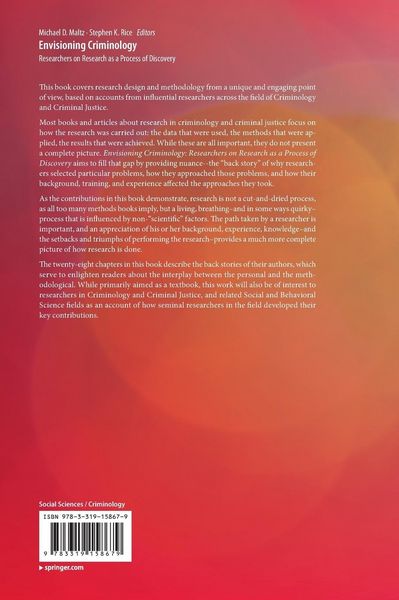
Envisioning Criminology Researchers on Research as a Process of Discovery

51,99 €

inkl. gesetzl. MwSt., Versandkostenfrei


Beschreibung

Produktdetails

Einband

Gebundene Ausgabe

Erscheinungsdatum

26.06.2015

Abbildungen

XXVI, 271 p. 30 illus., 16 illus. in color.

Herausgeber

Michael D. Maltz + weitere

Verlag

Springer

Seitenzahl

271

Maße (L/B/H)

26/18,3/2,2 cm

Gewicht

701 g

Auflage

2015

Sprache

Englisch

ISBN

978-3-319-15867-9

Beschreibung

Portrait


Michael D. Maltz
is Professor Emeritus of Criminal Justice and of Information and Decision Sciences at the University of Illinois at Chicago. He is also Senior Research Scientist at the Ohio State University’s Criminal Justice Research Center and Adjunct Professor of Sociology at OSU. He is the author of
Recidivism
(1984), which won awards in both criminology and operations research, and coauthor of
Mapping Crime in Its Community Setting
(1990), and was Editor of
the Journal of Quantitative Criminology
from 1996-2000. From 1995-2000 he was a Visiting Fellow at the Bureau of Justice Statistics (BJS), working on the development of graphical and geographical methods of analyzing data. For the past few years he has focused his attention on two areas: assessing and improving the quality of crime data, and improving the methods used to analyze criminal justice data. He is currently analyzing missing data in the FBI’s Uniform Crime Reports and developing imputation methods to improve their accuracy. Maltz received his undergraduate degree from Rensselaer Polytechnic Institute and his Ph.D. in from Stanford University, both in electrical engineering.

Stephen K. Rice
is Associate Professor of Criminal Justice at Seattle University. He studies cooperation and defiance in individuals’ interactions with the justice system (procedural justice, restorative justice; perceptions of racial profiling; police legitimacy; radicalization; final statements of the condemned); sentinel events; social media and criminal justice; data visualization; evidence-based law enforcement. He is co-editor of Race, Ethnicity and Policing (NYU Press, 2010) and Envisioning Criminology (Springer, 2015) and author of articles on topics to include guardian policing (Harvard Executive Session on Policing and Public Safety), radicalization, the variability of anger cross-culturally, and profiling of African Americans, Latinos, and Muslim Americans. Hispublications have appeared in outlets to include Criminology, Justice Quarterly, Deviant Behavior, and the Journal of Quantitative Criminology. He received his master’s degree from Florida State University and his Ph.D. from the University of Florida.

Produktdetails

Einband

Gebundene Ausgabe

Erscheinungsdatum

26.06.2015

Abbildungen

XXVI, 271 p. 30 illus., 16 illus. in color.

Herausgeber

Verlag

Springer

Seitenzahl

271

Maße (L/B/H)

26/18,3/2,2 cm

Gewicht

701 g

Auflage

2015

Sprache

Englisch

ISBN

978-3-319-15867-9

Herstelleradresse

Springer-Verlag KG
Sachsenplatz 4-6
1201 Wien
AT

Email: ProductSafety@springernature.com

Noch keine Bewertungen vorhanden

Verfassen Sie die erste Bewertung zu diesem Artikel

Helfen Sie anderen Kundinnen und Kunden durch Ihre Meinung.

Kundinnen und Kunden meinen

Bewertungen (0)

  • Produktbild: Envisioning Criminology
  • Produktbild: Envisioning Criminology

  • Foreword
    Alfred Blumstein
    .- Chapter 1: Introduction
    Michael D. Maltz
    and
    Stephen K. Rice
    .- Section 1:Voices from the Street.- Chapter 2: A Conversation with Street Daddy: Pulling Back the Curtain on Twenty Years of Ethnography
    Scott H. Decker
    and
    Dietrich Lester Smith
    .- Chapter 3: Warping Time and Space: What It Really Takes too do Action Research in Crime Control 
    David Kennedy
    .- Chapter 4: Observations on the Making of a Police Officer
    Peter Moskos
    .- Chapter 5: Cure Violence—Treating Violent Behavior as a Contagious Disease
    Gary Slutkin,

    Charles Ransford
      and
    R. Brent Decker
    .- Chapter 6: Why Criminals Tell Us the Truth
    Sudhir Venkatesh
    .- Section 2: Generating New Data.- Chapter 7: Gender & Sexuality as Methodological Confounds in the Study of Transgender Prisoners
    Valerie Jenness
    .- Chapter 8: Come Along and Ride on a Fantastic Voyage’: My Journey through Rap Music Lyrics
    Charis E. Kubrin
    .- Chapter 9: Getting Emotional
    Stephen K. Rice
    .- Chapter 10: The Making of the Chicago Project
    Robert J. Sampson
    .- Chapter 11: Surveying Police Officers
    Wesley G. Skogan
    .- Section 3: Mining Records.- Chapter 12: Criminology, Terrorism and Serendipity
    Gary LaFree
    .- Chapter 13: Playing in the Sandbox: A Methodological Conversation
    Nicole Rafter
    and
    Amy Farrell
    .- Chapter 14: Getting Things Wrong Really Does Help, as Long as You Keep Trying to Get Things Right: Developing Theories about Why Homicide Rates Rise and Fall
    Randolph Roth
    .- Chapter 15: Twists, Turns and Tears on the Path to the Cycle of Violence
    Cathy Spatz Widom
    .- Section 4: Analyses of Existing Data.- Chapter 16: Research Adventures with ‘Kinda Big’ Data: Using NIBRS to Study Crime
    Lynn A. Addington
    .- Chapter 17: Elusive Facts about Gun Violence: Where Good Surveys Go Bad
    Philip J. Cook
    and
    Jens Ludwig
    .- Chapter 18: SolvingCriminological Puzzles
    Kenneth C. Land
    .- Chapter 19: Upon Becoming a Criminologist…And Spending 30 Years Thinking about Interesting Things
    Pamela K. Lattimore
    .- Chapter 20: The Devil is in the Details: Crime and Victimization Research with the National Crime Victimization Survey
    Janet L. Lauritsen
    .- Chapter 21: What’s the Question? Ask That and You Will Follow the Path of Discovery
    Alex R. Piquero
    .- Chapter 22: Predicting Risk: Who Knew It Was Such a Risky Business?
    Susan Turner
    .- Section 5: Visual and Geographical Tools.- Chapter 23: Systems Modeling to Inform Drug Policy: A Personal Odyssey
    Jonathan P. Caulkins
    .- Chapter 24: Practitioner to Academic: An Interdisciplinary View from both Sides of the Looking Glass
    Elizabeth R. Groff
    .- Chapter 25: I Want You to Wear Something for Me’: On the In Situ Measurement of Police Stress and the Potential Rewards of Channeling One’s Inner Experimentalist
    Matthew J. Hickman
    .- Chapter 26: Sometimes Pictures Tell the Story
    Michael D. Maltz
    .- Chapter 27: Rounding Up Twice the Usual Number of Suspects
    D. Kim Rossmo
    .- Chapter 28: Small Worlds of Crime and Criminal Justice Interventions: Discovering Crime Hot Spots
    David Weisburd.