KI-Beratung Beta

Gutscheinbedingungen

**Gültig am 20.11.2026 ab einem Mindestbestellwert von 30€ auf Spielzeug, Schreibwaren, Filme, Geschenke & Trends, Musik, tolino eReader & Zubehör, Hörbücher und Hörbuch-Downloads, nicht preisgebundene Bücher und Kalender online auf thalia.at und in der Thalia App. Einzelne Artikel können ausgeschlossen sein. Aufgrund der Buchpreisbindung sind deutschsprachige Bücher und eBooks ausgenommen. Zusätzlich ausgenommen sind Abos & Flatrates, Games, Geschenkkarten/-boxen, Shelfies, Software, Zeitschriften sowie einzelne Artikel von tonies®. Pro Einkauf einmal einlösbar. Click & Collect nur bei Onlinevorabzahlung möglich. Keine Barauszahlung. Nicht kombinierbar mit anderen Aktionen und Gutscheinen. Gutschein wird auf max. 500€ Bestellwert angerechnet. Nicht gültig für Versandkosten und Services. Preisgebundene Artikel sind vom Mindestbestellwert ausgeschlossen.

  • Produktbild: Voting in Old and New Democracies
  • Produktbild: Voting in Old and New Democracies

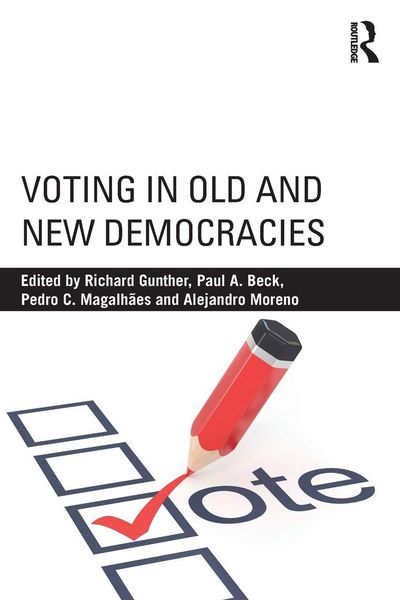
Voting in Old and New Democracies

78,99 €

inkl. gesetzl. MwSt., Versandkostenfrei


Beschreibung

Voting in Old and New Democracies examines voting behavior and its determinants based on 26 surveys from 18 countries on five continents between 1992 and 2008. It systematically analyzes the impact on voting choice of factors rooted in the currently dominant approaches to the study of electoral behavior,...

Beschreibung

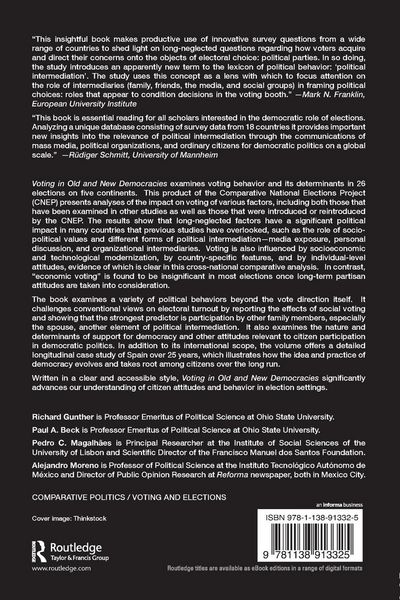
Voting in Old and New Democracies examines voting behavior and its determinants based on 26 surveys from 18 countries on five continents between 1992 and 2008. It systematically analyzes the impact on voting choice of factors rooted in the currently dominant approaches to the study of electoral behavior, but adds to this analysis factors introduced or reintroduced into this field by the Comparative National Elections Project (CNEP)-socio-political values, and political communication through media, personal discussion, and organizational intermediaries. It demonstrates empirically that these long-neglected factors have significant political impact in many countries that previous studies have overlooked, while "economic voting" is insignificant in most elections once long-term partisan attitudes are taken into consideration. Its examination of electoral turnout finds that the strongest predictor is participation by other family members, demonstrating the importance of intermediation. Another chapter surveys cross-national variations in patterns of intermediation, and examines the impact of general social processes (such as socioeconomic and technological modernization), country-specific factors, and individual-level attitudinal factors as determinants of those patterns. Complementing its cross-national comparative analysis is a detailed longitudinal case study of one country over 25 years. Finally, it examines the extent of support for democracy as well as significant cross-national differences in how democracy is understood by citizens.

Written in a clear and accessible style, Voting in Old and New Democracies significantly advances our understanding of citizen attitudes and behavior in election settings.

Rezension

'This book is essential reading for all scholars interested in the democratic role of elections. Analyzing a unique database consisting of survey data from 18 countries it provides important new insights into the relevance of political intermediation through the communications of mass media, political organizations and ordinary citizens for democratic politics on a global scale.' -Rüdiger Schmitt-Beck, University of Mannheim

'This insightful book makes productive use of innovative survey questions from a wide range of countries to shed light on long-neglected questions regarding how voters acquire and direct their concerns onto the objects of electoral choice: political parties. In so doing the study introduces an apparently new term to the lexicon of political behavior: "political intermediation." The study uses this concept as a lens with which to focus attention on the role of intermediaries (family, friends, the media, and social groups) in framing political choices: roles that appear to condition decisions in the voting booth.' -Mark N. Franklin, European University Institute

'La evidencia presentada en Voting in Old and New Democracies ensancha la agenda de investigación sobre el comportamiento político-electoral en el mundo, poniendo sobre la mesa la importancia de factores como los canales de intermediación política -que influyen en la relación entre partidos políticos y ciudadanos-, los cuales suelen estar ausentes en el análisis de la decisión de voto. Dicha contribución, sumada a la relevancia que se le da al proceso de modernización -ahora experimentado a través de cambios tecnológicos que se viven en el mundo con el uso de las redes socio-digitales y el Internet- indican que el estudio comparado del comportamiento electoral es todavía una agenda de investigación abierta a nuevas explicaciones teóricas y hallazgos novedosos. Voting in Old and New democracies contribuye a ello.'-Isaac Cisneros, Perfiles Latinoamericanos

'Voting in Old and New Democracies is a tour de force that dramatically improves scholarly understanding of why and how people turn out to vote and vote the way they do in a diverse group of democracies that vary dramatically in terms of their age, consolidation, level of economic development, and democratic quality. It is a book that I encourage all scholars of electoral behavior to read, and to read carefully.'-Mark P. Jones, Latin American Politics and Society

'Altogether, this is a very strong volume that clearly identifies both the strengths and limitations of comparative studies. It should find a place in every reading list on undergraduate and postgraduate modules in comparative political behaviour. It should also serve as a very reliable primer to more experienced researchers who need both a guide to the known terrain and a clear map as to where we go next.'-John Bartle, Party Politics
Produktdetails

Einband

Taschenbuch

Erscheinungsdatum

07.08.2015

Abbildungen

34 SW-Abb., 34 SW-Zeichn., 43 Tabellen

Herausgeber Gunther Richard + weitere

Produktdetails

Einband

Taschenbuch

Erscheinungsdatum

07.08.2015

Abbildungen

34 SW-Abb., 34 SW-Zeichn., 43 Tabellen

Herausgeber
Verlag Taylor & Francis
Seitenzahl

344

Maße (L/B/H)

22,9/15,2/1,9 cm

Gewicht

499 g

Sprache

Englisch

ISBN

978-1-138-91332-5

EU-Ansprechpartner

Taylor & Francis Verlag GmbH
Kaufingerstraße 24
80331 München
DE
GPSR@taylorandfrancis.com

Herstelleradresse

Taylor & Francis Group
5 Howick Place
SW1P 1WG London
UK
GPSR@taylorandfrancis.com

Noch keine Bewertungen vorhanden

Verfassen Sie die erste Bewertung zu diesem Artikel

Helfen Sie anderen Kundinnen und Kunden durch Ihre Meinung.

Kundinnen und Kunden meinen

Bewertungen (0)

  • Produktbild: Voting in Old and New Democracies
  • Produktbild: Voting in Old and New Democracies
  • Selected Contents:  1. Introduction Pedro C. Magalhães, with Paul A. Beck, Richard Gunther and Alejandro Moreno  2. Global Patterns of Exposure to Political Intermediaries Paul A. Beck and Richard Gunther  3. Mobilization, Informal Networks and the Social Contexts of Turnout Pedro C. Magalhães, with Paolo Segatti and Tianjian Shi  4. Value Cleavages Revisited Alejandro Moreno  5. The Changing Determinants of the Vote Richard Gunther, Marina Costa Lobo, Paolo Bellucci and Marco Lisi  6. Parties, Elections, Voters and Democracy Robert Mattes, with Saiful Mujani, R. William Liddle, Tianjian Shi and Yun-han Chu  7. Intermediation, Mobilization and Citizen Participation: Findings from In-Depth and Longitudinal Analyses of Spain Richard Gunther, José Ramón Montero and Hans-Jürgen Puhle  8. Conclusion Alejandro Moreno, with Paul A. Beck, Richard Gunther and Pedro C. Magalhães