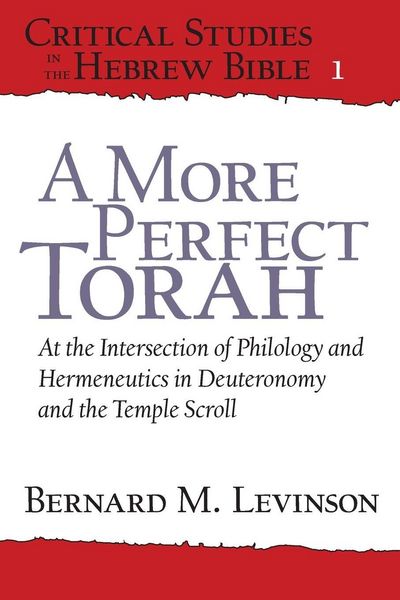
Critical Studies in the Hebrew Bible At the Intersection of Philology and Hermeneutics in Deuteronomy and the Temple Scroll
-
- Englisch ausgewählt
43,99 €
inkl. gesetzl. MwSt.,
Beschreibung
Produktdetails
Einband
Taschenbuch
Erscheinungsdatum
02.04.2019
Verlag
University PressesSeitenzahl
164
Maße (L/B/H)
22,9/15,2/0,9 cm
Gewicht
248 g
Sprache
Englisch
ISBN
978-1-57506-259-4
The historical-critical method that characterizes academic biblical studies too often remains separate from approaches that stress the history of interpretation, which are employed more frequently in the area of Second Temple or Dead Sea Scrolls research. Inaugurating the new series, Critical Studies in the Hebrew Bible, A More Perfect Torah explores a series of test-cases in which the two methods mutually reinforce one another.
The volume brings together two studies that investigate the relationship between the composition history of the biblical text and its reception history at Qumran and in rabbinic literature. The Temple Scroll is more than the blueprint for a more perfect Temple. It also represents the attempt to create a more perfect Torah. Its techniques for doing so are the focus of part 1, entitled "Revelation Regained: The Hermeneutics of KI and 'IM in the Temple Scroll." This study illuminates the techniques for marking conditional clauses in ancient Near Eastern literature, biblical law, and the Dead Sea Scrolls. It also draws new attention to the relationship between the Temple Scroll's use of conditionals and the manuscript's organized spacing system for marking paragraphs.
Part 2 is entitled "Reception History as a Window into Composition History: Deuteronomy's Law of Vows as Reflected in Qoheleth and the Temple Scroll." The law of vows in Deut 23:22-24 is difficult in both its syntax and its legal content. The difficulty is resolved once it is recognized that the law contains an interpolation that disrupts the original coherence of the law. The reception history of the law of vows in Numbers 20, Qoh 5:4-7, 11QTemple 53:11-14, and Sipre Deuteronomy confirms the hypothesis of an interpolation. Seen in this new light, the history of interpretation offers a window into the composition history of the biblical text.
Noch keine Bewertungen vorhanden
Verfassen Sie die erste Bewertung zu diesem Artikel
Helfen Sie anderen Kundinnen und Kunden durch Ihre Meinung.
Kurze Frage zu unserer Seite
Vielen Dank für Ihr Feedback
Wir nutzen Ihr Feedback, um unsere Produktseiten zu verbessern. Bitte haben Sie Verständnis, dass wir Ihnen keine Rückmeldung geben können. Falls Sie Kontakt mit uns aufnehmen möchten, können Sie sich aber gerne an unseren Kund*innenservice wenden.
zum Kundenservice