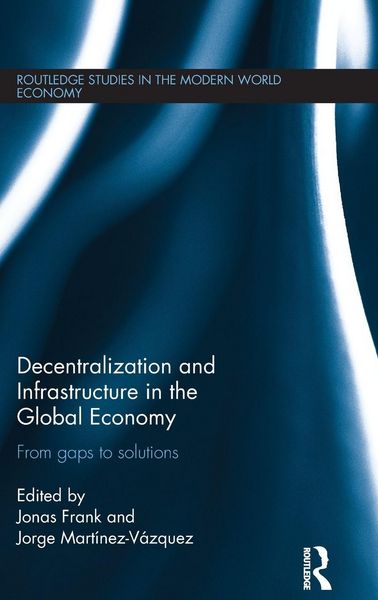
Decentralization and Infrastructure in the Global Economy From Gaps to Solutions
289,99 €
inkl. gesetzl. MwSt.,
Beschreibung
Produktdetails
Einband
Gebundene Ausgabe
Erscheinungsdatum
02.07.2015
Abbildungen
schwarz-weiss Illustrationen, Raster, schwarz-weiss, Zeichnungen, schwarz-weiss, Tabellen, schwarz-weiss
Herausgeber
Frank Jonas + weitereVerlag
Taylor and FrancisSeitenzahl
496
Maße (L/B/H)
24/16,1/3,1 cm
Gewicht
816 g
Sprache
Englisch
ISBN
978-1-138-90920-5
The subnational dimension of infrastructure has emerged as one of the greatest challenges in contemporary public finance policy and management. Ensuring the efficient provision of infrastructure represents a challenge for all countries irrespective of their level of centralization or decentralization. This is a task that needs several levels of government to intervene in order to provide solutions which are critical important to further social and economic development. This book proposes an innovative approach that pulls together two strands of policy-relevant literatures -- the provision of subnational infrastructure and decentralization. Decentralization and Infrastructure in the Global Economy: From Gaps to Solutions covers the most important aspects of infrastructure investment in a decentralized setting. It discusses the types and extent of infrastructure gaps and the quality of subnational spending; inquires how functional responsibilities, financing and equalization can be designed; discusses sector-specific arrangements in high expenditure areas, such as health, education and roads; drills down to the key steps of the public investment cycle and management aspects; and analyses the political economy and corruption challenges that typically accompany decentralized infrastructure projects. Against the backdrop of this comprehensive repertoire, the book presents avenues and options for the strengthening of decentralized public investment and infrastructure management. The decentralization of infrastructure challenges some of the well-accepted principles of intergovernmental fiscal relations: it recognizes that the assignment of responsibilities is often in flux as several levels of government intervene in the investment cycle. This underscores the need to step up efforts in the three areas: coordination of interventions across levels of government; equity in spending; and efficiency in infrastructure provision.
Noch keine Bewertungen vorhanden
Verfassen Sie die erste Bewertung zu diesem Artikel
Helfen Sie anderen Kundinnen und Kunden durch Ihre Meinung.
Kurze Frage zu unserer Seite
Vielen Dank für Ihr Feedback
Wir nutzen Ihr Feedback, um unsere Produktseiten zu verbessern. Bitte haben Sie Verständnis, dass wir Ihnen keine Rückmeldung geben können. Falls Sie Kontakt mit uns aufnehmen möchten, können Sie sich aber gerne an unseren Kund*innenservice wenden.
zum Kundenservice