Searching for Freedom After the Civil War Klansman, Carpetbagger, Scalawag, & Freedman
-
- Englisch ausgewählt
39,99 €
inkl. gesetzl. MwSt.,
Beschreibung
Produktdetails
Einband
Gebundene Ausgabe
Erscheinungsdatum
15.05.2015
Abbildungen
25 black and white illustrations
Verlag
The University of Alabama PressSeitenzahl
248
Maße (L/B/H)
23,6/15,9/2,5 cm
Gewicht
522 g
Sprache
Englisch
ISBN
978-0-8173-1860-4
Searching for Freedom after the Civil War: Klansman, Carpetbagger, Scalawag, and Freedman examines the life stories and perspectives about freedom of four figures depicted in an infamous Reconstruction-era political cartoon.
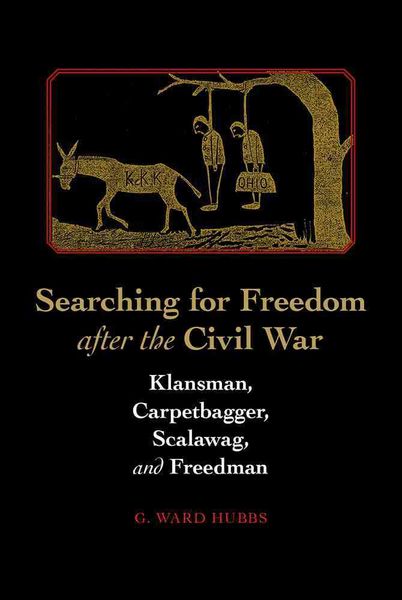
In Searching for Freedom after the Civil War: Klansman, Carpetbagger, Scalawag, and Freedman, G. Ward Hubbs uses a stark and iconic political cartoon to illuminate post-war conflicts over the meaning of freedom in the American South.
The cartoon first appeared in the Tuskaloosa Independent Monitor, helmed by local Ku Klux Klan boss Ryland Randolph, as a swaggering threat aimed at three individuals. Hanged from an oak branch clutching a carpetbag marked “OHIO” is the Reverend Arad S. Lakin, the Northern-born incoming president of the University of Alabama. Swinging from another noose is Dr. Noah B. Cloud—agricultural reformer, superintendent of education, and deemed by Randolph a “scalawag” for joining Alabama’s reformed state government. The accompanying caption, penned in purple prose, similarly threatens Shandy Jones, a politically active local man of colour.
Using a dynamic and unprecedented approach that interprets the same events through four points of view, Hubbs artfully unpacks numerous layers of meaning behind this brutal two-dimensional image.
The four men associated with the cartoon—Randolph, Lakin, Cloud, and Jones—were archetypes of those who were seeking to rebuild a South shattered by war. Hubbs explores these broad archetypes but also delves deeply into the four men’s life stories, writings, speeches, and decisions in order to recreate each one’s complex worldview and quest to live freely. Their lives, but especially their four very different understandings of freedom, help to explain many of the conflicts of the 1860s. The result is an intellectual tour de force.
Scholars of the Civil War, Reconstruction, and Southern history will all consider this an important work, and general readers of this highly accessible volume will discover fascinating new insights about life during and after America’s greatest crisis.
Noch keine Bewertungen vorhanden
Verfassen Sie die erste Bewertung zu diesem Artikel
Helfen Sie anderen Kundinnen und Kunden durch Ihre Meinung.
Kurze Frage zu unserer Seite
Vielen Dank für Ihr Feedback
Wir nutzen Ihr Feedback, um unsere Produktseiten zu verbessern. Bitte haben Sie Verständnis, dass wir Ihnen keine Rückmeldung geben können. Falls Sie Kontakt mit uns aufnehmen möchten, können Sie sich aber gerne an unseren Kund*innenservice wenden.
zum Kundenservice