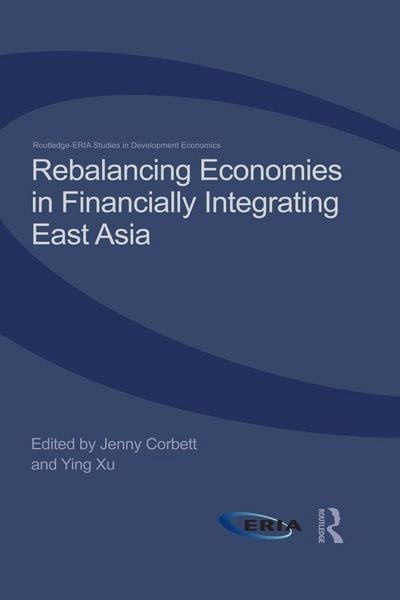
Rebalancing Economies in Financially Integrating East Asia
-
- Hardcover
- Taschenbuch
- eBook ausgewählt
-
Form:Einzelkauf Download
-
Sprache:Englisch
-
eBook Format:PDF
- PDF 66,90 € ausgewählt
- ePUB 66,90 €
66,90 €
inkl. gesetzl. MwSt.Beschreibung
Produktdetails
Format
Kopierschutz
Ja
Family Sharing
Nein
Text-to-Speech
Nein
Erscheinungsdatum
13.11.2014
Herausgeber
Jenny Corbett + weitereVerlag
Taylor & Francis eBooksSeitenzahl
288 (Printausgabe)
Dateigröße
4957 KB
Sprache
Englisch
EAN
9781317596462
Since the Asian Financial Crisis (AFC) of 1997-98 large current account surpluses have accumulated in the countries of Asia and the Pacific with corresponding deficits elsewhere. The sharp plunge in global trade volumes during the global financial crisis has highlighted the need for 'rebalancing'-focussing more on domestic sources of economic growth than on exports in some Asian economies. One key objective of the book is to elucidate the economic structures and policies that give rise to current account surpluses and imbalances and consider what policy adjustments could change them. Another objective is to show the link between financial systems, financial integration and the transmission of economic shocks between countries.
The book offers new dimensions to understand 'rebalancing' and provides alternative and arguably more fundamental solutions to address imbalances. Rather than focusing on exchange rate misalignment, this book begins from the premise that the imbalances are a macroeconomic problem that reflects a mismatch between savings and investment in the surplus countries. Then, it examines exchange rate policies adopted by countries in the region and finds that part of the explanation for their currency strategy lies in their perceived need to build foreign exchange reserves to provide a buffer in case of instabilities. The book examines whether there are other possibilities for countries to insure against economic volatility by more actively and openly engaging with international capital markets. The studies show that closer financial integration, involving more open financial markets, with well-chosen partners, would be welfare-improving and should reduce the need for the counter-productive, self-insurance policies that result in foreign exchange accumulation.
Noch keine Bewertungen vorhanden
Verfassen Sie die erste Bewertung zu diesem Artikel
Helfen Sie anderen Kundinnen und Kunden durch Ihre Meinung.
Kurze Frage zu unserer Seite
Vielen Dank für Ihr Feedback
Wir nutzen Ihr Feedback, um unsere Produktseiten zu verbessern. Bitte haben Sie Verständnis, dass wir Ihnen keine Rückmeldung geben können. Falls Sie Kontakt mit uns aufnehmen möchten, können Sie sich aber gerne an unseren Kund*innenservice wenden.
zum Kundenservice