KI-Beratung Beta

Produktbild: Practical Medicinal Chemistry with Macrocycles

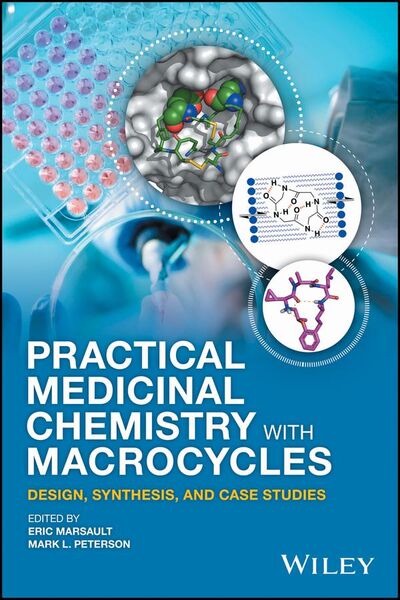
Practical Medicinal Chemistry with Macrocycles Design, Synthesis, and Case Studies

272,99 €

inkl. gesetzl. MwSt., Versandkostenfrei


Beschreibung

Including case studies of macrocyclic marketed drugs and macrocycles in drug development, this book helps medicinal chemists deal with the synthetic and conceptual challenges of macrocycles in drug discovery efforts. * Provides needed background to build a program in macrocycle drug discovery -design...

Beschreibung

Including case studies of macrocyclic marketed drugs and macrocycles in drug development, this book helps medicinal chemists deal with the synthetic and conceptual challenges of macrocycles in drug discovery efforts.
* Provides needed background to build a program in macrocycle drug discovery -design criteria, macrocycle profiles, applications, and limitations
* Features chapters contributed from leading international figures involved in macrocyclic drug discovery efforts
* Covers design criteria, typical profile of current macrocycles, applications, and limitations

Produktdetails

Einband

Gebundene Ausgabe

Erscheinungsdatum

12.09.2017

Herausgeber Eric Marsault + weitere
Verlag John Wiley & Sons Inc

Produktdetails

Einband

Gebundene Ausgabe

Erscheinungsdatum

12.09.2017

Herausgeber
Verlag John Wiley & Sons Inc
Seitenzahl

624

Maße (L/B/H)

27,7/21,1/3,6 cm

Gewicht

1792 g

Auflage

1. Auflage

Sprache

Englisch

ISBN

978-1-119-09256-8

Herstelleradresse

Libri GmbH
Europaallee 1
36244 Bad Hersfeld
DE

Email: gpsr@libri.de

Noch keine Bewertungen vorhanden

Verfassen Sie die erste Bewertung zu diesem Artikel

Helfen Sie anderen Kundinnen und Kunden durch Ihre Meinung.

Kundinnen und Kunden meinen

Bewertungen (0)

Die Leseprobe wird geladen.
  • Produktbild: Practical Medicinal Chemistry with Macrocycles
  • Foreword (ongoing, H. Kessler - due Jan 2017)
    Introduction
    About the contributors
    Part I Challenges Specific to Macrocycles
    1. Contemporary Macrocyclization Technologies
    Serge Zaretsky and Andrei K. Yudin
    1.1. Introduction
    1.2. Challenges inherent to the synthesis of macrocycles
    1.3. Challenges in macrocycle characterization
    1.4. Macrocyclization methods
    1.5. Cyclization on the solid phase
    1.6. Summary
    1.7. References
    2. A Practical Guide to Structural Aspects of Macrocycles (NMR, X-Ray and Modelling)
    David J. Craik, Quentin Kaas and Conan K. Wang
    Abstract
    2.1. Background
    2.1.1. Classes of macrocycles covered
    2.1.2. Applications of macromolecules in drug design and agriculture and the role of structural information in these applications
    2.1.3. Experimental techniques (NMR and X-ray)
    2.1.4. Modelling studies
    2.2. Experimental studies of macrocycles
    2.2.1. NMR experiments and parameters that yield structural information
    2.2.2. Protocols for 3D structural determination using NMR
    2.2.3. Dynamic aspects of structures (NMR relaxation)
    2.2.4. X-ray studies of macrocycles
    2.2.5. Macrocycle-receptor interactions (both NMR and X-ray)
    2.3. Molecular modelling of macrocyclic peptides
    2.3.1. Methods and challenges in modelling cyclic peptides
    2.3.1.1. Quantum mechanics
    2.3.1.2. Molecular mechanics
    2.3.2. Conformation, dynamics and electrostatics of cyclic peptides
    2.3.2.1. NMR spectroscopy combined with MD simulations
    2.3.2.2. Studying large conformational ensembles and folding
    2.3.2.3. Electrostatic characteristics of cyclic peptides
    2.3.3. Modelling the activity of cyclic peptides
    2.3.3.1. Cyclic peptide interactions with molecular targets
    2.3.3.2. Cyclic peptide nanotubes
    2.3.3.3. Membrane permeation and diffusion
    2.3.4. Engineering cyclic peptides as grafting scaffolds
    2.4. Summary
    2.5. Acknowledgments
    2.6. List of abbreviations
    2.7. References
    3. Designing Orally Bioavailable Peptide and Peptoid Macrocycles
    David Price, Alan M. Mathiowetz and Spiros Liras
    3.1. Introduction
    3.2. Improving peptide plasma half-life
    3.3. Absorption, bioavailability and methods for predicting absorption
    3.3.1. In vitro assays
    3.3.2. Paracellular absorption
    3.3.3. Tight junction modifiers to improve paracellular absorption
    3.3.4. Transcellular absorption of macrocycles
    3.3.4.1. Cyclisation
    3.3.4.2. N-methylation
    3.3.4.3. Cyclosporine A
    3.3.4.4. Conformational interconversion and H-bond networks
    3.3.4.5. Shielding
    3.3.4.6. Additional strategies for managing H-bond networks
    3.4. In silico modeling
    3.5. Future directions
    3.6. References
    Part II Classes of Macrocycles and their Potential for Drug Discovery
    4. Natural and Nature-Inspired Macrocycles - A Chemoinformatic Overview and Relevant Examples
    Ludger A. Wessjohann, Richard Bartelt, Ricardo A. W. Neves Filho,
    Wolfgang Brandt
    4.1. Introduction to natural macrocycles as drugs and drug leads
    4.2. Biosynthetic pathways, natural role and biotechnological access
    4.3. QSAR and chemoinformatic analyses of common features
    4.4. Case studies: selected natural macrocycles of special relevance in medicinal chemistry
    4.5. References
    5. Bioactive and Membrane-Permeable Cyclic Peptide Natural Products
    Andrew T. Bockus and R. Scott Lokey
    5.1. Introduction
    5.2. Structural motifs and permeability of cyclic peptide natural products
    5.3. Conformations of passively permeable bioactive cyclic peptide natural products
    5.3.1. Flexible scaffolds
    5.3.2. Structural analogs
    5.3.3. Lipophilic (AlogP > 3) peptides and reported bioactivities
    5.4. Recently discovered bioactive cyclic peptide natural products
    5.4.1. Mid-Sized Macrocycles
    5.4.1.1. Cytotoxics
    5.4.1.2. Antibacterials
    5.4.1.3. Antivirals
    5.4.1.4. Antiparasitics
    5.4.1.5. Antifungals
    5.4.1.6. Protease Inhibitors
    5.4.1.7. Ot