Beschreibung
Produktdetails
Einband
Gebundene Ausgabe
Erscheinungsdatum
27.01.2026
Verlag
WileySeitenzahl
464
Maße (L/B/H)
25,6/17,3/3,1 cm
Gewicht
980 g
Sprache
Englisch
ISBN
978-1-119-09267-4
Master composites modelling with this insightful and authoritative resource from a leading voice in the field
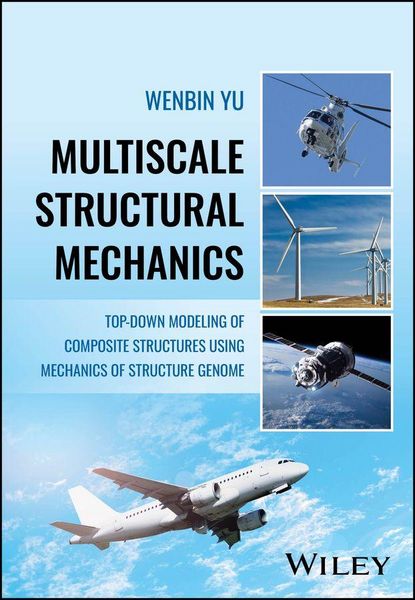
Multiscale Structural Mechanics: Top-Down Modelling of Composites using Mechanics of Structure Genome delivers a unified approach to composites modelling based on the concept of structure gene. Dr. Wenbin Yu, distinguished engineer, industry leader, and author, brings together micromechanics and structural mechanics using the Mechanics of Structure Genome. This approach allows multiscale constitutive modeling for general anisotropic and heterogeneous materials and structures without invoking assumptions commonly used in other approaches.
The book introduces readers unfamiliar with vectors and tensors, continuum mechanics, micromechanics, and structural mechanics to the basics of each of these topics. It goes on to bridge the gap between micromechanics and structural mechanics, offering readers multiscale structural models that remain as simple as classical engineering models but with the accuracy expected of more complex theories capturing microstructural details. Specifically, the book offers:
- A brief introduction to vectors and tensors, as well as continuum mechanics, classical structural models including kinematics, kinetics, energetics, and composite materials
- Fulsome discussions of the mechanics of structure genome (MSG) and its application to construct multiscale models for beams, plates, shells, and 3D solids
- Complete explorations of both micromechanics and structural mechanics, including the theories of beams, plates, and shells
- Introduction of the calculus of variations, variational asymptotic method, and their applications to model general anisotropic and heterogeneous materials and structures
- Information sufficient to allow readers to construct efficient high-fidelity models for composites using MSG introduced in this book
- Detailed discussions on stress and failure analysis of composite laminates
Perfect for graduate students in aerospace, mechanical, and other disciplines making use of anisotropic and heterogeneous materials such as composites, Multiscale Structural Mechanics will also earn a place in the libraries of researchers and engineers in university, government, and industry laboratories who work with composite materials and structures. It is the ideal resource for composites modelling across a wide spectrum of engineering applications.
Noch keine Bewertungen vorhanden
Verfassen Sie die erste Bewertung zu diesem Artikel
Helfen Sie anderen Kundinnen und Kunden durch Ihre Meinung.
Kurze Frage zu unserer Seite
Vielen Dank für Ihr Feedback
Wir nutzen Ihr Feedback, um unsere Produktseiten zu verbessern. Bitte haben Sie Verständnis, dass wir Ihnen keine Rückmeldung geben können. Falls Sie Kontakt mit uns aufnehmen möchten, können Sie sich aber gerne an unseren Kund*innenservice wenden.
zum Kundenservice