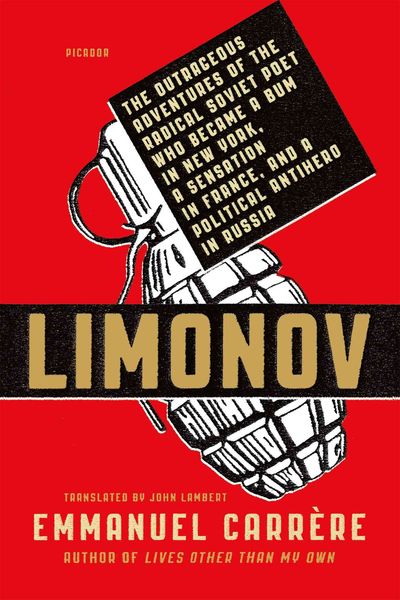
Limonov The Outrageous Adventures of the Radical Soviet Poet Who Became a Bum in New York, a Sensation in France, and a Political Antihero in Russia. Winner of the Prix de la Langue Francaise 2011 and Prix Renaudot 2011
-
- Taschenbuch ausgewählt
- eBook
-
Sprache:Englisch
-
Verlag:Macmillan US
- Macmillan US 22,99 € ausgewählt
- Penguin Books UK 10,79 €
22,99 €
inkl. gesetzl. MwSt.,
- Kostenlose Lieferung ab 30 € Einkaufswert
- Versandkostenfrei für Bonuscard-Kund*innen
Beschreibung
Produktdetails
Verkaufsrang
20084
Einband
Taschenbuch
Erscheinungsdatum
06.10.2015
Verlag
Macmillan USSeitenzahl
352
Maße (L/B/H)
21,6/14/2,1 cm
Gewicht
500 g
Sprache
Englisch
ISBN
978-1-250-07483-6
Named a Best Book of the Year by The New York Times and The Guardian (London)
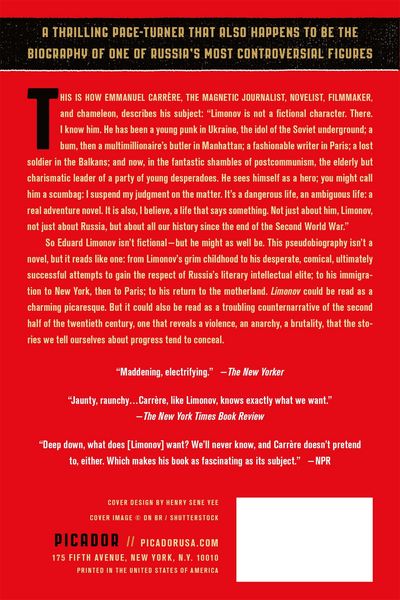
A thrilling page-turner that also happens to be the biography of one of Russia's most controversial figures
This is how Emmanuel Carrère, the magnetic journalist, novelist, filmmaker, and chameleon, describes his subject: "Limonov is not a fictional character. There. I know him. He has been a young punk in Ukraine, the idol of the Soviet underground; a bum, then a multimillionaire's butler in Manhattan; a fashionable writer in Paris; a lost soldier in the Balkans; and now, in the fantastic shambles of postcommunism, the elderly but charismatic leader of a party of young desperadoes. He sees himself as a hero; you might call him a scumbag: I suspend my judgment on the matter. It's a dangerous life, an ambiguous life: a real adventure novel. It is also, I believe, a life that says something. Not just about him, Limonov, not just about Russia, but about all our history since the end of the Second World War."
So Eduard Limonov isn't fictional-but he might as well be. This pseudobiography isn't a novel, but it reads like one: from Limonov's grim childhood to his desperate, comical, ultimately successful attempts to gain the respect of Russia's literary intellectual elite; to his immigration to New York, then to Paris; to his return to the motherland. Limonov could be read as a charming picaresque. But it could also be read as a troubling counternarrative of the second half of the twentieth century, one that reveals a violence, an anarchy, a brutality, that the stories we tell ourselves about progress tend to conceal.
Noch keine Bewertungen vorhanden
Verfassen Sie die erste Bewertung zu diesem Artikel
Helfen Sie anderen Kundinnen und Kunden durch Ihre Meinung.
Kurze Frage zu unserer Seite
Vielen Dank für Ihr Feedback
Wir nutzen Ihr Feedback, um unsere Produktseiten zu verbessern. Bitte haben Sie Verständnis, dass wir Ihnen keine Rückmeldung geben können. Falls Sie Kontakt mit uns aufnehmen möchten, können Sie sich aber gerne an unseren Kund*innenservice wenden.
zum Kundenservice