KI-Beratung Beta

Gutscheinbedingungen

**Gültig bis 18.11.2026 auf englischsprachige Klassiker (klassiker-32728) online auf thalia.at und in der Thalia App. Einzelne Artikel können ausgeschlossen sein. Ausgenommen sind preisgebundene Artikel & eBooks. Pro Einkauf einmal einlösbar. Click & Collect nur bei Onlinevorabzahlung möglich. Keine Barauszahlung. Nicht kombinierbar mit anderen Aktionen und Gutscheinen. Gutschein wird auf max. 500€ Bestellwert angerechnet. Nicht gültig für Geschenkkarten, Versandkosten und Services.

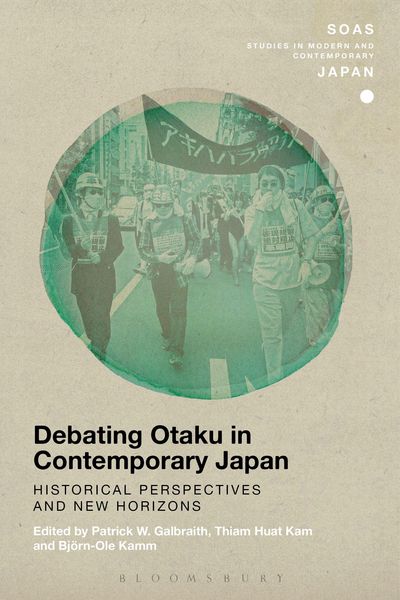
  • Produktbild: Debating Otaku in Contemporary Japan
  • Produktbild: Debating Otaku in Contemporary Japan

Debating Otaku in Contemporary Japan Historical Perspectives and New Horizons

224,99 €

inkl. gesetzl. MwSt., Versandkostenfrei


Beschreibung

With the spread of manga (Japanese comics) and anime (Japanese cartoons) around the world, many have adopted the Japanese term 'otaku' to identify fans of such media. The connection to manga and anime may seem straightforward, but, when taken for granted, often serves to obscure the debates within and...

Beschreibung

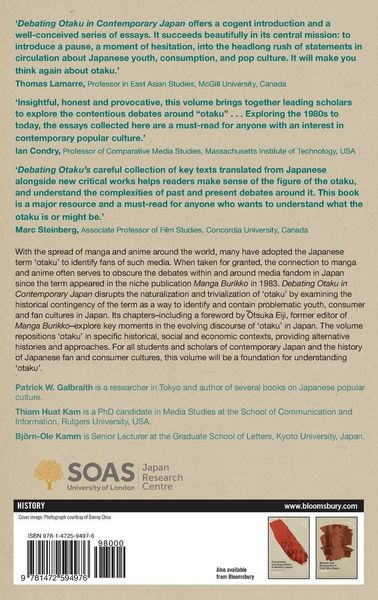
With the spread of manga (Japanese comics) and anime (Japanese cartoons) around the world, many have adopted the Japanese term 'otaku' to identify fans of such media. The connection to manga and anime may seem straightforward, but, when taken for granted, often serves to obscure the debates within and around media fandom in Japan since the term 'otaku' appeared in the niche publication Manga Burikko in 1983. Debating Otaku in Contemporary Japan disrupts the naturalization and trivialization of 'otaku' by examining the historical contingency of the term as a way to identify and contain problematic youth, consumers and fan cultures in Japan. Its chapters, many translated from Japanese and available in English for the first time - and with a foreword by Otsuka Eiji, former editor of Manga Burikko - explore key moments in the evolving discourse of 'otaku' in Japan. Rather than presenting a smooth, triumphant narrative of the transition of a subculture to the mainstream, the edited volume repositions 'otaku' in specific historical, social and economic contexts, providing new insights into the significance of the 'otaku' phenomenon in Japan and the world. By going back to original Japanese documents, translating key contributions by Japanese scholars and offering sustained analysis of these documents and scholars, Debating Otaku in Contemporary Japan provides alternative histories of and approaches to 'otaku'. For all students and scholars of contemporary Japan and the history of Japanese fan and consumer cultures, this volume will be a foundation for understanding how 'otaku', at different places and times and to different people, is meaningful.

Produktdetails

Einband

Gebundene Ausgabe

Erscheinungsdatum

21.05.2015

Herausgeber Patrick W. Galbraith + weitere
Verlag Bloomsbury 3PL

Produktdetails

Einband

Gebundene Ausgabe

Erscheinungsdatum

21.05.2015

Herausgeber
Verlag Bloomsbury 3PL
Seitenzahl

232

Maße (L/B/H)

24/16,1/1,7 cm

Gewicht

467 g

Sprache

Englisch

ISBN

978-1-4725-9497-6

Herstelleradresse

Libri GmbH
Europaallee 1
36244 Bad Hersfeld
DE

Email: gpsr@libri.de

Noch keine Bewertungen vorhanden

Verfassen Sie die erste Bewertung zu diesem Artikel

Helfen Sie anderen Kundinnen und Kunden durch Ihre Meinung.

Kundinnen und Kunden meinen

Bewertungen (0)

Die Leseprobe wird geladen.
  • Produktbild: Debating Otaku in Contemporary Japan
  • Produktbild: Debating Otaku in Contemporary Japan
  • Foreword: Otaku Culture as 'Conversion Literature' Otsuka Eiji (International Research Center for Japanese Studies, Japan)
    Introduction: 'Otaku Research' Past, Present and Future Patrick W. Galbraith (Duke University, USA) Thiam Huat Kam (Rutgers University, USA) and Björn-Ole Kamm (Heidelberg University, Germany)
    Section 1: The 1980s
    1. 'Otaku' Research and Anxiety About Failed Men Patrick W. Galbraith
    2. The Birth of 'Otaku:' Centring on Discourse Dynamics in Manga Burikko Yamanaka Tomomi (Yokohama National University, Japan)
    3. Opening the Black Box of the 1989 Otaku Discourse Björn-Ole Kamm
    Section 2: The 1990s
    4. Traversing Otaku Fantasy: Representation of the Otaku Subject, Gaze, and Fantasy in Otaku no Video Shen Lien Fan (University of Utah, USA)
    5. Introduction to Otaku Studies Okada Toshio (Osaka University of Arts, Japan)
    Section 3: The 2000s
    6. The Construction of Discourses on Otaku: The History of Subcultures from 1983 to 2005 Aida Miho (Hiroshima City University, Japan)
    7. Train Man and the Gender Politics of Japanese 'Otaku' Culture: The Rise of New Media, Nerd Heroes and Consumer Communities Alisa Freedman (University of Oregon, USA)
    8. The Transformation and the Diffusion of 'Otaku' Stereotypes and the Establishment of 'Akihabara' as a Place Brand Kikuchi Satoru (Shinshu Unviersity, Japan)
    9. The Transition of Otaku and Otaku Okada Toshio
    10. 'Otaku' as Label: Concerns over Productive Capacities in Contemporary Capitalist Japan Thiam Huat Kam
    Index