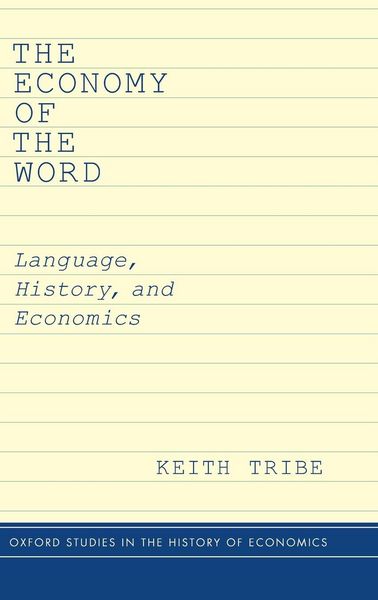
Economy of the Word Language, History, and Economics
182,99 €
inkl. gesetzl. MwSt.,
Beschreibung
Produktdetails
Einband
Gebundene Ausgabe
Erscheinungsdatum
01.03.2015
Verlag
Oxford AcademicSeitenzahl
348
Maße (L/B/H)
24/16,1/2,5 cm
Gewicht
751 g
Sprache
Englisch
ISBN
978-0-19-021161-5
It was only in the sixteenth century that texts began to refer to the significance of "economic activity" -- of sustaining life. This was not because the ordinary business of life was thought unimportant, but because the principles governing economic conduct were thought to be obvious or uncontroversial. The subsequent development of economic writing thus parallels the development of capitalism in Western Europe. From the seventeenth to the twenty-first century there has been a constant shift in content, audience, and form of argument as the literature of economic argument developed. The Economy of the Word proposes that to understand the various forms that economic literature has taken, we need to adopt a more literary approach in economics specifically, to adopt the instruments and techniques of philology. This way we can conceive the history of economic thought to be an on-going work in progress, rather than the story of the emergence of modern economic thinking. This approach demands that we pay attention to the construction of particular texts, showing the work of economic argument in different contexts. In sum, we need to pay attention to the "economy of the word." The Economy of the Word is divided into three parts. The first explains what the term "economy" has meant from Antiquity to Modernity, coupling this conceptual history with an examination of how the idea of national income was turned into a number during the first half of the twentieth century. The second part is devoted to Adam Smith's Wealth of Nations, considering first the manner in which Smith deals with international trade, and then the way in which the book was read in the course of the nineteenth century. Part III examines the sources used by Karl Marx and Léon Walras in developing their economic analysis, drawing attention to their shared intellectual context in French political economy.
Noch keine Bewertungen vorhanden
Verfassen Sie die erste Bewertung zu diesem Artikel
Helfen Sie anderen Kundinnen und Kunden durch Ihre Meinung.
Kurze Frage zu unserer Seite
Vielen Dank für Ihr Feedback
Wir nutzen Ihr Feedback, um unsere Produktseiten zu verbessern. Bitte haben Sie Verständnis, dass wir Ihnen keine Rückmeldung geben können. Falls Sie Kontakt mit uns aufnehmen möchten, können Sie sich aber gerne an unseren Kund*innenservice wenden.
zum Kundenservice