Gutscheinbedingungen

**Gültig bis 17.08.2026 auf Schreibwaren & Office-Artikel online auf thalia.at, in der Thalia App und in teilnehmenden Thalia Buchhandlungen in Österreich mit Schulsortiment. In den Buchhandlungen nur gültig auf lagernde Ware. Einzelne Artikel können ausgeschlossen sein. Ausgenommen sind preisgebundene Artikel. Pro Einkauf einmal einlösbar. Nur gültig gegen Vorlage oder im Onlineshop hinterlegter Bonuscard. Infos zur Einlösung in der Buchhandlung sind auf der Bonuscard-Vorteilspreisseite zu finden. Click & Collect nur bei Onlinevorabzahlung möglich. Keine Einlösung bei Scan & Go-Bezahlung. Keine Barauszahlung. Nicht kombinierbar mit anderen Aktionen und Gutscheinen. Gutschein wird auf max. 500€ Bestellwert angerechnet. Nicht gültig für Geschenkkarten, Versandkosten und Services.

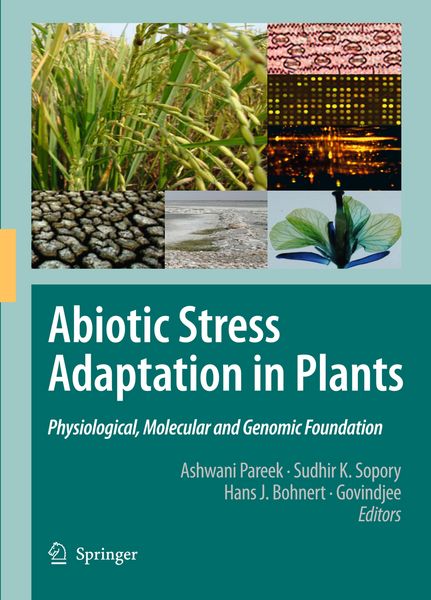
Produktbild: Abiotic Stress Adaptation in Plants
- 12%

Abiotic Stress Adaptation in Plants Physiological, Molecular and Genomic Foundation

12% sparen

192,99 € UVP 219,99 €

inkl. gesetzl. MwSt., Versandkostenfrei


Beschreibung

Produktdetails

Einband

Taschenbuch

Erscheinungsdatum

02.11.2014

Abbildungen

XXVII, 526 p.

Herausgeber

Ashwani Pareek + weitere

Verlag

Springer Netherland

Seitenzahl

526

Maße (L/B/H)

26/19,3/3,1 cm

Gewicht

1170 g

Auflage

2010

Sprache

Englisch

ISBN

978-94-007-9067-4

Beschreibung

Rezension

From the reviews:

“The book focuses on the ‘physiological, molecular, and genomic’ components of the problems and emphasizes various aspects of overcoming stress through breeding, transgenics, and the identification of markers associated with plant responses to stress. … The quality of the 23 chapters is very high, and they include much very current information from some of the top practitioners in the field. Summing Up: Recommended. Academic libraries serving upper-division undergraduates and above.” (W. Loescher, Choice, Vol. 48 (4), December, 2010)

“This book serves as a complete package on the basics and applications for abiotic stress response pathways in plants’. Indeed, at over 520 pages, with 23 predominantly multi-author chapters arranged in four parts, it is a considerable compendium of information and references … . The book is aimed at ‘late undergraduate through to beginning researchers’ in many areas of science and technology. … it is most suited to libraries, where it should find readers and will be useful.” (David Lawlor, Annals of Botany, Vol. 107 (4), 2011)

“The book is an important and timely addition in view of the frightening global climate change ‘issues and concerns’. … we would like to congratulate the editors for bringing out this vitally useful volume. … the book is informative and innovative. Researchers, teachers, graduate students and advanced undergraduate students would benefit from it. We recommended it to all those interested in plants and microbes, and their biology. … We agree that this is an exciting addition in the field.” (Prasanna Mohanty, S. Rajagopal and N. Raghuram, Current Science, Vol. 99 (9), November, 2010)

“The book presents a standard monograph in which individual chapters are written by different authors. The book is divided into four parts and contains altogether 23 chapters. … the large amount of information contained in this book should be of interest for plant physiologists, stress physiologists, and molecular plant biologists, both researchers and students.” (J. Nauš, Photosynthetica, Vol. 48 (3), 2010)

“This 500
+
page book is a timely and comprehensive survey of plant responses to environmental stress, encompassing together 23 chapters covering a wide range of highly relevant topics dealing with abiotic stress in plants. … This is a collection of state-of-the-art reviews useful for researchers, academics, and students who are at an advanced stage of study. … I strongly recommend this book to all the libraries of the universities as well as research institutions that deal with the study of plant biology and plant sciences.” (Maitrayee Bhattacharyya-Pakrasi, Photosynthesis Research, Vol. 108, 2011)

Produktdetails

Einband

Taschenbuch

Erscheinungsdatum

02.11.2014

Abbildungen

XXVII, 526 p.

Herausgeber

Verlag

Springer Netherland

Seitenzahl

526

Maße (L/B/H)

26/19,3/3,1 cm

Gewicht

1170 g

Auflage

2010

Sprache

Englisch

ISBN

978-94-007-9067-4

Herstelleradresse

Springer-Verlag KG
Sachsenplatz 4-6
1201 Wien
AT

Email: GPSR Kontakt

Noch keine Bewertungen vorhanden

Verfassen Sie die erste Bewertung zu diesem Artikel

Helfen Sie anderen Kundinnen und Kunden durch Ihre Meinung.

Kundinnen und Kunden meinen

Bewertungen (0)

  • Produktbild: Abiotic Stress Adaptation in Plants
  • Stress Perception and Signal Transduction.- Abiotic Tolerance and Crop Improvement.- Sensors and Signal Transducers of Environmental Stress in Cyanobacteria.- Stress Signaling I: The Role of Abscisic Acid (ABA).- Stress Signaling II: Calcium Sensing and Signaling.- Stress Signaling III: Reactive Oxygen Species (ROS).- A Biotic or Abiotic Stress?.- Protein Kinases and Phosphatases for Stress Signal Transduction in Plants.- Nitrogen Source Influences Root to Shoot Signaling Under Drought.- Stress Regulation of Gene Expression.- Abiotic Stress Responses: Complexities in Gene Expression.- Promoters and Transcription Factors in Abiotic Stress-Responsive Gene Expression.- Epigenetic Regulation: Chromatin Modeling and Small RNAs.- Physiology and Metabolism.- Ion Homeostasis.- Glutathione Homeostasis: Crucial for Abiotic Stress Tolerance in Plants.- Water Balance and the Regulation of Stomatal Movements.- Responses to Macronutrient Deprivation.- Osmolyte Regulation in Abiotic Stress.- Programmed Cell Death in Plants.- Overcoming Stress.- Varietal Improvement for Abiotic Stress Tolerance in Crop Plants: Special Reference to Salinity in Rice.- Transgenic Approaches.- Marker Assisted Breeding.- Stress, Mutators, Mutations and Stress Resistance.- Systems Biology of Abiotic Stress: The Elephant and the Blind Men.- Global Climate Change, Stress and Plant Productivity.