Gutscheinbedingungen

**Gültig bis 25.06.2026 auf fremdsprachige Bücher online auf thalia.at und in der Thalia App. Einzelne Artikel können ausgeschlossen sein. Ausgenommen sind preisgebundene Artikel & eBooks. Pro Einkauf einmal einlösbar. Click & Collect nur bei Onlinevorabzahlung möglich. Keine Barauszahlung. Nicht kombinierbar mit anderen Aktionen und Gutscheinen. Gutschein wird auf max. 500€ Bestellwert angerechnet. Nicht gültig für Geschenkkarten, Versandkosten und Services.

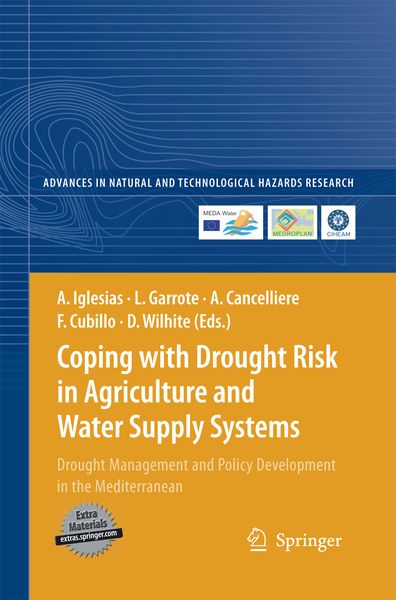
Produktbild: Coping with Drought Risk in Agriculture and Water Supply Systems
Band 26 - 11%

Coping with Drought Risk in Agriculture and Water Supply Systems Drought Management and Policy Development in the Mediterranean

11% sparen

96,99 € UVP 109,99 €

inkl. gesetzl. MwSt., Versandkostenfrei


Beschreibung

Produktdetails

Einband

Taschenbuch

Erscheinungsdatum

14.11.2014

Herausgeber

Ana Iglesias + weitere

Verlag

Springer Netherland

Seitenzahl

320

Maße (L/B/H)

23,5/15,5/1,9 cm

Gewicht

522 g

Auflage

1. Auflage

Sprache

Englisch

ISBN

978-94-007-8952-4

Beschreibung

Portrait

Dr. Ana Iglesias is a Research Scientist at the Universidad Politecnica de Madrid in Spain and previously in the Goddard Institute for Space Studies at Columbia University in New York. Her research focuses in understanding the interactions of global change with agriculture and water resources. Scientific advances include national and regional evaluations of adaptation strategies, focusing in the risk of vulnerable populations. She has contributed to programs of the U.N. Environmental Programme, UNESCO, U.S. Agency for International Development, and U.S. Environmental Protection Agency. She leads the development of Drought Management Guidelines within the MEDA program of the European Union. Prof. Luis Garrote is a Professor of Civil Engineering: Hydraulics and Energetics at the Universidad Politecnica de Madrid in Spain and received formal training at the Massachusetts Institute of Technology, USA. His academic and scientific contributions to planning and management of hydrological systems include development of hydrological models, flood forecasting, reservoir management, and intelligent decision support systems. His distinguished professional record in the integrated water resources management includes collaborations with National and International Administrations. He has developed widely applied projects financed by the programs of research and development of private companies, the Ministry of Education, Science and Technology, and the European Union. Prof. Donald Wilhite. The ongoing challenge of Dr. Wilhite’s work is convincing policy makers of the advantages of drought preparedness plans and mitigation actions and programs, in contrast to the more typical crisis management approach. Policy makers often do not understand drought climatology, and scientists have trouble providing probability-based information in a format that non-scientists can comprehend. Risk-based drought management can eliminate or reduce many of the impacts associatedwith drought-induced water shortages. Governments at all levels should take a multidisciplinary, interagency approach to drought planning as pressure on water and other natural resources increases as a result of increasing and shifting population and many other factors. Dr. Wilhite directs the National Drought Mitigation Center and the International Drought Information Center. He is a professor in the School of Natural Resources at the University of Nebraska–Lincoln, where he has been on the faculty since 1977. His research centers on drought management and preparedness, the policy implications of climate variability and climate change, and the effects of climate on society. In conjunction with this research, he has conducted training seminars and workshops in developing and developed countries to help governments create drought plans.
Produktdetails

Einband

Taschenbuch

Erscheinungsdatum

14.11.2014

Herausgeber

Verlag

Springer Netherland

Seitenzahl

320

Maße (L/B/H)

23,5/15,5/1,9 cm

Gewicht

522 g

Auflage

1. Auflage

Sprache

Englisch

ISBN

978-94-007-8952-4

Herstelleradresse

Springer-Verlag GmbH
Tiergartenstr. 17
69121 Heidelberg
DE

Email: ProductSafety@springernature.com

Kundinnen und Kunden meinen

0 Bewertungen

Informationen zu Bewertungen

Zur Abgabe einer Bewertung ist eine Anmeldung im Konto notwendig. Die Authentizität der Bewertungen wird von uns nicht überprüft. Wir behalten uns vor, Bewertungstexte, die unseren Richtlinien widersprechen, entsprechend zu kürzen oder zu löschen.

Die Bewertungen sind nach Format, Anzahl Sterne und Datum sortiert.

Verfassen Sie die erste Bewertung zu diesem Artikel

Helfen Sie anderen Kund*innen durch Ihre Meinung

Kundinnen und Kunden meinen

0 Bewertungen filtern

  • Produktbild: Coping with Drought Risk in Agriculture and Water Supply Systems
  • Foreword
    Part I Challenges to drought management in Mediterranean countries
    1. Drought Monitoring as a Component of Drought Preparedness Planning
    Donald A. Wilhite
    2. Soft law principles for improving drought management in Mediterranean countries
    Esther López-Barrero and Ana Iglesias
    3. A checklist for drought policy development
    Nicos X. Tsiourtis
    4. An environmental focus on drought: the Water Framework Directive
    Abel La Calle Marcos
    5. Guidelines to develop drought management plans
    Ana Iglesias, Luis Garrote and Antonino Cancelliere

    Part II Methods and approaches for drought management
    6. Drought characterisation in the Mediterranean
    George Tsakiris and Dialekti Pangalou
    7. A Paradigm for Applying Risk and Hazard Concepts in Proactive Planning
    George Tsakiris
    8. Assessment of drought risk in water supply systems
    Antonino Cancelliere, Vincenzo Nicolosi and Giuseppe Rossi
    9. Mathematical models for reservoir operation in Tunisia
    Mohammed Hedi Louati and Fethi Lebdi
    10. Risk management instruments supporting drought planning and policy
    Alberto Garrido, Almudena Gomez-Ramos
    11. Methods for evaluating social vulnerability to drought
    Ana Iglesias, Marta Moneo and Sonia Quiroga
    12. Methods for social participation and conflict resolution
    Ignacio Celaya, Antonio Rodríguez Perea and Xavi Carbonell

    Part III Learning from the Case studies
    13. Development of drought management plans in Spain
    Luis Garrote, Ana Iglesias and Francisco Flores
    14. Characterizing drought risk in a Sicilian river basin
    Giuseppe Rossi, Brunella Bonaccorso, Vincenzo Nicolosi and Antonino Cancelliere
    15. The role of groundwater during drought
    Maria Casado, Francisco Flores and Roberto Gil
    16. Drought severity thresholds and drought management in Greece
    Dialekti Pangalou, Dimitris Tigkas, Harris Vangelis, George Tsakiris and Aikaterini Nanou-Giannarou
    17. Using and testing drought indicators
    Luis García, Alejandro Carrasco and Juan Carlos Ibáñez
    18. Drought management in the urban water supply system of Canal de Isabel II, Spain
    Francisco Cubillo
    19. The role of non-conventional and lower quality water for the satisfaction of the domestic needs in drought management plans
    Nicos X. Tsiourtis
    Annex 1. Glossary of terms and concepts