KI-Beratung Beta

Gutscheinbedingungen

**Gültig bis 11.11.2026 auf Spielzeug, Schreibwaren, Filme, Geschenke & Trends, Musik, tolino eReader & Zubehör, Hörbücher und Hörbuch-Downloads, nicht preisgebundene Bücher und Kalender online auf thalia.at und in der Thalia App. Einzelne Artikel können ausgeschlossen sein. Aufgrund der Buchpreisbindung sind deutschsprachige Bücher und eBooks ausgenommen. Zusätzlich ausgenommen sind Abos & Flatrates, Games, Geschenkkarten/-boxen, Shelfies, Software, Zeitschriften sowie einzelne Artikel von tonies®. Pro Einkauf einmal einlösbar. Click & Collect nur bei Onlinevorabzahlung möglich. Keine Barauszahlung. Nicht kombinierbar mit anderen Aktionen und Gutscheinen. Gutschein wird auf max. 500€ Bestellwert angerechnet. Nicht gültig für Versandkosten und Services.

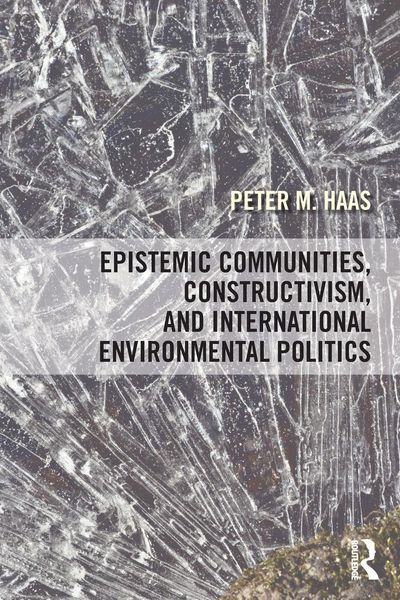
  • Produktbild: Epistemic Communities, Constructivism, and International Environmental Politics
  • Produktbild: Epistemic Communities, Constructivism, and International Environmental Politics

Epistemic Communities, Constructivism, and International Environmental Politics

74,99 €

inkl. gesetzl. MwSt., Versandkostenfrei


Beschreibung

Produktdetails

Einband

Taschenbuch

Erscheinungsdatum

17.08.2015

Abbildungen

8 SW-Abb., 8 SW-Zeichn., 35 Tabellen

Verlag

Taylor & Francis

Seitenzahl

422

Maße (L/B/H)

23,4/15,6/2,3 cm

Gewicht

638 g

Sprache

Englisch

ISBN

978-1-138-85855-8

Beschreibung

Rezension

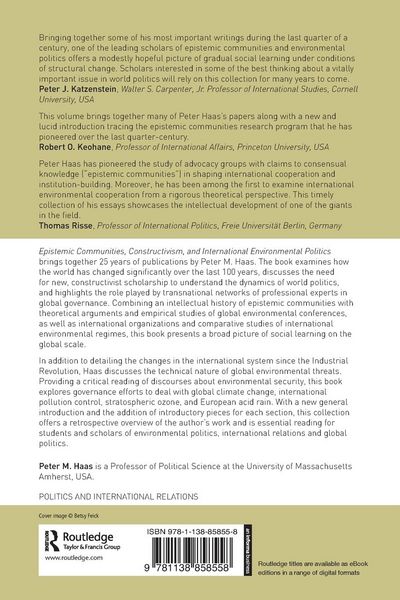
Bringing together some of his most important writings during the last quarter of century, one of the leading scholars of epistemic communities and environmental politics offers a modestly hopeful picture of gradual social learning under conditions of structural change. Scholars interested in some of the best thinking about a vitally important issue in world politics will rely on this collection for many years to come.

Peter J. Katzenstein, Walter S. Carpenter, Jr. Professor of International Studies, Cornell University, USA

This volume brings together many of Peter Haas's papers along with a new and lucid introduction tracing the epistemic communities research program that he has pioneered over the last quarter-century.

Robert O. Keohane, Professor of International Affairs, Princeton University, USA

Peter Haas has pioneered the study of advocacy groups with claims to consensual knowledge ("epistemic communities") in shaping international cooperation and institution-building. Moreover, he has been among the first to examine international environmental cooperation from a rigorous theoretical perspective. This timely collection of his essays showcases the intellectual development of one of the giants in the field.

Thomas Risse, Professor of International Politics, Freie Universität Berlin, Germany

Produktdetails

Einband

Taschenbuch

Erscheinungsdatum

17.08.2015

Abbildungen

8 SW-Abb., 8 SW-Zeichn., 35 Tabellen

Verlag

Taylor & Francis

Seitenzahl

422

Maße (L/B/H)

23,4/15,6/2,3 cm

Gewicht

638 g

Sprache

Englisch

ISBN

978-1-138-85855-8

EU-Ansprechpartner

Taylor & Francis Verlag GmbH
Kaufingerstraße 24
80331 München
DE
GPSR@taylorandfrancis.com

Herstelleradresse

Taylor & Francis Group
5 Howick Place
SW1P 1WG London
UK
GPSR@taylorandfrancis.com

Noch keine Bewertungen vorhanden

Verfassen Sie die erste Bewertung zu diesem Artikel

Helfen Sie anderen Kundinnen und Kunden durch Ihre Meinung.

Kundinnen und Kunden meinen

Bewertungen (0)

  • Produktbild: Epistemic Communities, Constructivism, and International Environmental Politics
  • Produktbild: Epistemic Communities, Constructivism, and International Environmental Politics
  • Preface 1. Introduction "ReConstructing Epistemic Communities" Part I: Ontology & Historical Background 2. Transnational Flows and the Transformation of International Relations 3. The Capacity of International Institutions to Manage Bhopal-like Problems 4. Introduction: Epistemic Communities and International Policy Coordination 5. Constructing Environmental Security from Resource Scarcity Part II: Regimes and Governance Patterns 6. Social Constructivism and the Evolution of Multilateral Environmental Governance 7. Prospects for Effective Marine Governance in the NW Pacific Region and "Letter to the Editor" 8. Epistemic Communities and International Environmental Law Part III: Institutions and Learning 9. UN Conferences and Constructivist Governance of the Environment 10. International Institutions and Social Learning in the Management of Global Environmental Risk 11. Addressing the Global Governance Deficit 12. Learning to Learn Part IV: Effectiveness 13. Choosing to Comply   14. Evaluating the Effectiveness of Marine Governance V: Science Policy 15. When Does Power Listen to Truth? A Constructivist Approach to the Policy Process 16. Organized Science, Usable Knowledge, and Multilateral Environmental Governance Part VI: Conclusion 17. Promoting Knowledge Based International Governance for Sustainable Development 18. The Global Spreading of Ideas