Produktbild: Field Archaeology from Around the World

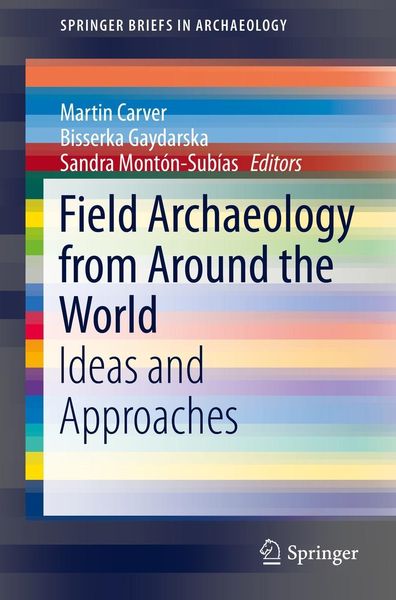
Field Archaeology from Around the World Ideas and Approaches

76,99 €

inkl. gesetzl. MwSt.

Beschreibung

Produktdetails

Format

PDF

Kopierschutz

Nein

Family Sharing

Nein

Text-to-Speech

Nein

Erscheinungsdatum

26.11.2014

Herausgeber

Martin Carver + weitere

Verlag

Springer

Seitenzahl

245 (Printausgabe)

Dateigröße

16387 KB

Sprache

Englisch

EAN

9783319098197

Beschreibung

Portrait

Martin Carver is emeritus Professor of Archaeology at the University of York (UK) and Editor of Antiquity. He is the founder of two commercial archaeology companies (FAS-Heritage and Birmingham Archaeology) and two museums (Sutton Hoo and the Tarbat Discovery Centre). He was secretary of the Institute of Field Archaeologists at its foundation and has carried out field research in England, Scotland, France, Italy and Algeria. His research interests are Field Method and the archaeology of protohistoric Europe.Bisserka Gaydarska is a Post Doctoral Research Assistant at the Department of Archaeology in Durham University. After graduating from Sofia University, she received her PhD in Durham University, which has been fostering her research activities ever since. Apart from her homeland Bulgaria, Bisserka has been involved in various field projects and museum studies in Romania, Greece, Turkey and recently Ukraine. Her main research interests are in landscape archaeology, material culture studies, the archaeology of gender and interdisciplinary studies that combine archeological science or information technology with archaeology. Sandra Montón-Subías is ICREA Research Professor at UPF (Universitat Pompeu Fabra), Barcelona, Spain. She is interested in broad issues in social and theoretical archaeology, including conflict, gender, identity and funerary practice. More recently, she has added historical archaeology and the archaeology of Modern Spanish colonialism to her research agenda She is co-chair of the EAA working party Archaeology and Gender in Europe.

Produktdetails

Format

PDF

eBooks im PDF-Format haben eine festgelegte Seitengröße und eignen sich daher nur bedingt zum Lesen auf einem tolino eReader oder Smartphone. Für den vollen Lesegenuss empfehlen wir Ihnen bei PDF-eBooks die Verwendung eines Tablets oder Computers.

Kopierschutz

Nein

Dieses eBook können Sie uneingeschränkt auf allen Geräten der tolino Familie, allen sonstigen eReadern und am PC lesen. Das eBook ist nicht kopiergeschützt und kann ein personalisiertes Wasserzeichen enthalten. Weitere Hinweise zum Lesen von eBooks mit einem personalisierten Wasserzeichen finden Sie unter Hilfe/Downloads.

Family Sharing

Nein

Mit Family Sharing können Sie eBooks innerhalb Ihrer Familie (max. sechs Mitglieder im gleichen Haushalt) teilen. Sie entscheiden selbst, welches Buch Sie mit welchem Familienmitglied teilen möchten. Auch das parallele Lesen durch verschiedene Familienmitglieder ist durch Family Sharing möglich. Um eBooks zu teilen oder geteilt zu bekommen, muss jedes Familienmitglied ein Konto bei Thalia oder einem anderen tolino-Buchhändler haben. Weitere Informationen finden Sie unter Hilfe/Family-Sharing.

Text-to-Speech

Nein

Bedeutet Ihnen Stimme mehr als Text? Mit der Funktion Text-to-Speech können Sie sich im tolino webReader und in der aktuellen Thalia – Lesen & Hören App das eBook vorlesen lassen. Weitere Informationen finden Sie unter Hilfe/Text-to-Speech.

Barrierefreiheit

  • keine Information zur Barrierefreiheit bekannt

Erscheinungsdatum

26.11.2014

Herausgeber

Verlag

Springer

Seitenzahl

245 (Printausgabe)

Dateigröße

16387 KB

Sprache

Englisch

EAN

9783319098197

Noch keine Bewertungen vorhanden

Verfassen Sie die erste Bewertung zu diesem Artikel

Helfen Sie anderen Kundinnen und Kunden durch Ihre Meinung.

Kundinnen und Kunden meinen

Bewertungen (0)

Weitere Artikel finden Sie in

  • Produktbild: Field Archaeology from Around the World
  • Part 1: Methods.- Chapter 1: Field Method in Archaeology: Overview.- Chapter 2: Natural and Cultural Formation Processes.- Chapter 3: Aerial archaeology.- Chapter 4: Surface Survey: Method and Strategies.- Chapter 5: Non-destructive Subsurface Mapping.- Chapter 6: Excavation methods.- Chapter 7: The Archaeological Study of Buildings.- Chapter 8: Recording Fieldwork.- Chapter 9: Spatial analysis.- Chapter 10: Sequence and Date.- Chapter 11: Ethno-archaeology: approaches to fieldwork.- Chapter 12: Publication.- Part 2: Projects.- Chapter 13: Large scale landscape mapping in Yorkshire, England.- Chapter 14: Seascape Survey on the Inner Ionian archipelago.- Chapter 15: Archaeology in advance of motorway construction in Ireland.- Chapter 16: Digging through permafrost in Siberia.- Chapter 17: A tropical rainforest site in Belize  Cynthia Robin.- Chapter 18: Excavating a Rock shelter in north-west Greece Nena Galanidou.- Chapter 19: Excavation and survey at Pinnacle Point, S Africa.- Chapter 20: An upper Paleolithic living floor at Monruz, Switzerland.- Chapter 21: On the beach in Remote Oceania.- Chapter 22: Defining the Neolithic on the German loess.- Chapter 23: Crannóg investigations in Scotland.- Chapter 24: Investigating Tells in Syria.- Chapter 25: Terp excavation in the Netherlands.- Chapter 26: A terramare site on the Po Plain, Italy.- Chapter 27: Hillfort investigations in the Czech Republic.- Chapter 28: Excavating burials in Anglo-Saxon England.- Chapter 29: A Burial mound dissection in Sweden.- Chapter 30: Down a mine at Gavá, Spain.- Chapter 31: Urban archaeology at Five Points New York City.- Chapter 32: After the earthquake in Bam, Iran; archaeological and social investigations.- Chapter 33: Ethnoarchaeology in the field: Learning from potters in Gilund, India.- Part 3: Traditions.- Chapter 34: America.- Chapter 35: Poland.- Chapter 36: Britain.- Chapter 37: Scandinavia.- Chapter 38: France.- Chapter 39: China.- Chapter 40: Japan.- Chapter 41: Australia.