KI-Beratung Beta

Gutscheinbedingungen

**Gültig bis 18.11.2026 auf englischsprachige Klassiker (klassiker-32728) online auf thalia.at und in der Thalia App. Einzelne Artikel können ausgeschlossen sein. Ausgenommen sind preisgebundene Artikel & eBooks. Pro Einkauf einmal einlösbar. Click & Collect nur bei Onlinevorabzahlung möglich. Keine Barauszahlung. Nicht kombinierbar mit anderen Aktionen und Gutscheinen. Gutschein wird auf max. 500€ Bestellwert angerechnet. Nicht gültig für Geschenkkarten, Versandkosten und Services.

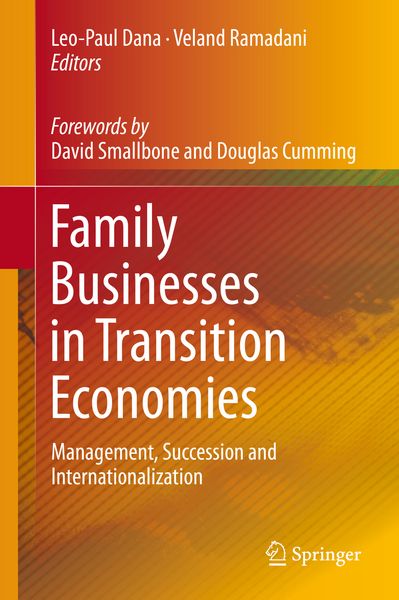
Produktbild: Family Businesses in Transition Economies

Family Businesses in Transition Economies Management, Succession and Internationalization

51,99 €

inkl. gesetzl. MwSt., Versandkostenfrei


Beschreibung

This book presents the reader a comprehensive understanding of the development of family business in transitional economies. Throughout eastern Europe, post-Communist countries transitioning to market-based economies are obtaining a variety of results due to diverse policy approaches. Expert contributions...

Beschreibung

This book presents the reader a comprehensive understanding of the development of family business in transitional economies. Throughout eastern Europe, post-Communist countries transitioning to market-based economies are obtaining a variety of results due to diverse policy approaches. Expert contributions in this book draw from a wealth of information in this context and include thought-provoking policy prescriptions for the future. This book concentrates on the challenges to predict the direction emerging markets will take, particularly when dealing with the wide-ranging social and economic situations taking place in post-Communist Eastern Europe. This reference volume for policymakers, educators, investors, and researchers also provides a much-needed and timely survey of family firms in the transitioning markets of post-Communist Europe.

Portrait

Léo-Paul Dana received BA and MBA degrees at McGill University and a PhD from HEC-Montreal. He is Professor of Entrepreneurship at Montpellier Business School and holds the honorary title of Adjunct Professor at the University of Regina, in Canada. He was earned tenure at the University of Canterbury and formerly served as Visiting Professor of Entrepreneurship at INSEAD and Deputy Director of the International Business MBA Programme at Nanyang Business School. He has published extensively in a variety of leading journals including the Cornell Quarterly, Entrepreneurship and Regional Development, Entrepreneurship: Theory and Practice, Journal of Small Business Management, Journal of World Business, and Small Business Economics. His research interests focus on cultural issues, including the internationalization of entrepreneurship. He is Editor Emeritus of the Journal of International Entrepreneurship. Among his books are When Economies Change Hands: A Survey of Entrepreneurship in the Emerging Markets of Europe from the Balkans to the Baltic States , published by Routledge in 2010 and the World Encyclopedia of Entrepreneurship, released in 2011.

Veland Ramadani  is an Assistant Professor at South-East European University, Republic of Macedonia, where he teaches both undergraduate andpostgraduate courses in entrepreneurship and small business management. During the period 2012- 2014, he served as Coordinator of Integrated Study Programme Department: Contemporary Enterprise Management, within South-East European University. He formerly served as Visiting Professor of Entrepreneurship at Universum College and AAB University, Republic of Kosovo. His research interests include entrepreneurship, small business management and venture capital investments. He authored or co-authored around forty-five research articles and ten books. Among his recent books are Entrepreneurship in the Balkans , published by Springer, Entrepreneurship , published by South-East European University and Female entrepreneurship in transitional economies: Trends and challenges , published by Palgrave Macmillan. Veland also serves as a member of editorial and reviewer board of several international journals. He was engaged by the President of Republic of Macedonia as a member of experts’ committee to analyse the economical, technological and juridical conditions for establishing techno-parks in the Republic of Macedonia. He has also delivered different trainings to the heads of departments in the Ministry of Economy of Macedonia.
Produktdetails

Einband

Gebundene Ausgabe

Erscheinungsdatum

07.04.2015

Abbildungen

XXIV, 349 p. 52 illus., 15 illus. in color.

Herausgeber Léo-Paul Dana + weitere

Produktdetails

Einband

Gebundene Ausgabe

Erscheinungsdatum

07.04.2015

Abbildungen

XXIV, 349 p. 52 illus., 15 illus. in color.

Herausgeber
Verlag Springer
Seitenzahl

349

Maße (L/B/H)

24,1/16/2,6 cm

Gewicht

677 g

Sprache

Englisch

ISBN

978-3-319-14208-1

Herstelleradresse

Springer-Verlag KG
Sachsenplatz 4-6
1201 Wien
AT

Email: ProductSafety@springernature.com

Noch keine Bewertungen vorhanden

Verfassen Sie die erste Bewertung zu diesem Artikel

Helfen Sie anderen Kundinnen und Kunden durch Ihre Meinung.

Kundinnen und Kunden meinen

Bewertungen (0)

Die Leseprobe wird geladen.
  • Produktbild: Family Businesses in Transition Economies
  • Introduction.- Introductory Issues: Context and Uniqueness of Family Businesses.- Content and Uniqueness of Transition Economies.- Different Features of Transition Economies - Institutions Matter.- Management, Succession and Financial Issues: To Be or Not to Be in a Family Business: The Case of Eight Countries in South-Eastern European Region.- Management in Practices in Bulgarian Family and Non-Family SMEs: Exploring  "Real" Differences.- Obstacles and Opportunities for Development of Family Businesses: Experiences from Moldova.- Successors' Innovativeness as a Crucial Succession Challenge of Family Businesses in Transition Economies: The Case of Slovenia.- Family Business Succession Risks: The Croatian Context.- The Succession Issues in Family Firms: Insights from Macedonia.- Attributes of Financial Management of Family Companies in the Czech Republic and Slovakia.- Ownership Structure, Cash Constraints and Investment Behaviour in Russian Family Firms.- Internationalization and Other Issues: Family Businesses Motives for Internationalisation: Evidence from Serbia.- Entering in New Markets: Strategies for Internationalization of Family Business.- Family Business in Sport Organizations: Western Experiences as Lessons for Transitional Economies.- Family Businesses in the Trade Sector: An Examination of a Case Study from Kosovo.