
KI-Beratung Beta

Gutscheinbedingungen

**Gültig am 25.11.2026 auf fremdsprachige Bücher online auf thalia.at und in der Thalia App. Einzelne Artikel können ausgeschlossen sein. Ausgenommen sind preisgebundene Artikel & eBooks. Pro Einkauf einmal einlösbar. Click & Collect nur bei Onlinevorabzahlung möglich. Keine Barauszahlung. Nicht kombinierbar mit anderen Aktionen und Gutscheinen. Gutschein wird auf max. 500€ Bestellwert angerechnet. Nicht gültig für Geschenkkarten, Versandkosten und Services.

  • Produktbild: Complexity Hints for Economic Policy
  • Produktbild: Complexity Hints for Economic Policy

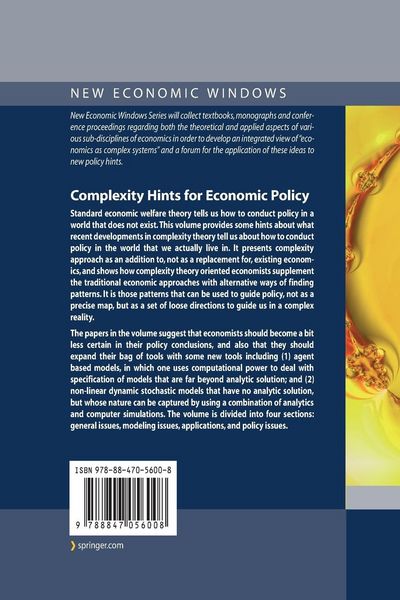
Complexity Hints for Economic Policy

Aus der Reihe New Economic Windows

102,99 €

inkl. gesetzl. MwSt., Versandkostenfrei


Beschreibung

To do science is to find patterns, and scientists are always looking for p- terns that they can use to structure their thinking about the world around them. Patterns are found in data, which is why science is inevitably a qu- titative study. But there is a difficulty in finding stable patterns in the...

Beschreibung

To do science is to find patterns, and scientists are always looking for p- terns that they can use to structure their thinking about the world around them. Patterns are found in data, which is why science is inevitably a qu- titative study. But there is a difficulty in finding stable patterns in the data since many patterns are temporary phenomena that have occurred r- domly, and highly sophisticated empirical methods are necessary to dist- guish stable patterns from temporary or random patterns. When a scientist thinks he has found a stable pattern, he will generally try to capture that pattern in a model or theory. A theory is essentially a pattern, and thus theory is a central part of science. It would be nice to have a single pattern - a unified theory - that could serve as a map relating our understanding with the physical world around us. But the physical world has proven far too complicated for a single map, and instead we have had to develop smaller sub maps that relate to small areas of the physical world around us. This multiple theory approach presents the pr- lem of deciding not only what the appropriate map for the particular issue is, but also of handling the map overlays where different maps relate to overlapping areas of reality. It is not only science that is focused on finding patterns; so too are most individuals.

Produktdetails

Einband

Taschenbuch

Erscheinungsdatum

30.10.2014

Abbildungen

XXIII, 311 p.

Herausgeber Massimo Salzano + weitere

Produktdetails

Einband

Taschenbuch

Erscheinungsdatum

30.10.2014

Abbildungen

XXIII, 311 p.

Herausgeber
Verlag Springer Italia
Seitenzahl

311

Maße (L/B/H)

23,5/15,5/1,9 cm

Gewicht

511 g

Auflage

1. Auflage

Sprache

Englisch

ISBN

978-88--4705600-8

Herstelleradresse

Springer-Verlag GmbH
Tiergartenstr. 17
69121 Heidelberg
DE

Email: ProductSafety@springernature.com

Noch keine Bewertungen vorhanden

Verfassen Sie die erste Bewertung zu diesem Artikel

Helfen Sie anderen Kundinnen und Kunden durch Ihre Meinung.

Kundinnen und Kunden meinen

Bewertungen (0)

  • Produktbild: Complexity Hints for Economic Policy
  • Produktbild: Complexity Hints for Economic Policy
  • General Issues.- Rationality, learning and complexity: from the Homo economicus to the Homo sapiens.- The Confused State of Complexity Economics: An Ontological Explanation.- Modeling Issues I: Modeling Economic Complexity.- The Complex Problem of Modeling Economic Complexity.- Visual Recurrence Analysis: Application to Economic Time series.- Complexity of Out-of-Equilibrium Play in Tax Evasion Game.- Modeling Issues II: Using Models from Physics to Understand EconomicPhenomena.- A New Stochastic Framework for Macroeconomics: Some Illustrative Examples.- Probability of Traffic Violations and Risk of Crime: A Model of Economic Agent Behavior.- Markov Nets and the NetLab Platform: Application to Continuous Double Auction.- Synchronization in Coupled and Free Chaotic Systems.- Agent Based Models.- Explaining Social and Economic Phenomena by Models with Low or Zero Cognition Agents.- Information and Cooperation in a Simulated Labor Market: A Computational Model for the Evolution of Workers and Firms.- Applications.- Income Inequality, Corruption, and the Non-Observed Economy: A Global Perspective.- Forecasting Inflation with Forecast Combinations: Using Neural Networks in Policy.- Policy Issues.- The Impossibility of an Effective Theory of Policy in a Complex Economy.- Implications of Scaling Laws for Policy-Makers.- Robust Control and Monetary Policy Delegation.