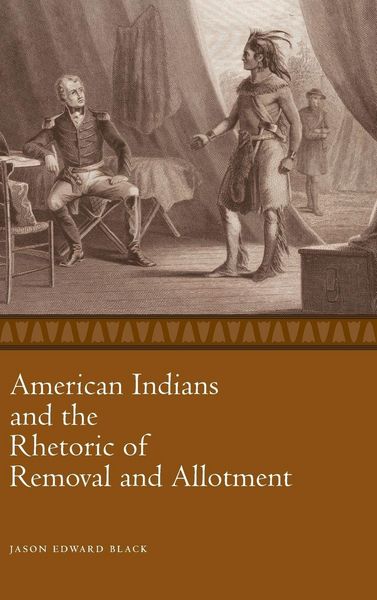
American Indians and the Rhetoric of Removal and Allotment
144,99 €
inkl. gesetzl. MwSt.,
Beschreibung
Produktdetails
Einband
Gebundene Ausgabe
Erscheinungsdatum
13.01.2015
Verlag
University Press Of MississippiSeitenzahl
226
Maße (L/B/H)
23,5/15,7/1,8 cm
Gewicht
524 g
Sprache
Englisch
ISBN
978-1-62846-196-1
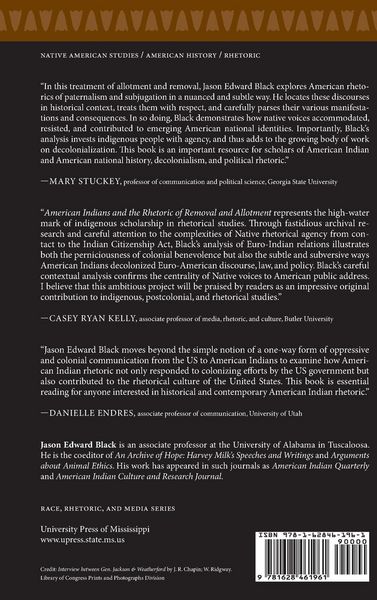
Jason Black examines the ways the U.S. government's rhetoric and American Indian voices contributed to the policies of Native-U.S. relations throughout the nineteenth century's removal and allotment eras. Black shows how these discourses co-constructed the perception of the U.S. government and American Indian communities and contributed to the relationship. Such interactions - though certainly not equal between the two - illustrated the hybrid nature of Native-U.S. rhetoric in the nineteenth century. That is, both governmental colonizing discourse and indigenous decolonizing discourse added arguments, identity constructions, and rhetorical moves to the colonizing relationship. Native Dualities demonstrates how American Indians decolonized dominant rhetoric in terms of impeding the removal and allotment policies. By turning around the U.S. government's discursive frameworks and inventing their own rhetorical tactics, American Indian communities helped restyle their own and the government's identities. During the first third of the twentieth century, Native decolonization impacted the Native-U.S. relationship as American Indians urged for the successful passage of the Indian Citizenship Act of 1924 and the Indian New Deal of 1934. In the end, Native communities were granted increased rhetorical power through decolonization, though the U.S. government retained a powerful colonial influence through its territorial management of Natives. The Indian Citizenship Act and the Indian New Deal - where this book concludes - emblemize the prevalence of the identity duality of U.S. citizenship that amalgamated American Indians to the nation, yet segregated them on reservations outside the spaces of U.S. society. This duality of inclusion and exclusion was built incrementally and existed as residues of nineteenth century Native-U.S. rhetorical relations.
Noch keine Bewertungen vorhanden
Verfassen Sie die erste Bewertung zu diesem Artikel
Helfen Sie anderen Kundinnen und Kunden durch Ihre Meinung.
Kurze Frage zu unserer Seite
Vielen Dank für Ihr Feedback
Wir nutzen Ihr Feedback, um unsere Produktseiten zu verbessern. Bitte haben Sie Verständnis, dass wir Ihnen keine Rückmeldung geben können. Falls Sie Kontakt mit uns aufnehmen möchten, können Sie sich aber gerne an unseren Kund*innenservice wenden.
zum Kundenservice