Produktbild: Pharmacology of the Blood Brain Barrier: Targeting CNS Disor

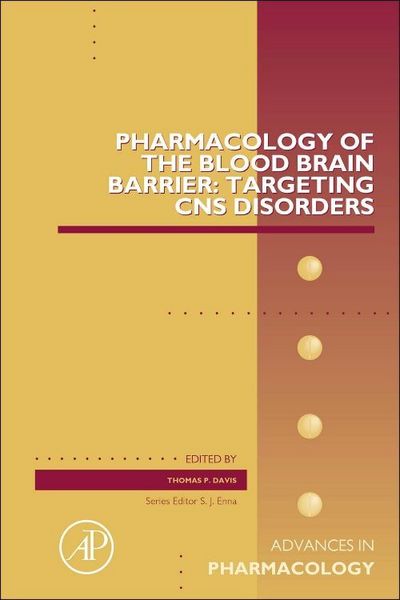
Pharmacology of the Blood Brain Barrier: Targeting CNS Disor Volume 71

187,99 €

inkl. gesetzl. MwSt., Versandkostenfrei


Beschreibung

Produktdetails

Einband

Gebundene Ausgabe

Erscheinungsdatum

19.09.2014

Herausgeber

Thomas P. Davis

Verlag

Elsevier LTD

Seitenzahl

512

Maße (L/B/H)

23,8/15,6/3,8 cm

Gewicht

921 g

Sprache

Englisch

ISBN

978-0-12-800282-7

Beschreibung

Rezension

"...it will be of immense value to those working in the area of CNS drug research or development and will also have a place in the libraries of academic institutions." -- The Pharmaceutical Journal, November 2014

Portrait

Professor of Pharmacology, and Program in Physiology and Neuroscience. The University of Arizona College of Medicine. Director of the Laboratory of Blood Brain Barrier Research. Tucson, Arizona. USA.

Dr. Thomas P. Davis has excelled in science, teaching, mentoring and service for over 30 years with consistency and creativity. Dr. Davis’ many accomplishments and work ethic can be credited to his disciplined training by renowned Harvard physiologist, David Bruce Dill, Missouri biochemist and lunar researcher, Charles W. Gehrke, and his University of Arizona College of Medicine mentors, the first Founders Day Lecturer, Henry I. Yamamura, and a College of Medicine founder, John D. Palmer.

Dr. Davis joined the University of Arizona in 1980, after completing two years of rigorous post-doctoral training at Abbott Pharmaceutical Company, as a member of the Therapeutic Drug Delivery (TDx) team. The Abbott TDx program proved highly successful in developing the first non-radioactive, automated, assay platform to monitor therapeutic drug levels in the physician office. Since his arrival at the University of Arizona College of Medicine, Dr. Davis has made outstanding contributions to the field of blood brain barrier (BBB) research by changing how drugs are designed and manufactured by pharmaceutical companies for brain delivery.

Many national and international scientists consider the substantial body of work that he has contributed to the scientific community as ground- breaking. In understanding the role that the blood brain barrier, at the level of the cerebral vasculature, plays in human health and disease, Dr. Davis is regarded as one of the premier investigators in the field. His pioneering studies, showing that drug pharmacokinetics and brain uptake of pain relieving, analgesic agents differ under pathologic conditions, are considered paradigm shifting; thus fundamentally affecting how we approach drug delivery for all CNS disorders, including brain injury, stroke and neurodegeneration. His work on hypoxia, stroke, peripheral pain and drug delivery is credited with the pivotal discovery that macromolecular, structural movement in “tight junction” proteins and drug transporter proteins at the BBB dramatically alters CNS drug delivery, under disease states.

His outstanding record of attracting extramural funding for his research also reflects the quality of Dr. Davis’ work. Since 2000, he has been the Principal Investigator on three continuing National Institutes of Health (NIH) R01 Basic science research grants, the sponsor of seven-funded post-doctoral National research service Awards and six pre-doctoral NIH awards to his students. Each of Dr. Davis’ last seven post-doctoral fellows has been funded by a three year NIH-NRSA grant sponsored by Dr. Davis. This success rate for NIH-NRSA funding may be the highest of record at Arizona; a true testimony to Dr. Davis’ mentoring success. The merit of his highly cited research has been awarded by continuous RO1 and PO1 NIH funding for over 30 consecutive years and publishing over 210 well cited manuscripts leading to a h factor of 50.

His enthusiastic mentorship of more than 50 undergraduate, graduate and medical students, and 25 post-doctoral fellows in his laboratory, since 1982, reflect Dr. Davis’ contribution to the teaching mission of the College of Medicine. Dr. Davis’ success at placing his students in tenure track professor positions, 12 since 2000, demonstrates his dedication and respect as a mentor. He presently coordinates and directs the graduate pharmacology course and sincerely enjoys teaching both graduate and medical students while receiving outstanding teaching evaluations every year.
Produktdetails

Einband

Gebundene Ausgabe

Erscheinungsdatum

19.09.2014

Herausgeber

Thomas P. Davis

Verlag

Elsevier LTD

Seitenzahl

512

Maße (L/B/H)

23,8/15,6/3,8 cm

Gewicht

921 g

Sprache

Englisch

ISBN

978-0-12-800282-7

EU-Ansprechpartner

Zeitfracht Medien GmbH
Ferdinand-Jühlke-Straße 7
99095 Erfurt
DE
produktsicherheit@zeitfracht.de

Herstelleradresse

Elsevier Science & Technology
125 London Wall
EC2Y 5AS London
GB
tradeorders@elsevier.com

Noch keine Bewertungen vorhanden

Verfassen Sie die erste Bewertung zu diesem Artikel

Helfen Sie anderen Kundinnen und Kunden durch Ihre Meinung.

Kundinnen und Kunden meinen

Bewertungen (0)

Die Leseprobe wird geladen.
  • Produktbild: Pharmacology of the Blood Brain Barrier: Targeting CNS Disor
  • 1. ABC Transporter Regulation by Signaling at the Blood-Brain Barrier: Relevance to Pharmacology
    David S. Miller
    2. P-glycoprotein Trafficking as a Therapeutic Target to Optimize CNS Drug Delivery
    Thomas P. Davis, Lucy Sanchez-Covarubias and Margaret E. Tome
    3. Functional Expression of Drug Transporters in Glial Cells: Potential Role on Drug Delivery to the CNS
    Tamima Ashraf, Amy Kao and Reina Bendayan
    4. Blood-Brain Barrier Na Transporters in Ischemic Stroke
    Martha E. O'Donnell
    5. Transcytosis of Macromolecules at the Blood-Brain Barrier
    Jane E. Preston, N. Joan Abbott and David J. Begley
    6. Drug Delivery to the Ischemic Brain
    Brandon J. Thompson and Patrick T. Ronaldson
    7. Delivery of Chemotherapeutics Across the Blood-Brain Barrier: Challenges and Advances
    Nancy D. Doolittle, Leslie L. Muldoon, Aliana Y. Culp and Edward A. Neuwelt
    8. Delivery of Antihuman African Trypanosomiasis Drugs Across the Blood-Brain and Blood-CSF Barriers
    Gayathri N. Sekhar, Christopher P. Watson, Mehmet Fidanboylu, Lisa Sanderson and Sarah A. Thomas
    9. Delivery of Therapeutic Peptides and Proteins to the CNS
    Therese S. Salameh and William A. Banks
    10. Engineering and Pharmacology of Blood-Brain Barrier-Permeable Bispecific Antibodies
    Danica Stanimirovic, Kristin Kemmerich, Arsalan S. Haqqani and Graham K. Farrington
    11. Pharmacological Significance of Prostaglandin E2 and D2 Transport at the Brain Barriers
    Masanori Tachikawa, Ken-ichi Hosoya and Tetsuya Terasaki
    12. Steroids and the Blood-Brain Barrier: Therapeutic Implications
    Ken A. Witt and Karin E. Sandoval
    13. Combination Approaches to Attenuate Hemorrhagic Transformation After tPA Thrombolytic Therapy in Patients with Poststroke Hyperglycemia/Diabetes
    Xiang Fan, Yinghua Jiang, Zhanyang Yu, Jing Yuan, Xiaochuan Sun, Shuanglin Xiang, Eng H. Lo and Xiaoying Wang
    14. Aging, the Metabolic Syndrome, and Ischemic Stroke: Redefining the Approach for Studying the Blood-Brain Barrier in a Complex Neurological Disease
    Brandon P. Lucke-Wold, Aric F. Logsdon, Ryan C. Turner, Charles L. Rosen and Jason D. Huber
    15. Drug Abuse and the Neurovascular Unit
    Richard D. Egleton and Thomas Abbruscato