Gutscheinbedingungen

**Gültig bis 24.09.2026 ab einem Mindestbestellwert von 30€ auf Spielzeug, Schreibwaren, Filme, Geschenke & Trends, Musik, tolino eReader & Zubehör, Hörbücher und Hörbuch-Downloads, nicht preisgebundene Bücher und Kalender online auf thalia.at und in der Thalia App. Einzelne Artikel können ausgeschlossen sein. Aufgrund der Buchpreisbindung sind deutschsprachige Bücher und eBooks ausgenommen. Zusätzlich ausgenommen sind Abos & Flatrates, Games, Geschenkkarten/-boxen, Shelfies, Software, Zeitschriften sowie einzelne Artikel von tonies®. Pro Einkauf einmal einlösbar. Click & Collect nur bei Onlinevorabzahlung möglich. Keine Barauszahlung. Nicht kombinierbar mit anderen Aktionen und Gutscheinen. Gutschein wird auf max. 500€ Bestellwert angerechnet. Nicht gültig für Versandkosten und Services. Preisgebundene Artikel sind vom Mindestbestellwert ausgeschlossen.

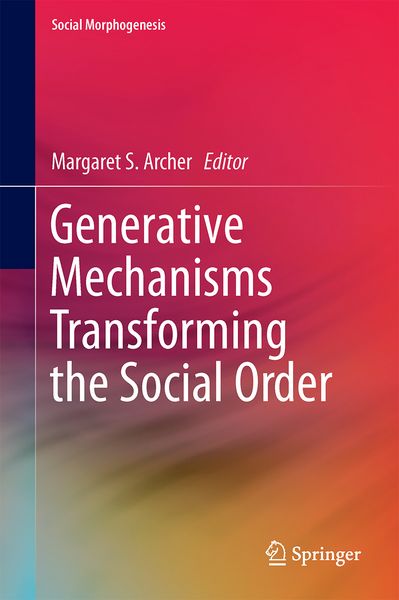
Produktbild: Generative Mechanisms Transforming the Social Order

Generative Mechanisms Transforming the Social Order

Aus der Reihe Social Morphogenesis

51,99 €

inkl. gesetzl. MwSt., Versandkostenfrei


Beschreibung

Produktdetails

Einband

Gebundene Ausgabe

Erscheinungsdatum

20.03.2015

Abbildungen

VIII, 248 p. 14 illus., 4 illus. in color.

Herausgeber

Margaret S. Archer

Verlag

Springer

Seitenzahl

248

Maße (L/B/H)

24,1/16/2 cm

Gewicht

553 g

Sprache

Englisch

ISBN

978-3-319-13772-8

Beschreibung

Portrait

Margaret Archer heads the project at EPFL 'From Modernity to Morphogenesis'. She was elected as the first woman President of the International Sociological Association at the 12th World Congress of Sociology. She is a founder member of both the Pontifical Academy of Social Sciences and the Academy of Learned Societies in the Social Sciences and is a trustee of the Centre for Critical Realism. She studied at the University of London, graduating B.Sc. in 1964 and Ph.D. in 1967 with a thesis on The Educational Aspirations of English Working Class Parents. She was a lecturer at the University of Reading from 1966 to 1973. She is one of the most influential theorists in the critical realist tradition. At the 12th World Congress of Sociology, she was elected as the first woman President of the International Sociological Association, is a founder member of both the Pontifical Academy of Social Sciences and the Academy of Learned Societies in the Social Sciences. She is a Trustee of the Centre for Critical Realism.

Produktdetails

Einband

Gebundene Ausgabe

Erscheinungsdatum

20.03.2015

Abbildungen

VIII, 248 p. 14 illus., 4 illus. in color.

Herausgeber

Margaret S. Archer

Verlag

Springer

Seitenzahl

248

Maße (L/B/H)

24,1/16/2 cm

Gewicht

553 g

Sprache

Englisch

ISBN

978-3-319-13772-8

Herstelleradresse

Springer-Verlag KG
Sachsenplatz 4-6
1201 Wien
AT

Email: ProductSafety@springernature.com

Noch keine Bewertungen vorhanden

Verfassen Sie die erste Bewertung zu diesem Artikel

Helfen Sie anderen Kundinnen und Kunden durch Ihre Meinung.

Kundinnen und Kunden meinen

Bewertungen (0)

Die Leseprobe wird geladen.
  • Produktbild: Generative Mechanisms Transforming the Social Order
  • Foreword.- Chapter 1. Introduction: Other Conceptions of Generative Mechanisms and Ours; Margaret S. Archer.- Part I. Conceptualising Mechanisms.- Chapter 2. Causal Mechanisms: Lessons from the Life Sciences; Philip Gorski.- Chapter 3. Mechanisms and Models; Some Examples from International Relations; Colin Wright.- Chapter 4. Social Mechanisms and Their Feedbacks; Pierpaolo Donati.- Part II. Venturing Morphogenetic Mechanisms.- Chapter 5. ''Mechanisms'' of the Build-Up of Information Society; Wolfgang Hofkirchner.- Chapter 6. Body Captors and Network Profiles: A Neo-Structural Note on Digitalized Social Control and Morphogenesis; Emmanuel Lazega.- Chapter 7. How Agency is Transformed in the Course of Social Transformation: Don't Forget the Double Morphogenesis; Margaret S. Archer.- Chapter 8. Turbulence and Relational Conjunctures: The Emergence of Morphogenic Environments; Andrea Maccarini.- Part III. Mechanisms and Morphostasis: Power of Life and Death.- Chapter 9. Why Don't Things Change? The Matter of Morphostasis; Douglas V. Porpora.- Chapter 10. The Modern Corporation: The Site of a Mechanism (of Global Social Change) that is Out-of-Control; Tony Lawson.- Chapter 11. Death Contested: Morphonecrosis and Conflicts of Interpretation; Ismael Al-Amoudi and John Latsis.