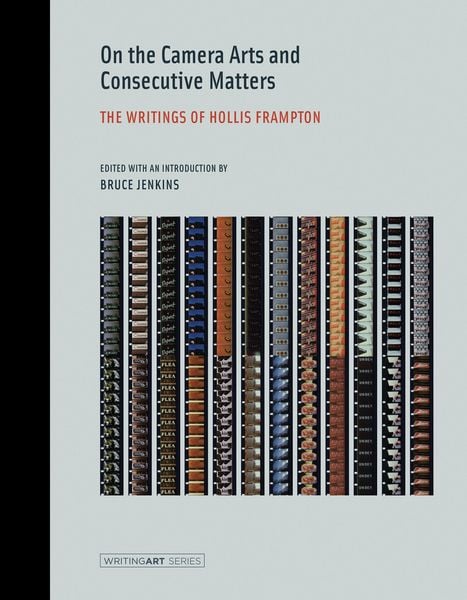
On the Camera Arts and Consecutive Matters The Writings of Hollis Frampton
-
- Englisch ausgewählt
44,99 €
inkl. gesetzl. MwSt.,
Beschreibung
Produktdetails
Einband
Taschenbuch
Altersempfehlung
ab 18 Jahr(e)
Erscheinungsdatum
01.02.2015
Abbildungen
34 b&w illus., Illustrationen, nicht spezifiziert
Herausgeber
Bruce JenkinsVerlag
MIT PressSeitenzahl
352
Maße (L/B/H)
25,1/15,2/2,5 cm
Gewicht
1089 g
Sprache
Englisch
ISBN
978-0-262-52760-6
The collected writings of artist and filmmaker Hollis Frampton, including all the essays from the long-unavailable Circles of Confusion along with rare additional material.
As Hollis Frampton's photographs and celebrated experimental films were testing the boundaries of “the camera arts” in the 1960s and 1970s, his provocative and highly literate writings were attempting to establish an intellectually resonant form of discourse for these critically underexplored fields. It was a time when artists working in diverse disciplines were beginning to pick up cameras and produce films and videotapes, well before these practices were understood or embraced by institutions of contemporary art. This collection of Frampton's writings presents his critical essays (many written for Artforum and October) along with additional material, including lectures, correspondence, interviews, and production notes and scripts. It replaces—and supersedes—the long-unavailable Circles of Confusion, published in 1983. Frampton ranged widely over the visual arts in his writing, and the texts in this collection display his unique approaches to photography, film, and video, as well as the plastic and literary arts. They include critically acclaimed essays on Edward Weston and Eadweard Muybridge as well as appraisals of contemporary photographers; the influential essay, “For a Metahistory of Film,” along with scripts, textual material, and scores for his films; writings on video that constitute a prehistory of the digital arts; a dialogue with Carl Andre (his friend and former Phillips Andover classmate) from the early 1960s; and two inventive, almost unclassifiable pieces that are reminiscent of Borges, Joyce, and Beckett.
Kundinnen und Kunden meinen
Verfassen Sie die erste Bewertung zu diesem Artikel
Helfen Sie anderen Kund*innen durch Ihre Meinung
Kurze Frage zu unserer Seite
Vielen Dank für Ihr Feedback
Wir nutzen Ihr Feedback, um unsere Produktseiten zu verbessern. Bitte haben Sie Verständnis, dass wir Ihnen keine Rückmeldung geben können. Falls Sie Kontakt mit uns aufnehmen möchten, können Sie sich aber gerne an unseren Kund*innenservice wenden.
zum Kundenservice