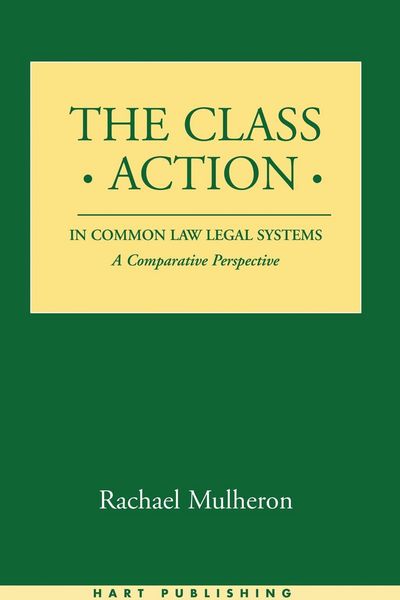
The Class Action in Common Law Legal Systems A Comparative Perspective
-
- Einzelkauf Download ausgewählt
-
Sprache:Englisch
197,40 €
inkl. gesetzl. MwSt.Beschreibung
Produktdetails
Format
Kopierschutz
Ja
Family Sharing
Nein
Text-to-Speech
Nein
Erscheinungsdatum
15.11.2004
Verlag
Bloomsbury eBooks UKSeitenzahl
616 (Printausgabe)
Dateigröße
2090 KB
Auflage
1. Auflage
Sprache
Englisch
EAN
9781847310965
Multi-party litigation is a world-wide legal process, and the class action device is one of its best-known manifestations. As a means of providing access to justice and achieving judicial economies, the class action is gaining increasing endorsement - particularly given the prevalence of mass consumerism of goods and services, and the extent to which the activities and decisions of corporations and government bodies can affect large numbers of people.
The primary purpose of this book is to compare and contrast the class action models that apply under the federal regimes of Australia and the United States and the provincial regimes of Ontario and British Columbia in Canada. While the United States model is the most longstanding, there have now been sufficient judicial determinations under each of the studied jurisdictions to provide a constructive basis for comparison. In the context of the drafting and application of a workable class action framework, it is apparent that similar problems have been confronted across these jurisdictions, which in turn promotes a search for assistance in the experience and legal analysis of others.
The book is presented in three Parts. The first Part deals with the class action concept and its alternatives, and also discusses and critiques the stance of England where the introduction of the opt-out class action model has been opposed. The second Part focuses upon the various criteria and factors governing commencement of a class action (encompassing matters such as commonality, superiority, suitability, and the class representative). Part 3 examines matters pertaining to conduct of the action itself (such as becoming a class member, notice requirements, settlement, judgments, and costs and fees).
The book is written to have practical utility for a wide range of legal practitioners and professionals, such as: academics and students of comparative civil procedure and multi-party litigation; litigation lawyers who may use the reference materials cited to the benefit of their own class action clients; and those charged with law reform who look to adopt the most workable (and avoid the unworkable) features in class action models elsewhere.
The primary purpose of this book is to compare and contrast the class action models that apply under the federal regimes of Australia and the United States and the provincial regimes of Ontario and British Columbia in Canada. While the United States model is the most longstanding, there have now been sufficient judicial determinations under each of the studied jurisdictions to provide a constructive basis for comparison. In the context of the drafting and application of a workable class action framework, it is apparent that similar problems have been confronted across these jurisdictions, which in turn promotes a search for assistance in the experience and legal analysis of others.
The book is presented in three Parts. The first Part deals with the class action concept and its alternatives, and also discusses and critiques the stance of England where the introduction of the opt-out class action model has been opposed. The second Part focuses upon the various criteria and factors governing commencement of a class action (encompassing matters such as commonality, superiority, suitability, and the class representative). Part 3 examines matters pertaining to conduct of the action itself (such as becoming a class member, notice requirements, settlement, judgments, and costs and fees).
The book is written to have practical utility for a wide range of legal practitioners and professionals, such as: academics and students of comparative civil procedure and multi-party litigation; litigation lawyers who may use the reference materials cited to the benefit of their own class action clients; and those charged with law reform who look to adopt the most workable (and avoid the unworkable) features in class action models elsewhere.
Noch keine Bewertungen vorhanden
Verfassen Sie die erste Bewertung zu diesem Artikel
Helfen Sie anderen Kundinnen und Kunden durch Ihre Meinung.
Kurze Frage zu unserer Seite
Vielen Dank für Ihr Feedback
Wir nutzen Ihr Feedback, um unsere Produktseiten zu verbessern. Bitte haben Sie Verständnis, dass wir Ihnen keine Rückmeldung geben können. Falls Sie Kontakt mit uns aufnehmen möchten, können Sie sich aber gerne an unseren Kund*innenservice wenden.
zum Kundenservice