KI-Beratung Beta

Gutscheinbedingungen

**Gültig am 20.11.2026 ab einem Mindestbestellwert von 30€ auf Spielzeug, Schreibwaren, Filme, Geschenke & Trends, Musik, tolino eReader & Zubehör, Hörbücher und Hörbuch-Downloads, nicht preisgebundene Bücher und Kalender online auf thalia.at und in der Thalia App. Einzelne Artikel können ausgeschlossen sein. Aufgrund der Buchpreisbindung sind deutschsprachige Bücher und eBooks ausgenommen. Zusätzlich ausgenommen sind Abos & Flatrates, Games, Geschenkkarten/-boxen, Shelfies, Software, Zeitschriften sowie einzelne Artikel von tonies®. Pro Einkauf einmal einlösbar. Click & Collect nur bei Onlinevorabzahlung möglich. Keine Barauszahlung. Nicht kombinierbar mit anderen Aktionen und Gutscheinen. Gutschein wird auf max. 500€ Bestellwert angerechnet. Nicht gültig für Versandkosten und Services. Preisgebundene Artikel sind vom Mindestbestellwert ausgeschlossen.

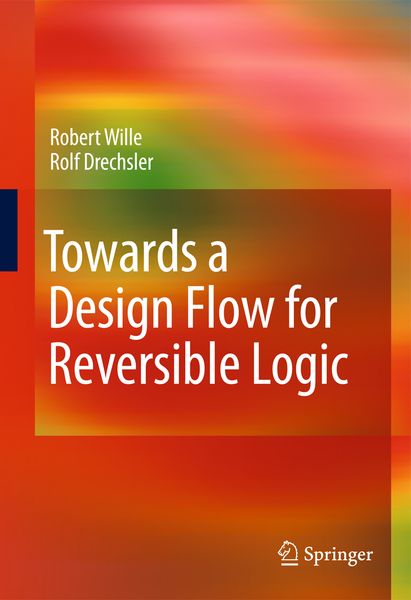
Produktbild: Towards a Design Flow for Reversible Logic
- 11%

Towards a Design Flow for Reversible Logic

11% sparen

96,99 € UVP 109,99 €

inkl. gesetzl. MwSt., Versandkostenfrei


Beschreibung

The development of computing machines found great success in the last decades. But the ongoing miniaturization of integrated circuits will reach its limits in the near future. Shrinking transistor sizes and power dissipation are the major barriers in the development of smaller and more powerful circuits....

Beschreibung

The development of computing machines found great success in the last decades. But the ongoing miniaturization of integrated circuits will reach its limits in the near future. Shrinking transistor sizes and power dissipation are the major barriers in the development of smaller and more powerful circuits. Reversible logic p- vides an alternative that may overcome many of these problems in the future. For low-power design, reversible logic offers signi?cant advantages since zero power dissipation will only be possible if computation is reversible. Furthermore, quantum computation pro?ts from enhancements in this area, because every quantum circuit is inherently reversible and thus requires reversible descriptions. However, since reversible logic is subject to certain restrictions (e.g. fanout and feedback are not directly allowed), the design of reversible circuits signi?cantly differs from the design of traditional circuits. Nearly all steps in the design ?ow (like synthesis, veri?cation, or debugging) must be redeveloped so that they become applicable to reversible circuits as well. But research in reversible logic is still at the beginning. No continuous design ?ow exists so far. Inthisbook,contributionstoadesign?owforreversiblelogicarepresented.This includes advanced methods for synthesis, optimization, veri?cation, and debugging.

Rezension

From the reviews:

“This is a book about the present and the future of computing machines. … At the end of the book a list of 144 refs are included giving the reader the possibility to know more than there are in the book. … the book represents an excellent text at a post-graduate level aiming to give to the researchers the basic ideas and techniques in this new emerging domain.” (Dumitru Stanomir, Zentralblatt MATH, Vol. 1210, 2011)

Produktdetails

Einband

Taschenbuch

Erscheinungsdatum

18.10.2014

Abbildungen

XIII, 184 p.

Verlag Springer Netherland

Produktdetails

Einband

Taschenbuch

Erscheinungsdatum

18.10.2014

Abbildungen

XIII, 184 p.

Verlag Springer Netherland
Seitenzahl

184

Maße (L/B/H)

23,5/15,5/1,2 cm

Gewicht

312 g

Auflage

1. Auflage

Sprache

Englisch

ISBN

978-94-007-9425-2

Herstelleradresse

Springer-Verlag KG
Sachsenplatz 4-6
1201 Wien
AT

Email: ProductSafety@springernature.com

Noch keine Bewertungen vorhanden

Verfassen Sie die erste Bewertung zu diesem Artikel

Helfen Sie anderen Kundinnen und Kunden durch Ihre Meinung.

Kundinnen und Kunden meinen

Bewertungen (0)

  • Produktbild: Towards a Design Flow for Reversible Logic
  • Preliminaries.- Synthesis of Reversible Logic.- Exact Synthesis of Reversible Logic.- Embedding of Irreversible Functions.- Optimization.- Formal Verification and Debugging.- Summary and Conclusions.