• Produktbild: Spatio-Temporal Modeling of Nonlinear Distributed Parameter Systems
  • Produktbild: Spatio-Temporal Modeling of Nonlinear Distributed Parameter Systems
Band 50

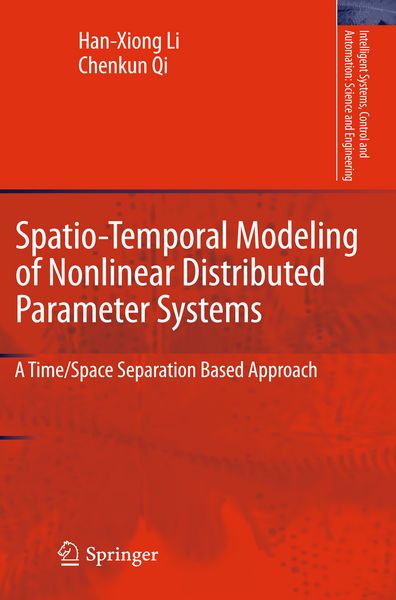
Spatio-Temporal Modeling of Nonlinear Distributed Parameter Systems A Time/Space Separation Based Approach

49,99 €

inkl. gesetzl. MwSt., Versandkostenfrei


Beschreibung

Produktdetails

Einband

Taschenbuch

Erscheinungsdatum

16.10.2014

Verlag

Springer Netherland

Seitenzahl

175

Maße (L/B/H)

23,5/15,5/1,1 cm

Gewicht

306 g

Auflage

1. Auflage

Sprache

Englisch

ISBN

978-94-017-8254-8

Beschreibung

Rezension

From the reviews:

“A distributed parameter system (DPS) is usually an engineering equivalent of a partial differential equation (PDE) or a system of PDEs. … this book is the extension of this idea to the nonlinear setting. … The book addresses an engineering audience, and people not very familiar with the subject will find the list of abbreviations especially useful. The chapters are inter-connected and each chapter looks like an independent entity; it starts and ends with a summary and has its own list of references … .” (Sergey V. Lototsky, Mathematical Reviews, Issue 2012 a)

Produktdetails

Einband

Taschenbuch

Erscheinungsdatum

16.10.2014

Verlag

Springer Netherland

Seitenzahl

175

Maße (L/B/H)

23,5/15,5/1,1 cm

Gewicht

306 g

Auflage

1. Auflage

Sprache

Englisch

ISBN

978-94-017-8254-8

Herstelleradresse

Springer-Verlag KG
Sachsenplatz 4-6
1201 Wien
AT

Email: GPSR Kontakt

Noch keine Bewertungen vorhanden

Verfassen Sie die erste Bewertung zu diesem Artikel

Helfen Sie anderen Kundinnen und Kunden durch Ihre Meinung.

Kundinnen und Kunden meinen

Bewertungen (0)

  • Produktbild: Spatio-Temporal Modeling of Nonlinear Distributed Parameter Systems
  • Produktbild: Spatio-Temporal Modeling of Nonlinear Distributed Parameter Systems
  • Preface; List of Figures; List of Tables; Abbreviations; 1 Introduction; 1.1 Background; 1.1.1 Examples of distributed parameter processes; 1.1.2 Motivation; 1.2 Contributions and organization of the book; 1.3 References; 2 Modeling of Distributed Parameter Systems: Overview and Classification; 2.1 Introduction; 2.2 White-box modeling: model reduction for known DPS; 2.2.1 Eigenfunction method; 2.2.2 Green’s function method; 2.2.3 Finite difference method; 2.2.4 Weighted residual method; 2.2.4.1 Classification based on weighting functions; 2.2.4.2 Classification based on basis functions; 2.2.5 Comparison studies of spectral and KL method; 2.3 Grey-box modeling: parameter estimation for partly known DPS; 2.3.1 FDM based estimation; 2.3.2 FEM based estimation; 2.3.3 Spectral based estimation; 2.3.4 KL based estimation; 2.4 Black-box modeling: system identification for unknown DPS; 2.4.1 Green’s function based identification; 2.4.2 FDM based identification; 2.4.3 FEM based identification; 2.4.4 Spectral based identification; 2.4.5 KL based identification; 2.4.6 Comparison studies of neural spectral and neural KL method; 2.5 Concluding remarks; 2.6 References; 3 Spatio-Temporal Modeling for Wiener Distributed Parameter Systems; 3.1 Introduction; 3.2 Wiener distributed parameter system; 3.3 Spatio-temporal Wiener modeling methodology; 3.4 Karhunen-Loève decomposition; 3.5 Wiener model identification; 3.5.1 Model parameterization; 3.5.2 Parameter estimation; 3.6 Simulation and experiment; 3.6.1 Catalytic rod; 3.6.2 Snap curing oven; 3.7 Summary; 3.8 References; 4 Spatio-Temporal Modeling for Hammerstein Distributed Parameter Systems; 4.1 Introduction; 4.2 Hammerstein distributed parameter system; 4.3 Spatio-temporal Hammerstein modeling methodology; 4.4 Karhunen-Loève decomposition; 4.5 Hammerstein model identification; 4.5.1 Model parameterization; 4.5.2 Structure selection; 4.5.3 Parameter estimation; 4.6 Simulation and experiment; 4.6.1 Catalytic rod; 4.6.2 Snap curing oven; 4.7 Summary; 4.8 References; 5 Multi-Channel Spatio-Temporal Modeling for Hammerstein Distributed Parameter Systems; 5.1 Introduction; 5.2 Hammerstein distributed parameter system; 5.3 Basic identification approach; 5.3.1 Basis function expansion; 5.3.2 Temporal modeling problem; 5.3.3 Least-squares estimation; 5.3.4 Singular value decomposition; 5.4 Multi-channel identification approach; 5.4.1 Motivation; 5.4.2 Multi-channel identification; 5.4.3 Convergence analysis; 5.5 Simulation and experiment; 5.5.1 Packed-bed reactor; 5.5.2 Snap curing oven; 5.6 Summary; 5.7 References; 6 Spatio-Temporal Volterra Modeling for a Class of Nonlinear DPS; 6.1 Introduction; 6.2 Spatio-temporal Volterra model; 6.3 Spatio-temporal modeling approach; 6.3.1 Time/space separation; 6.3.2 Temporal modeling problem; 6.3.3 Parameter estimation; 6.4 State space realization; 6.5 Convergence analysis; 6.6 Simulation and experiment; 6.6.1 Catalytic rod; 6.6.2 Snap curing oven; 6.7 Summary; 6.8 References; 7 Nonlinear Dimension Reduction based Neural Modeling for Nonlinear Complex DPS; 7.1 Introduction; 7.2 Nonlinear PCA based spatio-temporal modeling framework; 7.2.1 Modeling methodology; 7.2.2 Principal component analysis; 7.2.3 Nonlinear PCA for projection and reconstruction; 7.2.4 Dynamic modeling; 7.3 Nonlinear PCA based spatio-temporal modeling in neural system; 7.3.1 Neural network for nonlinear PCA; 7.3.2 Neural network for dynamic modeling; 7.4 Simulation and experiment; 7.4.1 Catalytic rod; 7.4.2 Snap curing oven; 7.5 Summary; 7.6 References; 8 Conclusions; 8.1 Conclusions; 8.2 References; Index.