• Produktbild: Multiple Perspectives on Difficulties in Learning Literacy and Numeracy
  • Produktbild: Multiple Perspectives on Difficulties in Learning Literacy and Numeracy
- 13%

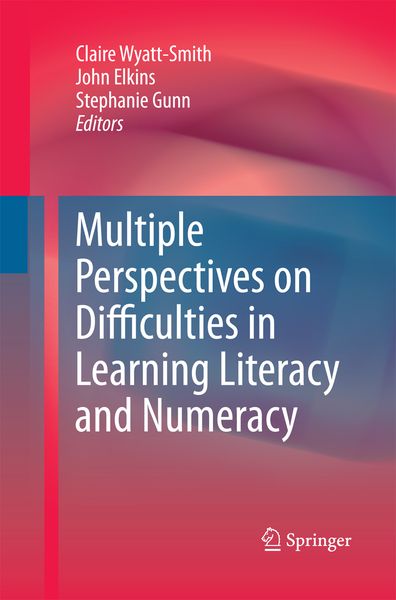
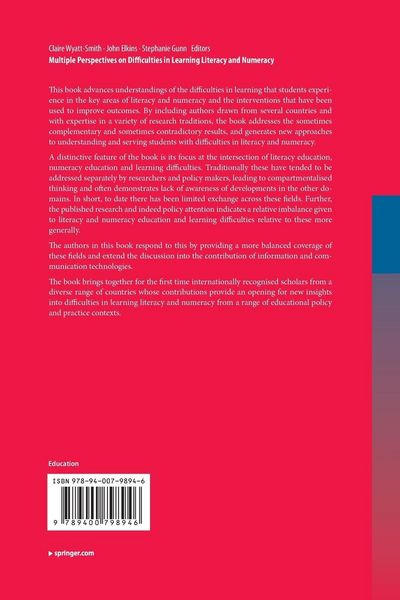
Multiple Perspectives on Difficulties in Learning Literacy and Numeracy

13% sparen

142,99 € UVP 164,99 €

inkl. gesetzl. MwSt., Versandkostenfrei


Beschreibung

Produktdetails

Einband

Taschenbuch

Erscheinungsdatum

02.09.2014

Herausgeber

Claire Wyatt-Smith + weitere

Verlag

Springer Netherland

Seitenzahl

375

Maße (L/B/H)

23,5/15,5/2,2 cm

Gewicht

611 g

Auflage

2011

Sprache

Englisch

ISBN

978-94-007-9894-6

Beschreibung

Rezension

From the reviews:

“This book is likely to be found soon on all recommended reading lists for graduate and postgraduate students pursuing studies in special and inclusive education. It is also relevant reading for students undertaking courses in the teaching of reading and mathematics. … brings together under one cover the diverse theories, perspectives and studies that have hitherto been confined to discipline-specific texts and professional journals. … the book has probably achieved its purpose in advancing our understanding of issues surrounding learning difficulties in literacy and numeracy.” (Peter Westwood, Australian Journal of Learning Difficulties, Vol. 17 (1), May, 2012)

Produktdetails

Einband

Taschenbuch

Erscheinungsdatum

02.09.2014

Herausgeber

Verlag

Springer Netherland

Seitenzahl

375

Maße (L/B/H)

23,5/15,5/2,2 cm

Gewicht

611 g

Auflage

2011

Sprache

Englisch

ISBN

978-94-007-9894-6

Herstelleradresse

Springer-Verlag GmbH
Tiergartenstr. 17
69121 Heidelberg
DE

Email: ProductSafety@springernature.com

Noch keine Bewertungen vorhanden

Verfassen Sie die erste Bewertung zu diesem Artikel

Helfen Sie anderen Kundinnen und Kunden durch Ihre Meinung.

Kundinnen und Kunden meinen

Bewertungen (0)

Weitere Artikel finden Sie in

  • Produktbild: Multiple Perspectives on Difficulties in Learning Literacy and Numeracy
  • Produktbild: Multiple Perspectives on Difficulties in Learning Literacy and Numeracy
  • Contents
    Acknowledgements
    About the contributors
    List of figures
    List of tables
    Chapter 1
    Theoretical frameworks and ways of seeing: Operating at the intersection—literacy, numeracy and learning difficulties
    Claire Wyatt-Smith & John Elkins, Griffith University, Australia
    Chapter 2
    Learning difficulties, literacy and numeracy: Conversations across the fields
    Stephanie Gunn & Claire Wyatt-Smith, Griffith University, Australia
    Chapter 3
    Researching the opportunities for learning for students with learning difficulties in classrooms: An ethnographic perspective
    Judith Green & Beth Yeager, University of California, Santa Barbara, United States, & Maria Lucia Castanheira, Federal University of Minas Gerais, Brazil
    Chapter 4
    The new literacies of online reading comprehension: New opportunities and challenges for students with learning difficulties
    Jill Castek, University of California, Berkeley, Lisa Zawilinski, J. Greg McVerry, W. Ian O’Byrne & Donald J. Leu, University of Connecticut, United States
    Chapter 5
    Literacy, technology and the Internet: What are the challenges and opportunities for learners with reading difficulties, and how do we support them in meeting those challenges and grasping those opportunities?
    Colin Harrison, University of Nottingham, United Kingdom
    Chapter 6
    Essential provisions for quality learning support: Connecting literacy, numeracy and learning needs
    Peta Colbert, Griffith University, Australia
    Chapter 7
    Reading the home and reading in school: Framing deficit constructions as learning difficulties in Singapore English classrooms
    Anneliese Kramer-Dahl & Dennis Kwek, National Institute of Education/Nanyang Technological University, Singapore
    Chapter 8
    Parent, family and community support for addressing difficulties in literacy
    Janice Wearmouth, University of Bedfordshire, Bedford, United Kingdom & Mere Berryman, Poutama Pounamu Education Research and Development Centre, New Zealand
    Chapter 9
    Enhancing reading comprehension through explicit comprehending strategy teaching
    John Munro, The University of Melbourne, Australia
    Chapter 10
    The writing achievement, metacognitive knowledge of writing and motivation of middle-school students with learning difficulties
    Christina E. van Kraayenoord, Karen B. Moni, Anne Jobling & Robyn Miller, The University of Queensland, Australia; John Elkins, Griffith University, Australia & David Koppenhaver, Appalachian State University, Boone, North Carolina, United States
    Chapter 11
    The role of self-monitoring in initial word recognition learning
    Robert M. Schwartz, Oakland University, Michigan & Patricia A. Gallant, University of Michigan-Flint, Michigan, United States
    Chapter 12
    Effective instruction for older, low-progress readers: Meeting the needs of Indigenous students
    Kevin Wheldall & Robyn Beaman, Macquarie University, Australia
    Chapter 13
    Actualising potential in the classroom: Moving from practising to be numerate towards engaging in the literate practice of mathematics
    Raymond Brown, Griffith University, Australia
    Chapter 14
    Effective instruction in mathematics for students with learning difficulties
    Marjorie Montague, University of Miami, Florida, United States
    Chapter 15
    Language, culture and learning mathematics: A Bourdieuian analysis of Indigenous learning
    Robyn Jorgensen (Zevenbergen), Griffith University, Australia and Nyangatjatjara Aboriginal Corporation, Yulara, Northern Territory, Australia
    Chapter 16
    ‘She’s not in my head or in my body’: Developing identities of exclusion and inclusion in whole-class discussions
    Laura Black, University of Manchester, United Kingdom
    Chapter 17
    Breaking down the silos: The search for an evidentiary base
    John Elkins & Claire Wyatt-Smith, Griffith University, Australia

    Index