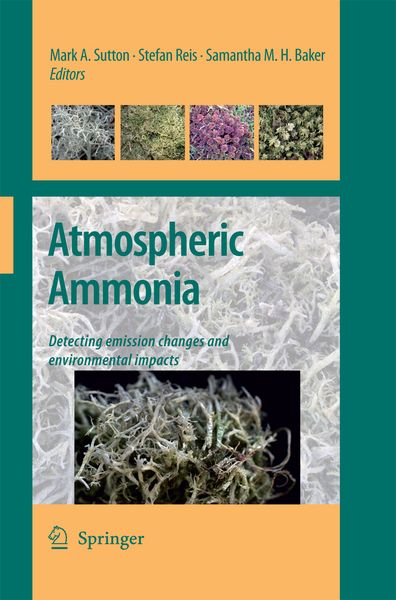
• Produktbild: Atmospheric Ammonia
  • Produktbild: Atmospheric Ammonia

Atmospheric Ammonia Detecting emission changes and environmental impacts. Results of an Expert Workshop under the Convention on Long-range Transboundary Air Pollution

144,99 €

inkl. gesetzl. MwSt., Versandkostenfrei


Beschreibung

Produktdetails

Einband

Taschenbuch

Erscheinungsdatum

12.09.2014

Herausgeber

Mark Sutton + weitere

Verlag

Springer Netherland

Seitenzahl

464

Maße (L/B/H)

23,5/15,5/2,7 cm

Gewicht

747 g

Auflage

1. Auflage

Sprache

Englisch

ISBN

978-94-007-8953-1

Beschreibung

Portrait

Mark Sutton

Is a specialist in the behaviour of ammonia in the atmosphere, based at the NERC Centre for Ecology and Hydrology, Edinburgh. He is the coordinator of the NitroEurope Integrated Project, chairman of the European Centre of the International Nitrogen Initiative and co-chair of the UNECE Task Force on Reactive Nitrogen.

Stefan Reis

Is an expert on emissions of atmospheric pollutants and integrated assessment modelling. Formerly of the Institute of Energy Economics and the Rational Use of Energy at the University of Stuttgart, Germany, he is now the Scientific Project Manager of the NitroEurope Integrated Project.

Samantha Baker

Is a scientific policy analyst at the UK Department for Environment Food and Rural Affairs (Defra), with extensive experience of transboundary air pollution issues. She and a member of the Natural Resource and Rural Affairs (NRRA) Science Division at Defra and co-chairs the Projections Panel of the UNECE Task Force on Emission Inventories and Projections.

Produktdetails

Einband

Taschenbuch

Erscheinungsdatum

12.09.2014

Herausgeber

Verlag

Springer Netherland

Seitenzahl

464

Maße (L/B/H)

23,5/15,5/2,7 cm

Gewicht

747 g

Auflage

1. Auflage

Sprache

Englisch

ISBN

978-94-007-8953-1

Herstelleradresse

Springer-Verlag KG
Sachsenplatz 4-6
1201 Wien
AT

Email: GPSR Kontakt

Noch keine Bewertungen vorhanden

Verfassen Sie die erste Bewertung zu diesem Artikel

Helfen Sie anderen Kundinnen und Kunden durch Ihre Meinung.

Kundinnen und Kunden meinen

Bewertungen (0)

  • Produktbild: Atmospheric Ammonia
  • Produktbild: Atmospheric Ammonia
  • 1. Introduction PART I: AMMONIA CRITICAL THRESHOLDS 2. Reassessment of critical levels for atmospheric ammonia 3. Potential for the further development and application of critical levels to assess the environmental impacts of ammonia. 4. Long-term cumulative exposure exacerbates the effects of atmospheric ammonia on an ombrotrophic bog: Implications for Critical Levels. 5. The application of transects to assess the effects of ammonia on woodland groundflora. 6. Estimation of the ammonia critical level for epiphytic lichens based on observations at farm, landscape and national scales. 7. Mapping ammonia emissions and concentrations for Switzerland – effects on lichen vegetation. 8. Over which averaging period is the ammonia critical level most precautionary? 9. Machrolichens on twigs and trunks as indicators of ammonia concentrations across the UK – a practical method. 10. Assessment of critical levels of atmospheric ammonia for lichen diversity in cork-oak woodland, Portugal. PART II: TEMPORAL TRENDS IN ATMOSPHERIC AMMONIA 11. Linking ammonia emission trends to measured concentrations and deposition of reduced nitrogen at different scales. 12. Long-term record (1981-2005) of ammonia and ammonium concentrations at K-puszta Hungary and the effect of SO2 emission change on measured and modelled concentrations. 13. Assessment of NH3 and NH4+ trends and relationship to critical levels in the UK National Ammonia Monitoring Network (NAMN). 14. Review of published studies estimating the abatement efficacy of reduced-emission slurry spreading techniques. PART III: ANALYSIS OF AMMONIA HOTSPOTS 15. Ammonia deposition near hot spots: processes, models and monitoring methods. 16. Standardised grasses as biomonitors ofammonia pollution around agricultural point sources. 17. Soluble ammonium in plants as a bioindicator for atmospheric nitrogen deposition: refinement and testing of a practical method. 18. Spatial planning as a complementary tool to abate the effects of atmospheric NH# deposition at the landscape scale. PART IV: REGIONAL MODELLING OF ATMOSPHERIC AMMONIA 19. Modelling of the atmospheric transport and deposition of ammonia at a national and regional scale. 20. Application of a Lagrangian model FRAME to estimate reduced nitrogen deposition and ammonia concentrations in Poland. 21. Application of the EMEP Unified Model to the UK with a horizontal resolution of 5 x 5 km2. PART V: CONCLUSIONS AND OUTLOOK 22. Critical Levels for NH3. 23. Detecting change in atmospheric ammonia following emission changes. 24. Assessment methods for ammonia hot-spots. ( 25. Modelling the national and regional transport and deposition of ammonia. 26. Reliability of ammonia emission estimates and abatement efficiencies. 27. Ammonia policy context and future challenges. 28. Synthesis and summary for policy makers.