• Produktbild: Handbook of Multimedia for Digital Entertainment and Arts
  • Produktbild: Handbook of Multimedia for Digital Entertainment and Arts
- 12%

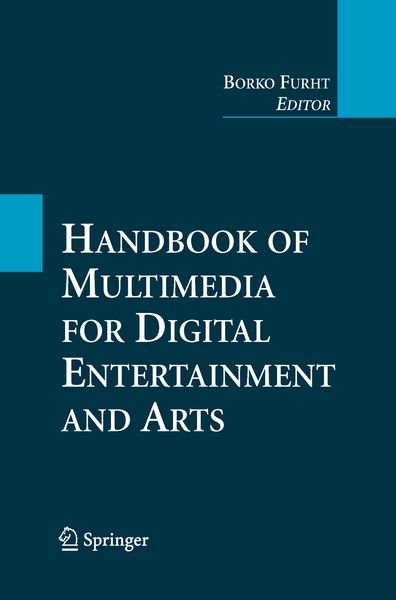
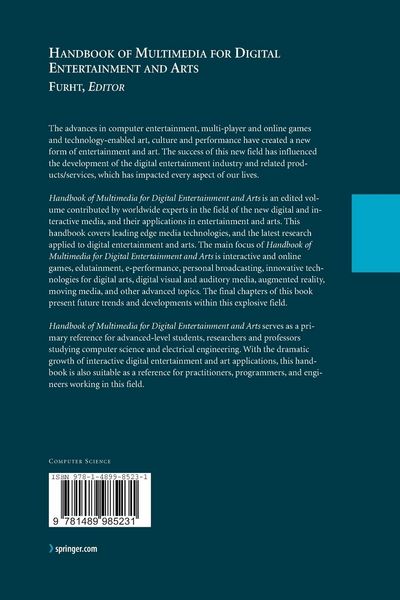
Handbook of Multimedia for Digital Entertainment and Arts

12% sparen

192,99 € UVP 219,99 €

inkl. gesetzl. MwSt., Versandkostenfrei


Beschreibung

Produktdetails

Einband

Taschenbuch

Erscheinungsdatum

06.09.2014

Herausgeber

Borko Furht

Verlag

Springer Us

Seitenzahl

769

Maße (L/B/H)

23,5/15,5/4,2 cm

Gewicht

1171 g

Auflage

2009

Sprache

Englisch

ISBN

978-1-4899-8523-1

Beschreibung

Rezension

From the reviews:

“This handbook is a good collection of the latest research papers on digital entertainment … . The target audience includes post-graduates, research scholars, and teachers of computing, electronics, and electrical engineering, as well as programmers in the field of digital art and edutainment. A sound literature review and a helpful index are a plus.” (Soubhik Chakraborty, ACM Computing Reviews, August, 2010)

Portrait

The list of contributors includes:

Jakob Abesser, Fraunhofer Institute, Ilmenau, Germany

Harry Agius, Brunel University, Uxbridge, United Kingdom

Dewan Tanvir Ahmed, University of Ottawa, Ottawa, Canada

Salah Uddin Ahmed, Norwegian University of Science and Technology, Norway

Marios Angelides, Brunel University, Uxbridge, United Kingdom

Lora Aroyo, Eindhoven University of Technology, Eindhoven, The Netherlands

Shumeet Baluja, Google, Mountain View, CA, USA

Pieter Bellekens, Eindhoven University of Technology, Eindhoven, The Netherlands

Oliver Bimber, Bauhaus University, Weimar, Germany

Leslie Bishko, Emily Carr University, Vancouver, Canada

Alan Bovik, University of Texas at Austin, Austin, Texas, USA

Karlheinz Brandenburg, Fraunhofer Institute, Ilmenau, Germany

Pedro Sergio Branco, University of Minho, Guimaraes, Portugal

Anthony Brooks, Aalborg University, Esbjerg, Denmark

Siwoo Byun, Anyang University, Anyang, Korea

Yiwei Cao, Technical University of Aachen, Aachen, Germany

Cristoforo Camerano, University of Catania, Italy

Petros Caravelas, Athens University of Economics and Business, Athens, Greece

Matina Charami, Athens University of Economics and Business, Athens, Greece

Michele Covell, Google, Mountain View, CA, USA

Christian Dittmar, Fraunhofer Institute, Ilmenau, Germany

Peter Dunker, Fraunhofer Institute, Ilmenau, Germany

Magy Seif El-Nasr, Simon Fraser University, Vancouver, Canada

Stefano Ferretti, University of Bologna, Bologna, Italy

Michael Fink, The Hebrew University of Jerusalem, Israel

Jenneke Fokker, Delft University of Technology, Delft, The Netherlands

Luigi Fortuna, University of Catania, Italy

Mattia Frasca, University of Catania, Italy

Yeung Siu Fung, The Chinese University of Hong Kong, Ma Liu Shui, China

Marco Furini, University of Modena and Reggio Emilia, Italy

Daniel Gartner, Fraunhofer Institute, Ilmenau, Germany

Holger Grossmann, Fraunhofer Institute, Ilmenau, Germany

Matthias Gruhne, Fraunhofer Institute, Ilmenau, Germany

Ian Gwilt, University of Technology, Sydney, Australia

Masaki Hoshino, Sony Corporation, Tokyo, Japan

Geert-Jan Houben, Eindhoven University of Technology, Eindhoven, The Netherlands

Wolfgang Hürst, Utrecht University, Utrecht, The Netherlands

Letizia Jaccheri, Norwegian University of Science and Technology, Norway

Matthias Jarke, Technical University of Aachen, Aachen, Germany

Sung Ho Jin, Information and Communications University, Daejeon, Korea

Yohan Jin, University of Texas at Dallas, Texas, USA

Naoki Kamimaeda, Sony Corporation, Tokyo, Japan

Mohan Kankanhalli, National University of Singapore, Singapore

Munchurl Kim, Information and Communication University, Daejeon, Korea

Munjo Kim, Information and Communication University, Daejeon, Korea

Ralf Klamma, Technical University of Aachen, Aachen, Germany

Bumshik Lee, Information and Communication University, Daejeon, Korea

Han Kyu Lee, Electronics and Telecommunications Research Institute, Daejeon, Korea

Heekyung Lee, Electronics and Telecommunications Research Institute, Daejeon, Korea

In-Kwon Lee, Yonsei University, Seoul, Korea

George Lekakos, Athens University of Economics and Business, Athens, Greece

Hua-Fu Li, Kainan University, Taoyuan, Taiwan

Jeongyeon Lim, Information and Communication University, Daejeon, Korea

John C.S. Lui, The Chinese University of Hong Kong, Ma Liu Shui, China

Rastislav Lukac, Epson Canada Ltd., Toronto, Canada

Hanna Lukashevich, Fraunhofer Institute, Ilmenau, Germany

Aderito Fernandes Marcos, University of Minho, Guimaraes, Portugal

David Milam, Simon Fraser University, Surrey, Canada

Manuela Montangero, University of Modena and ReggioEmilia, Italy

Anush K. Moorthy, University of Texas at Austin, Austin, Texas, USA

Michael Nixon, Simon Fraser University, Vancouver, Canada

Stefanie Nowak, Fraunhofer Institute, Ilmenau, Germany

Johan Pouwelse, Delft University of Technology, Delft, The Netherlands

B. Prabhakaran, University of Texas at Dallas, Texas, USA

Marcel Reinders, Delft University of Technology, Delft, The Netherlands

Yong Man Ro, Information and Communications University, Daejeon, Korea

Graham Sellers, Advanced Micro Devices, Orlando, Florida, USA

Kalpana Seshadrinathan, University of Texas at Austin, Austin, Texas, USA

Shervin Shirmohammadi, University of Ottawa, Ottawa, Canada

Anastas Sofokleus, Brunel University, Uxbridge, United Kingdom

Sara Owsley Sood, Pomona College, Claremont, CA, USA

Flavia Sparacino, Sensing Places and MIT, Santa Monica, CA, USA

Myunghoon Suk, University of Texas at Dallas, Texas, USA

Tomohiro Tsunoda, Sony Corporation, Tokyo, Japan

Athanasios Vasiliakos, University of Peloponnese, Nauplion, Greece

Arjen de Vries, CWI, Amsterdam, The Netherlands

Ron Wakkary, Simon Fraser University, Surrey, Canada

Jun Wang , Delft University of Technology, Delft, The Netherlands

Huaxin Wei, Simon Fraser University, Vancouver, Canada

Kay Wolter, Fraunhofer Institute, Ilmenau, Germany

Linxing Xiao, Tsinghua University, Beijing, China

WeiQi Yan, Queen’s University of Belfast, Belfast, UK

Xubo Yang, Shanghai Jiao Tong University, Shanghai, China

Jong-Chul Yoon, Yonsei University, Seoul, Korea

Damon Daylamani Zad, Brunel University, Uxbridge, United Kingdom

Nelson Troca Zagalo, University of Minho, Braga, Portugal

Veronica Zammitto, Simon Fraser University, Vancouver, Canada

Jie Zhou, Tsinghua University, Beijing, China

Produktdetails

Einband

Taschenbuch

Erscheinungsdatum

06.09.2014

Herausgeber

Borko Furht

Verlag

Springer Us

Seitenzahl

769

Maße (L/B/H)

23,5/15,5/4,2 cm

Gewicht

1171 g

Auflage

2009

Sprache

Englisch

ISBN

978-1-4899-8523-1

Herstelleradresse

Springer-Verlag KG
Sachsenplatz 4-6
1201 Wien
AT

Email: GPSR Kontakt

Noch keine Bewertungen vorhanden

Verfassen Sie die erste Bewertung zu diesem Artikel

Helfen Sie anderen Kundinnen und Kunden durch Ihre Meinung.

Kundinnen und Kunden meinen

Bewertungen (0)

  • Produktbild: Handbook of Multimedia for Digital Entertainment and Arts
  • Produktbild: Handbook of Multimedia for Digital Entertainment and Arts
  • PART I – DIGITAL ENTERTAINMENT TECHNOLOGIES
    Topics will include:

    Digital entertainment systems and their performance

    Interactive Digital Entertainment Unification framework

    Networked and free-standing interactive computer games

    Massive multi-player online games

    E-performance: e-Opera, e-Theatre, e-Concert

    Wearable computing for entertainment purposes

    Telepresence for entertainment and education purposes

    Entertainment robotics

    Development of haptic devices

    Home automation

    Novel interactive entertainment applications

    PART II –NEW MEDIA EMERGING TECHNOLOGIES
    Topics will include:

    Digital consumer networks

    Personal broadcasting

    Novel applications for mobile phones

    Social and interactive computing applications

    Collaborative spaces and environments

    Media technologies applied in the arts

    Mixed reality and enhanced visualization

    Adaptive media and AI

    Augmented reality

    Interactive music

    Video annotation in multimedia entertainment

    PART III – DIGITAL ART
    Topics will include:

    Algorithmic art

    Software art

    Net art

    Tangible computing

    Sonic Art

    Graphical user interface in art applications

    Virtual reality systems for 3D digital art

    PART IV – DIGITAL VISUAL AND AUDITORY MEDIA
    Topics will include:

    Digital photography

    Digital imaging asart

    Advances in 3D modeling

    Digital printing

    Non-photorealistic rendering

    Digital sound and music

    Digital music synthesis and composition

    Graphics and animation

    Digital comics

    Software & hardware implementations

    Digital video

    Interactive movies

    Interactive television and cinema

    PART V – CULTURE OF NEW MEDIA
    Topics will include:

    Digital lifestyle

    Managing digital entertainment

    Philosophy of new media

    Digital identity

    New human-computer interaction models