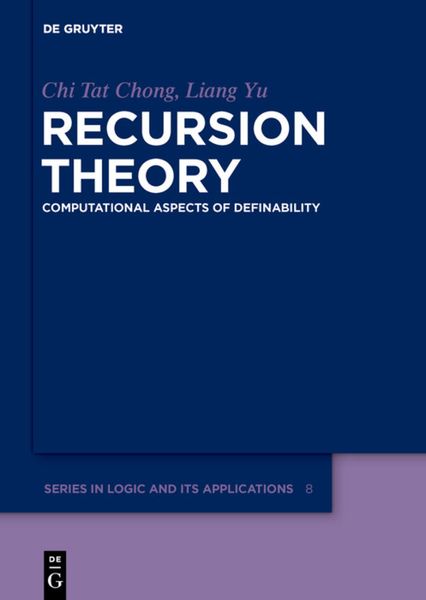
Recursion Theory Computational Aspects of Definability
169,99 €
inkl. gesetzl. MwSt.,
Beschreibung
Produktdetails
Einband
Gebundene Ausgabe
Erscheinungsdatum
30.07.2015
Abbildungen
10 schw.-w. Abb.
Verlag
De GruyterSeitenzahl
306
Maße (L/B/H)
24,6/17,5/2,3 cm
Gewicht
665 g
Auflage
1
Sprache
Englisch
ISBN
978-3-11-027555-1
This monograph presents recursion theory from a generalized point of view centered on the computational aspects of definability. A major theme is the study of the structures of degrees arising from two key notions of reducibility, the Turing degrees and the hyperdegrees, using techniques and ideas from recursion theory, hyperarithmetic theory, and descriptive set theory.
The emphasis is on the interplay between recursion theory and set theory, anchored on the notion of definability. The monograph covers a number of fundamental results in hyperarithmetic theory as well as some recent results on the structure theory of Turing and hyperdegrees. It also features a chapter on the applications of these investigations to higher randomness.
Noch keine Bewertungen vorhanden
Verfassen Sie die erste Bewertung zu diesem Artikel
Helfen Sie anderen Kundinnen und Kunden durch Ihre Meinung.
Kurze Frage zu unserer Seite
Vielen Dank für Ihr Feedback
Wir nutzen Ihr Feedback, um unsere Produktseiten zu verbessern. Bitte haben Sie Verständnis, dass wir Ihnen keine Rückmeldung geben können. Falls Sie Kontakt mit uns aufnehmen möchten, können Sie sich aber gerne an unseren Kund*innenservice wenden.
zum Kundenservice