Gutscheinbedingungen

**Gültig bis 14.09.2026 auf Spielzeug, Schreibwaren, Filme, Geschenke & Trends, Musik, tolino eReader & Zubehör, Hörbücher, nicht preisgebundene Bücher und Kalender in der Thalia App. Einzelne Artikel können ausgeschlossen sein. Aufgrund der Buchpreisbindung sind deutschsprachige Bücher und eBooks ausgenommen. Zusätzlich ausgenommen sind Abos & Flatrates, Games, Geschenkkarten/-boxen, Shelfies, Software, Zeitschriften sowie einzelne Artikel von tonies®. Pro Einkauf einmal einlösbar. Nur gültig mit im Onlineshop hinterlegter Bonuscard. Click & Collect nur bei Onlinevorabzahlung möglich. Keine Barauszahlung. Nicht kombinierbar mit anderen Aktionen und Gutscheinen. Gutschein wird auf max. 500€ Bestellwert angerechnet. Nicht gültig für Versandkosten und Services.

  • Produktbild: Nutrient Use Efficiency: from Basics to Advances
  • Produktbild: Nutrient Use Efficiency: from Basics to Advances
- 12%

Nutrient Use Efficiency: from Basics to Advances

12% sparen

144,99 € UVP 164,99 €

inkl. gesetzl. MwSt., Versandkostenfrei


Beschreibung

Produktdetails

Einband

Gebundene Ausgabe

Erscheinungsdatum

14.01.2015

Abbildungen

XXIII, 417 p. 57 illus., 29 illus. in color.

Herausgeber

Amitava Rakshit + weitere

Verlag

Springer India

Seitenzahl

417

Maße (L/B/H)

26/18,3/3 cm

Gewicht

1027 g

Auflage

2015

Sprache

Englisch

ISBN

978-81-322-2168-5

Beschreibung

Portrait


Amitava Rakshit
, an IIT, Kharagpur alumnus is presently the faculty member in the Department of Soil Science and Agricultural Chemistry at Institute of Agricultural Sciences, Banaras Hindu University(IAS, BHU). Dr. Rakshit worked in the Department of Agriculture, Government of West Bengal in administration and extension roles. He has visited Norway, Finland, Denmark, France, Austria, Russia, Thailand, Egypt, Turkey pertaining to his research work and presentation. He was awarded with TWAS Nxt Fellow (Italy), Biovision Nxt Fellow (France), Darwin Now Bursary (British Council), Young Achiever Award and Best Teacher’s Award at UG and PG level (BHU & ICAR, New Delhi). He is serving as review college member of British Ecological Society, London since 2011. He has published 70 research papers, 15 book chapters, 28 popular articles, one manual and co authored five books.

Avijit Sen
is presently Professor and Head in the Department of Agronomy, IAS, BHU. He has presented more than 40 research papers and delivered lectures in conferences/seminars/refresher courses within and outside the country besides handling 5 ad-hoc projects. Currently he is the Deputy Coordinator of the prestigious Special Assistance Programme awarded to the Department by UGC. He is recipient of CWSS Gold Medal 2013. With 33 years of experience, he has published more than 60 research papers and articles, and written 3 chapters of books till date.

Harikesh  B.  Singh
  is  presently Professor  of  Mycology  and  Plant  Pathology  at  IAS, BHU. He served State Agriculture University, Central University and CSIR Institute in teaching, research, and extension roles. In recognition of Prof. Singh’s scientific contributions and leadership in the field of plant pathology, he was honored with several prestigious awards, notable being, CSIR Prize for Biological Sciences, Vigyan Bharti Award, Prof. V.P. Bhide Memorial Award, BRSI Industrial Medal Award, Bioved Fellowship Award, Prof. Panchanan Maheshwari, IPS Plant Pathology Leader Award, CSIR–CAIRD Team award, Environment Conservation Award, CST Vigyan Ratna Award and many more. Dr. Singh  has  been  the Fellow  of  National  Academy  of  Agricultural  Sciences. Prof. Singh has written two  books,  several  training  modules  and  manuals  and  more  than 150  research  publications  and  has  more than 18 US patents and 3 PCTs to his credit.

Produktdetails

Einband

Gebundene Ausgabe

Erscheinungsdatum

14.01.2015

Abbildungen

XXIII, 417 p. 57 illus., 29 illus. in color.

Herausgeber

Verlag

Springer India

Seitenzahl

417

Maße (L/B/H)

26/18,3/3 cm

Gewicht

1027 g

Auflage

2015

Sprache

Englisch

ISBN

978-81-322-2168-5

Herstelleradresse

Springer-Verlag KG
Sachsenplatz 4-6
1201 Wien
AT

Email: ProductSafety@springernature.com

Noch keine Bewertungen vorhanden

Verfassen Sie die erste Bewertung zu diesem Artikel

Helfen Sie anderen Kundinnen und Kunden durch Ihre Meinung.

Kundinnen und Kunden meinen

Bewertungen (0)

Die Leseprobe wird geladen.
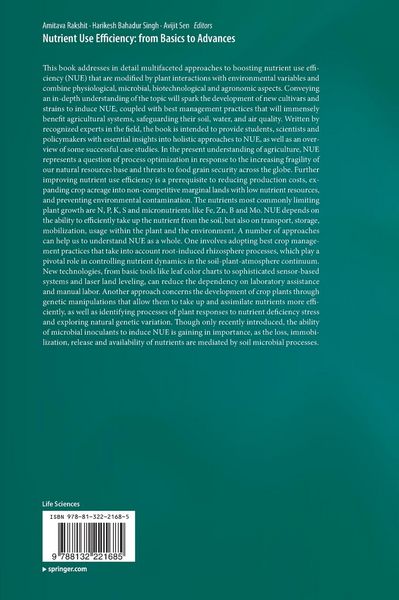
  • Produktbild: Nutrient Use Efficiency: from Basics to Advances
  • Produktbild: Nutrient Use Efficiency: from Basics to Advances

  • Chapter 1: Nutrient use efficiency in plants: an overview.- Part I: Nutrients as a Key Driver of Nutrient Use Efficiency.- Chapter 2: Soils and Inputs Management Options for Increasing Nutrient Use Efficiency.- Chapter 3:

    Nutrient and water use efficiency in soil: The influence of geological mineral amendments.- Chapter 4: Resource conserving techniques for improving nitrogen use-efficiency.- Chapter 5: Strategies for enhancing phosphorus efficiency in crop production systems.- Chapter 6: Efficiency of soil and fertilizer phosphorus use in time: a comparison between recovered struvite, FePO
    4
    -sludge, digestate, animal manure and synthetic fertilizer.- Chapter 7: Strategies for Enhancing Zinc Efficiency in Crop Plants.- Chapter 8: Nitrification inhibitors: classes and its use in nitrification management.- Part-II: Microbiological aspects of Nutrient Use Efficiency.- Chapter 9: Role of Microorganisms in Plant Nutrition and Health.- Chapter 10: Role of Cyanobacteria inNutrient Cycle and Use Efficiency in the Soil.- Chapter 11:
    Trichoderma
    improves nutrient use efficiency in crop plants.- Chapter 12: Bio-priming mediated nutrient use efficiency of crop species.- Chapter 13: Unrealized potential of seed biopriming for versatile agriculture.- Part-III: Molecular and physiological aspects of Nutrient Use Efficiency.- Chapter 14: Improving nutrient use efficiency by exploiting genetic diversity of crops.- Chapter 15: Micro RNA based approach to improve nitrogen use efficiency in plants.- Chapter 16: Biofortification for selecting and developing crop cultivars denser in iron and zinc.- Chapter 17: Understanding genetic and molecular bases of Fe and Zn accumulation towards development of micronutrient enriched maize.- Part-IV: Nutrient Use Efficiency of Crop Species.- Chapter 18: Nitrogen uptake and use efficiency in rice.- Chapter 19: Nutrient-use efficiency in Sorghum.- Chapter 20: Improving nutrient use efficiency in oilseeds Brassica.- Chapter21: Strategies for higher nutrient use efficiency and productivity in forage crops.- Chapter 22: Integrated nutrient management in potato for increasing nutrient use efficiency and sustainable productivity.- Part-V: Specialised Case Studies.- Chapter 23: Enhancing Nutrient Use Efficiencies in Rainfed Systems.- Chapter 24: Dynamics Of Plant Nutrients, Utilization And Uptake, And Soil Microbial Community In Crops Under Ambient And Elevated Carbon Dioxide.- Chapter 25: Phytometallophore Mediated Nutrient Acquisition by Plants.