Gutscheinbedingungen

**Gültig nur für Bestellungen an die Wunsch-Poststation bis 10.06.2026 auf Spielzeug, Schreibwaren, Filme, Geschenke & Trends, Musik, tolino eReader & Zubehör, Hörbücher und Hörbuch-Downloads (außer Abo), nicht preisgebundene Bücher und Kalender online auf thalia.at und in der Thalia App. Einzelne Artikel können ausgeschlossen sein. Aufgrund der Buchpreisbindung sind deutschsprachige Bücher und eBooks ausgenommen. Zusätzlich ausgenommen sind preisgebundene Artikel, Abos & Flatrates, eBooks, Games, Geschenkkarten/-boxen, Shelfies, Software, Zeitschriften sowie einzelne Artikel von tonies®. Pro Einkauf einmal einlösbar. Kein Click & Collect möglich. Keine Barauszahlung. Nicht kombinierbar mit anderen Aktionen und Gutscheinen. Gutschein wird auf max. 500€ Bestellwert angerechnet. Nicht gültig für Versandkosten und Services.

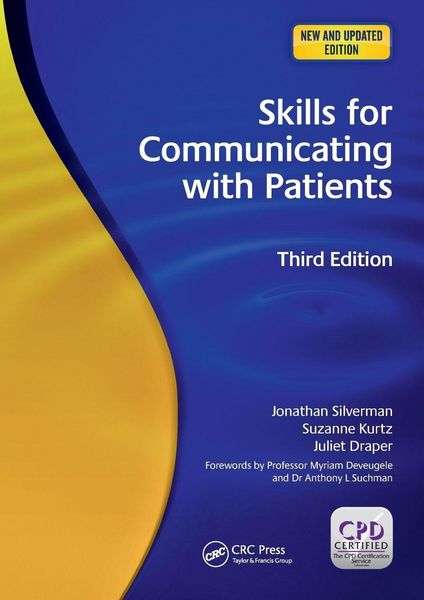
  • Produktbild: Skills for Communicating with Patients
  • Produktbild: Skills for Communicating with Patients

Skills for Communicating with Patients 3rd Revised Edition

64,99 €

inkl. gesetzl. MwSt., Versandkostenfrei


Beschreibung

Produktdetails

Einband

Taschenbuch

Erscheinungsdatum

28.09.2013

Verlag

Taylor & Francis

Seitenzahl

328

Maße (L/B/H)

24,6/17,4/1,8 cm

Gewicht

1300 g

Auflage

3. Auflage

Sprache

Englisch

ISBN

978-1-84619-365-1

Beschreibung

Rezension

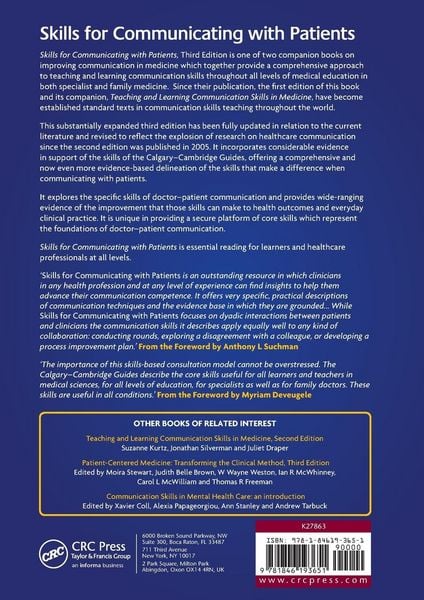
"... an outstanding resource in which clinicians in any health profession and at any level of experience can find insights to help them advance their communication competence. It offers very specific, practical descriptions of communication techniques and the evidence base in which they are grounded..."
-Anthony L. Suchman (in the Foreword)

"The importance of this skills-based consultation model cannot be overstressed. The Calgary-Cambridge Guides describe the core skills useful for all learners and teachers in medical sciences, for all levels of education, for specialists as well as for family doctors. These skills are useful in all conditions."
-Myriam Deveugele (in the Foreword)

Produktdetails

Einband

Taschenbuch

Erscheinungsdatum

28.09.2013

Verlag

Taylor & Francis

Seitenzahl

328

Maße (L/B/H)

24,6/17,4/1,8 cm

Gewicht

1300 g

Auflage

3. Auflage

Sprache

Englisch

ISBN

978-1-84619-365-1

Herstelleradresse

Libri GmbH
Europaallee 1
36244 Bad Hersfeld
DE

Email: gpsr@libri.de

Kundinnen und Kunden meinen

0 Bewertungen

Informationen zu Bewertungen

Zur Abgabe einer Bewertung ist eine Anmeldung im Konto notwendig. Die Authentizität der Bewertungen wird von uns nicht überprüft. Wir behalten uns vor, Bewertungstexte, die unseren Richtlinien widersprechen, entsprechend zu kürzen oder zu löschen.

Die Bewertungen sind nach Format, Anzahl Sterne und Datum sortiert.

Verfassen Sie die erste Bewertung zu diesem Artikel

Helfen Sie anderen Kund*innen durch Ihre Meinung

Kundinnen und Kunden meinen

0 Bewertungen filtern

Die Leseprobe wird geladen.
  • Produktbild: Skills for Communicating with Patients
  • Produktbild: Skills for Communicating with Patients
  • Foreword by Myriam Deveugele vi Foreword by Anthony L Suchman viii Preface to the third edition x Preface to the second edition xi About this book xv About the authors xvi Acknowledgements xvii Introduction 1 1 Defi ning what to teach and learn: an overview of the communication skills curriculum 7 Introduction 7 More effective consultations 8 Improved health outcomes 8 A collaborative partnership 9 Plan of chapter 10 Types of communication skills and how they interrelate 10 The problem of separating content and process skills in teaching and learning about the medical interview 12 An overall curriculum of doctor-patient communication skills 14 The Calgary-Cambridge Guide 14 The enhanced Calgary-Cambridge Guides 16 The need for a clear overall structure 27 Choosing the process skills to include in the communication curriculum 29 The research and theoretical basis that validates the inclusion of each individual skill 30 Underlying goals and principles of communication that helped in choosing the skills 31 Skills and individuality 32 Relating specifi c issues to core communication skills 33 Summary 34 2 Initiating the session 35 Introduction 35 Problems in communication 35 Objectives 36 Skills 37 'What' to teach and learn about the initiation: the evidence for the skills 38 Preparation 38 Establishing initial rapport 39 Identifying the reason(s) for the consultation 42 Summary 57 3 Gathering information 59 Introduction 59 Problems in communication 59 Objectives 61 The content of information gathering in medical interviews 62 The traditional medical history 62 The disease-illness model 64 An alternative template for the content of the informationgathering section of the interview 69 The process skills of information gathering 72 Exploration of the patient's problems 73 Additional skills for understanding the patient's perspective 88 Putting the process skills of information gathering together 101 The complete versus the focused history in information gathering 103 The effect of clinical reasoning on the process of information gathering 106 Summary 108 4 Providing structure to the interview 109 Introduction 109 Objectives 110 Skills 111 'What' to teach and learn about providing structure: the evidence for the skills 112 Making organisation overt 112 Attending to fl ow 117 Summary 118 5 Building the relationship 119 Introduction 119 Problems in communication 122 Objectives 123 Skills 124 'What' to teach and learn about building the relationship: the evidence for the skills 125 Using appropriate non- verbal communication 125 Developing rapport 133 Involving the patient 146 Summary 148 6 Explanation and planning 149 Introduction 149 Problems in communication 149 Objectives 155 The content of explanation and planning 156 The process skills of explanation and planning 157 Providing the correct amount and type of information 161 Aiding accurate recall and understanding 171 Achieving a shared understanding - incorporating the patient's perspective 177 Planning - shared decision making 188 Options in explanation and planning 207 Summary: explanation and planning is an interactive process 213 7 Closing the session 215 Introduction 215 Objectives 215 The process skills for closing the session 216 'What' to teach and learn about endings: the evidence for the skills 217 Summary 221 8 Relating specifi c issues to core communication skills 223 Introduction 223 Specifi c issues 224 Breaking bad news 224 Cultural and social diversity 233 Age- related issues 240 - communicating with older patients 241 - communicating with children and parents 244 The telephone interview 248 Patients with mental illness 251 Medically unexplained symptoms 259 Other communication issues 260 Further reading 261 References 263 Index 295 Author index 302