Gutscheinbedingungen

**Gültig bis 02.09.2026 auf fremdsprachige Bücher in der Thalia App. Einzelne Artikel können ausgeschlossen sein. Ausgenommen sind preisgebundene Artikel & eBooks. Pro Einkauf einmal einlösbar. Click & Collect nur bei Onlinevorabzahlung möglich. Keine Barauszahlung. Nicht kombinierbar mit anderen Aktionen und Gutscheinen. Gutschein wird auf max. 500€ Bestellwert angerechnet. Nicht gültig für Geschenkkarten, Versandkosten und Services.

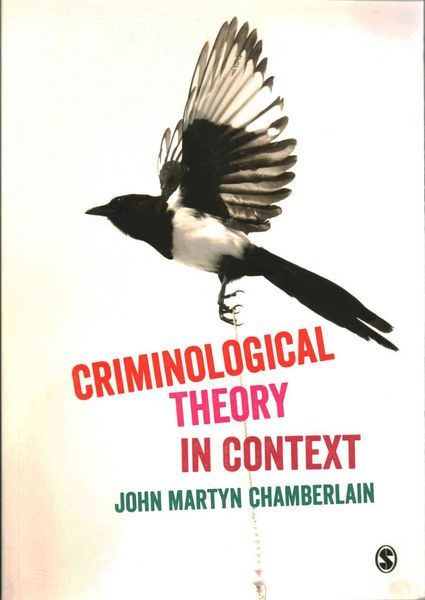
  • Produktbild: Criminological Theory in Context
  • Produktbild: Criminological Theory in Context

Criminological Theory in Context An Introduction

44,99 €

inkl. gesetzl. MwSt., Versandkostenfrei


Beschreibung

Produktdetails

Einband

Taschenbuch

Erscheinungsdatum

19.01.2015

Verlag

Sage Publications

Seitenzahl

232

Maße (L/B/H)

24,4/17/1,3 cm

Gewicht

409 g

Sprache

Englisch

ISBN

978-1-4462-6987-9

Beschreibung

Rezension

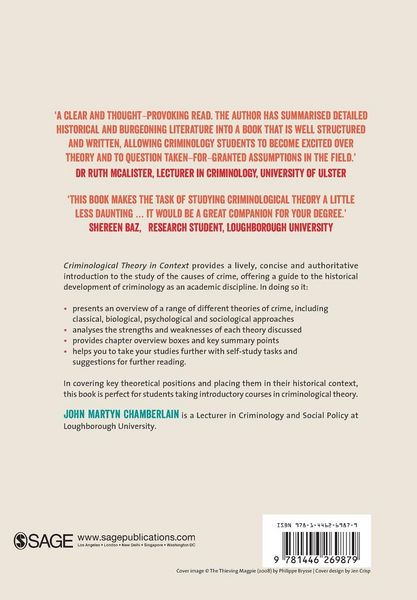
This book makes the task of studying criminological theory a little less daunting it would be a great companion for your degree
Shereen Baz

Produktdetails

Einband

Taschenbuch

Erscheinungsdatum

19.01.2015

Verlag

Sage Publications

Seitenzahl

232

Maße (L/B/H)

24,4/17/1,3 cm

Gewicht

409 g

Sprache

Englisch

ISBN

978-1-4462-6987-9

EU-Ansprechpartner

Zeitfracht Medien GmbH
Ferdinand-Jühlke-Straße 7|99095|Erfurt|DE

Herstelleradresse

SAGE Publications
1 Oliver's Yard 55 City Road|EC1Y 1SP|London|GB

Noch keine Bewertungen vorhanden

Verfassen Sie die erste Bewertung zu diesem Artikel

Helfen Sie anderen Kundinnen und Kunden durch Ihre Meinung.

Kundinnen und Kunden meinen

Bewertungen (0)

  • Produktbild: Criminological Theory in Context
  • Produktbild: Criminological Theory in Context
  • Chapter 1: Studying Criminal Life
    Crime and society: an introduction
    Researching criminal life: the place of theories of crime
    Chapter 2: Classical Criminology and Contemporary Rational Choice Theory
    Introduction: the reasoning criminal and the social contract
    Society, crime and punishment
    Classical criminology and crime deterrence
    Neoclassical criminology
    Critiquing Classical/Neoclassical criminology: does deterrence work?
    Contemporary rational choice theory
    Situational crime prevention, opportunity theory and routine activity
    Chapter 3: Biological Criminology
    Introduction: Classicism, positivism and the development of Biological forms of criminology
    Physiognomy and phrenology
    Lombroso and atavism
    Lombroso's heritage: in search of the criminal type
    Genes and crime
    Brain development, injuries and mapping
    Biochemistry, hormones, diet and crime
    Chapter 4: Psychological Criminology
    Introduction: the Classical school and Psychological and Biological theories of crime
    Freud and personality development
    Eysenck, dimensions of personality and criminal behaviour
    Sutherland, differential association theory and social learning
    Psychological criminology and mentally disordered offenders
    Chapter 5: Strain Theory, Social Disorganisation Theory and Labelling Theory
    Introducing the sociological study of criminal life
    Durkheim: social facts, social solidarity and anomie
    Merton and Agnew: anomie and Strain Theory
    Park and Burgess: Social Disorganisation Theory and the Broken Windows hypothesis
    Mead and Blumer: symbolic interactionism and Labelling Theory
    Lemert, Becker and Erikson: towards the sociology of deviance
    Restorative justice and Braithwaite's Reintegrative Shaming Theory
    Chapter 6: Critical Criminology, Part 1: Marxist, Peacemaking and Realist Theories of Crime
    Determinism and free will in sociological forms of criminology
    Critical criminology: a conflict theory of society
    Critical criminology and the duality of structure
    Karl Marx and Willem Bonger: towards a Marxist theory of crime
    Marxist criminology: crime as a rational response to the conditions of capitalism
    Peacemaking criminology
    Left and Right Realist criminology
    Chapter 7: Critical Criminology, Part 2: Feminist and Cultural Criminology
    Critical criminology and Feminist and Cultural theories of crime
    The feminist critique of 'malestream' criminology
    Marxism and Feminist criminology
    The growth of female offending: power/control theory, the liberation opportunity thesis and the economic marginalisation thesis
    Feminism, masculinity studies and contemporary Critical criminology: highlighting the importance of gender, race and class
    Cultural criminology
    Chapter 8: Postmodern Critical Standpoints and the Criminal Life Course
    Introduction: Critical criminology revisited
    Positivism and realism, postmodernism and anti-realism
    Life Course criminology
    Chapter 9: Reflecting on Theories of Crime, Theories of Human Nature: Crime in the Age of the Enterprising Risky Citizen-subject
    From modernity to high modernity
    The neoliberal enterprise form and the criminal justice system
    Conclusion: reflecting on theories of crime and theories of human nature