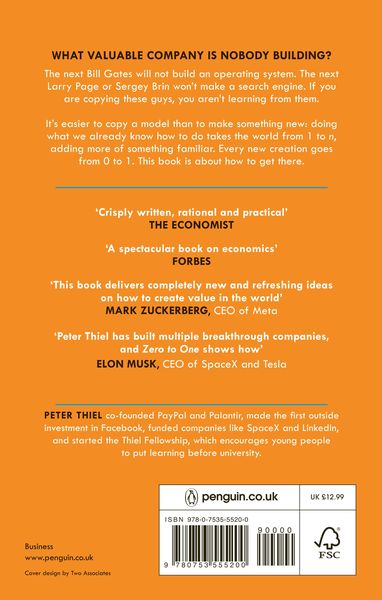
The next Bill Gates will not build an operating system. The next Larry Page or Sergey Brin won't make a search engine. If you are copying these guys, you aren't learning from them. It's easier to copy a model than to make something new: doing what we already know how to do takes the world from 1 to n, adding more of something familiar. Every new creation goes from 0 to 1. This book is about how to get there.
'Peter Thiel has built multiple breakthrough companies, and Zero to One shows how.' ELON MUSK, CEO of SpaceX and Tesla
'This book delivers completely new and refreshing ideas on how to create value in the world.' MARK ZUCKERBERG, CEO of Facebook
'When a risk taker writes a book, read it. In the case of Peter Thiel, read it twice. Or, to be safe, three times. This is a classic.' NASSIM NICHOLAS TALEB, author of The Black Swan
Kundinnen und Kunden meinen
4.1/5.0
Bewertung
4/5
07.11.2023
Buch (Taschenbuch)
Critical Review
The book «Zero to One» by Peter Thiel is a book about starting new and unique businesses. It’s based on Thiel’s own experiences and ideas. The book helps understand the difficulties and challenges that one has to think about when starting a new company in today’s competitive world. However, it doesn’t give a clear, step-by-step guide on how to start a business. In this review, I will look at what the strengths and weaknesses of the book are and where it falls short.
I will start with some of the strengths the book has. First of all, the book gives a clear understanding of startup challenges. Peter Thiel himself is the co-founder of PayPal and an investor in many successful startups like Facebook & Linked- In, which allows him to understand the difficulties of starting a company. In his book he deeply explores the problems startups face when they are just starting out. He uses his real experiences to make his points stronger and more believable. He also emphasizes how important it is for startups to create something truly unique and valuable in a crowded market, since many startups fail in the first few years because of this reason. This idea is crucial for new entrepreneurs, as it helps them understand the business world better.
Secondly the book provides a full list of things that startups need to think about when they begin their journey. Thiel has experienced many of these factors firsthand. He talks about the significance of technology, how networks work, distribution, and the monopoly model. By explaining these important elements and many more, he gives a complete picture of what’s needed for a successful startup.
Thirdly he highlights the importance of thinking long- term and creating value rather than thinking in short-terms. Thiel emphasizes looking at the big picture instead of just short-term gains. Drawing from his own experiences in helping and investing in startups, he stresses the value of creating businesses that last and aren’t affected by short-lived trends. This is especially important in a world where people often focus on quick profits.
The most important part for me is where Thiel writes about the common mistakes that startups do. He talks about competition, innovation and the role of technology in shaping our world. I think that every startup should read this book before creating a business so they won’t make easily avoidable mistakes.
After discussing all the strengths, the book brings with it I have also noticed some weak links. First of all, I was hoping on getting a more step-by-step guide on how to start a business. It offers valuable insights into the theoretical aspects of entrepreneurship but lacks concrete guidance on the practical steps to take when launching a startup.
With that said I am getting to my second point which is that Thiel mostly talks about big ideas and strategies, which might not be very hands- on or practical for people starting businesses. It’s like having a lot of theories but not a clear step-by-step guide.
Lastly the book is based a lot on his own experiences as a successful entrepreneur and investor. This means it might not fit well for people from different backgrounds and industries. While his insights are helpful, they might not cover all the specific needs and problems that different entrepreneurs face.
To conclude in my opinion the book gives a very good overview on how the economy works and what challenges startups are most likely to experience. It also provides us with helpful information on how a startup can survive in this fierce economy we live in. Besides that I would suggest also reading books that go more in depth about how to actually start a business and give some clear roadmap with a step-by-step guide.
By Celina Fröhli
Bewertung
4/5
30.10.2023
Buch (Taschenbuch)
Zero to One review by Aydin Dib
"Zero to One," penned by entrepreneur and investor Peter Thiel, is a thought-provoking exploration into the world of startups, innovation, and the quest for creating something entirely new. Thiel, a co-founder of PayPal and an early investor in Facebook, leverages his profound experiences to present unconventional wisdom about building successful startups.
The book's title, "Zero to One," encapsulates its central thesis: true innovation occurs when we create something entirely new (going from zero to one), as opposed to merely iterating on existing models (going from one to n). This concept is both challenging and invigorating. In an age where replication and iteration are often celebrated, Thiel prompts readers to think bigger, to strive for monopolies, and to carve out unique spaces in the market.
One of Thiel’s more controversial points is his advocacy for monopolies. In stark contrast to conventional economic teachings that praise competition, Thiel posits that monopolies (in the sense of companies offering unique, unmatched value) drive true innovation. Competitive markets, he argues, push companies into a survival mode, leaving little room for groundbreaking innovations. This viewpoint, while contrarian, is underpinned by compelling arguments, making readers reconsider widely accepted business axioms.
However, while Thiel’s insights are sharp and often refreshing, I found myself grappling with certain oversimplifications. His categorical dichotomy between "zero to one" and "one to n" innovations, for instance, may not account for the myriad shades of gray in the innovation landscape. Many successful products or services lie somewhere in between, blending novelty with iteration. A more nuanced discussion of these in-between spaces would have enriched his narrative.
Furthermore, the book is sprinkled with Thiel's unique perspectives on various subjects, from the importance of sales, the pitfalls of higher education, to the future of technology. While these insights are valuable, the book occasionally risks becoming a collection of Thiel's personal beliefs rather than a cohesive guide to startup innovation.
One of the book's standout sections is Thiel’s take on the importance of a strong founding team. He delves into the dynamics that make or break startup teams, emphasizing the significance of shared vision and robust interpersonal relationships. It's a sobering reminder that even the most groundbreaking ideas can falter without the right team to execute them.
"Zero to One" also poses a series of thought experiments and questions for aspiring entrepreneurs, nudging them to critically evaluate their ideas. Thiel’s famous interview question, "What important truth do very few people agree with you on?" captures the essence of his philosophy, urging readers to identify and pursue contrarian but valuable truths.
In conclusion, "Zero to One" is an essential read for anyone interested in startups and innovation. While it may occasionally come across as prescriptive or overly opinionated, its core message is undeniably powerful: true progress requires thinking differently and daring to venture where others haven't. Approaching Thiel's insights with an open yet critical mind ensures a balanced assimilation of the book's rich content, paving the way for innovative thinking and action.
A.S.
aus Zürich
4/5
07.11.2022
Buch (Taschenbuch)
The book titled "Zero to One:…
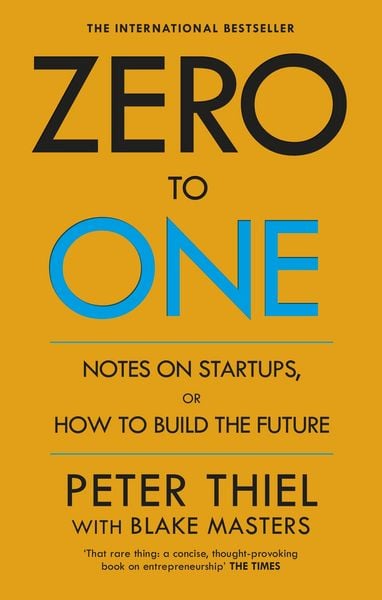
The book titled "Zero to One: Notes on Startups, or How to Build the Future", a non-fiction book written by Peter Thiel with Blake Masters and published in 2014, had been recommended to me many times by friends due to my interest in startups. Most recently, I had the chance to read the book as part of a course taught by Alex Mari at the University of Zurich. In the following I would like to review this book: Short summary of content: Peter Thiel, who by the way is a founder of PayPal and well-known venture capitalist, wrote this book about startups. In it, he shares his knowledge on how to take your startup from zero to one. It's well known that many people start up, but a large percentage of those who do fail. In his book, Thiel explains the reasons for this, such as the lack of courage to venture into something completely new and to develop a proper view of the future. His work gives helpful tips on how to create a business from scratch. Practically from zero to one, like his book title. Likewise, he shows how to get off the beaten business path and gives valuable tips to consider when creating a start-up. One of his basic ideas in this book is to see the present from different and unusual perspectives. Furthermore, he defines the term future in terms of what is now and what will be soon. Here he differentiates between horizontal progress (further development and expansion of existing ideas) & vertical progress (creating something completely new out of nothing). Another important topic in Thiel's book is the future. (As early as possible, parents try to set up their children broadly and diversely. Already at school age, parents want their children to learn Chinese and Spanish and, best of all, to learn to play several instruments). Because of the lack of ability to predict the future, which according to Thiel not even a fortune teller can predict, it is very difficult to prepare for it. Thiel explains in his book why it is even hopeless to prepare oneself diversely for the future. Thiel's opinion here is that "The future can only be seen by those who have mastered unconventional thinking." According to Thiel, however, there is only one best possible future for start-ups, and they must head straight for it. Anyone who believes that there is no more room for innovation in our high-tech society will be proven wrong by Thiel. Nevertheless, he will take away the belief in quick success from the over-enthusiastic and explain why a company needs many years to become successful and often first has to cover a great distance of hunger in order to become profitable for the first time after a few years. Furthermore, in "Zero to One" you learn why a good team is one of the most important factors in the formation of a stable startup and why corporate culture means more than just putting a foosball table in the workroom and having a barbecue every now and then. Thiel gives an example of how, as a founder of PayPal, he managed to introduce a corporate culture in which such a good working atmosphere prevailed that some employees later founded their own companies together. The last topic Thiel addresses is sales and why sales strategies are much more than just pure selling. He reveals how to put together a super sales team with unique sales ideas. Evaluation: Peter Thiel's book is highly recommended for all startup enthusiasts in my opinion. The topic of the book hit exactly my taste, as I am very interested in the start-up scene and would like to start one myself. Nevertheless, I have to say that due to my interest in this field, I was already familiar with some of the content that was addressed in the book. Nevertheless, the author goes into great detail about various tricks of the trade that you should definitely keep in mind when starting a business, which I think still makes the book worth reading even for those already interested in startups. In my opinion, the book does not necessarily read like a non-fiction book or a manual, but rather reflects Peter Thiel's subjective opinion and experience in most situations. Basically, however, I found it very exciting to dive into the mind of one of the most important founders of our time and to learn his methods, tips and tricks. The structure and flow of his book was, in my opinion, quite logical and comprehensible. Conclusion: All in all, I liked the book a lot. The book is a must-read for all startup enthusiasts who want to understand the thoughts of a super successful founder and startup investor. Nevertheless, the insight you get from reading this book strongly depends on the background of your own previous knowledge and experience. Nevertheless, I think everyone can get a message and added value from this one.
Bewertung
4/5
05.11.2022
Buch (Taschenbuch)
Mindopening view on economics and business
What is the book about?
Zero to one takes you through a short history of business and teaches you about 7 important questions that every startup should pose itself in corresponding chapters. Each question is carefully explained with examples that make the concepts easy to grasp and understand. At the end types of founders and their trades are discussed with a short view of the future in economics and how the world could develop.
Specific points that I learned from or I particularly liked/agreed with:
- Chapter about competitive market and monopoly was, as a business student, very eye opening. I learned about the theoretical part at university but not how businesses are effected in the real world. Quote form the book: “If you lose sight of competitive reality and focus on trivial differentiating factors – your business is unlikely to survive”
- Don’t be the first mover. Being thought the first mover advantage in school the insights in that specific part were thought provoking. The book talks about how it is much better to be the last mover. Being the first will do your business no good if a competitor unseats you. Finding a small niche dominate it and expand form there towards long term goals is much more beneficial.
- Equity as a form of compensation in place of cash. This is an automatic way to see if the person is committed to the company in a long run. Never really thought of this as a viable option but it may be the way to find people who are aligned with yourself.
- Hiring people that would actually enjoy working together. This may seem like a really mundane concept, but I strongly believe it to be true and also that itsometimes gets lost in big corporation where accolades are more important than durable relationships at the work place.
- Man and Machine Chapter 12; I often hear from the older generations that we have to fear computers because they will replace us humans. I never believed this to be true but also could not explain why I think that way. The author puts it perfectly: “Computers are complements to humans not substitutes.
Statements I do not agree with or that I did not like:
- For example explanations about how higher education breeds rivalries and conventional careers with high tuitions is a truth that is probably more common for Americans but I do not believe to be true everywhere. The way this matter is explained semes very “American” in my opinion and one dimensional.
- The section “on the bus or off the bus”. A general rule is mentioned that everyone working in your startup should be working full time (except for lawyers, accountants, and so on). Hiring consultants and part time jobs do not work and even working remotely should be avoided according to the book. This is one point in my own opinion, especially in the last years with the pandemic, that has proven itself to be wrong. It is a rather pessimistic view of humans, that when there is no money involved the person is misaligned and won’t work efficiently. I personally believe that sometimes beliefs and morals can be more motivating when you find the right people (of course with a fair salary but that is not the end all be all).
I would recommend this book even if you’re not about to start a business but are generally interested in economics and business. Some points as mentioned made me think differently about concepts I was thought in my bachelors. All in all I thoroughly enjoyed this book.
A. P.
Bewertung
aus Bonaduz
4/5
13.02.2018
Buch (Taschenbuch)
Genie und Wahnsinn
Das Buch ist genial und wahnsinnig zu gleich und deshalb wahrscheinlich ein Abbild von Peter Thiels Gedanken. Viele der Ausführungen sind einige der Besten Ratschläge die man für die Unternehmensgründung mit auf den Weg bekommen kann. Bodenständige und fundierte Anweisungen werden aber gefolgt Philosophien die extrem unkonventionellen sind und einen oft den Kopf schütteln lassen. Das Buch ist wie Peter Thiel: kontrovers, genial aber auch sehr spannend!
Kurze Frage zu unserer Seite
Vielen Dank für Ihr Feedback
Wir nutzen Ihr Feedback, um unsere Produktseiten zu verbessern. Bitte haben Sie Verständnis, dass wir Ihnen keine Rückmeldung geben können. Falls Sie Kontakt mit uns aufnehmen möchten, können Sie sich aber gerne an unseren Kund*innenservice wenden.