KI-Beratung Beta

Gutscheinbedingungen

**Gültig bis 11.11.2026 auf Spielzeug, Schreibwaren, Filme, Geschenke & Trends, Musik, tolino eReader & Zubehör, Hörbücher und Hörbuch-Downloads, nicht preisgebundene Bücher und Kalender online auf thalia.at und in der Thalia App. Einzelne Artikel können ausgeschlossen sein. Aufgrund der Buchpreisbindung sind deutschsprachige Bücher und eBooks ausgenommen. Zusätzlich ausgenommen sind Abos & Flatrates, Games, Geschenkkarten/-boxen, Shelfies, Software, Zeitschriften sowie einzelne Artikel von tonies®. Pro Einkauf einmal einlösbar. Click & Collect nur bei Onlinevorabzahlung möglich. Keine Barauszahlung. Nicht kombinierbar mit anderen Aktionen und Gutscheinen. Gutschein wird auf max. 500€ Bestellwert angerechnet. Nicht gültig für Versandkosten und Services.

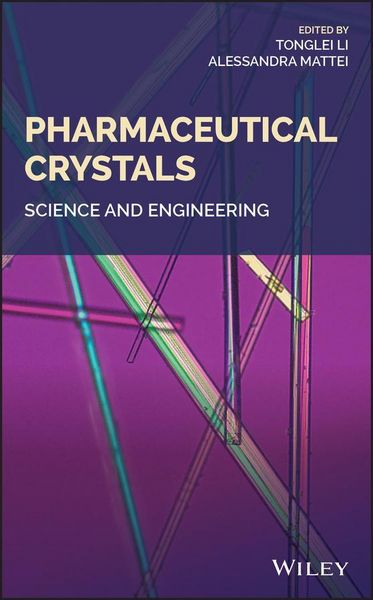
Produktbild: Pharmaceutical Crystals

Pharmaceutical Crystals Science and Engineering

274,99 €

inkl. gesetzl. MwSt., Versandkostenfrei


Beschreibung

An important resource that puts the focus on understanding and handling of organic crystals in drug development   Since a majority of pharmaceutical solid-state materials are organic crystals, their handling and processing are critical aspects of drug development. Pharmaceutical Crystals: Science and Engineering...

Beschreibung

An important resource that puts the focus on understanding and handling of organic crystals in drug development
 
Since a majority of pharmaceutical solid-state materials are organic crystals, their handling and processing are critical aspects of drug development. Pharmaceutical Crystals: Science and Engineering offers an introduction to and thorough coverage of organic crystals, and explores the essential role they play in drug development and manufacturing. Written contributions from leading researchers and practitioners in the field, this vital resource provides the fundamental knowledge and explains the connection between pharmaceutically relevant properties and the structure of a crystal.
 
Comprehensive in scope, the text covers a range of topics including: crystallization, molecular interactions, polymorphism, analytical methods, processing, and chemical stability. The authors clearly show how to find solutions for pharmaceutical form selection and crystallization processes. Designed to be an accessible guide, this book represents a valuable resource for improving the drug development process of small drug molecules. This important text:
* Includes the most important aspects of solid-state organic chemistry and its role in drug development
* Offers solutions for pharmaceutical form selection and crystallization processes
* Contains a balance between the scientific fundamental and pharmaceutical applications
* Presents coverage of crystallography, molecular interactions, polymorphism, analytical methods, processing, and chemical stability
 
Written for both practicing pharmaceutical scientists, engineers, and senior undergraduate and graduate students studying pharmaceutical solid-state materials, Pharmaceutical Crystals: Science and Engineering is a reference and textbook for understanding, producing, analyzing, and designing organic crystals which is an imperative skill to master for anyone working in the field.

Produktdetails

Einband

Gebundene Ausgabe

Erscheinungsdatum

16.10.2018

Verlag John Wiley & Sons
Seitenzahl

528

Produktdetails

Einband

Gebundene Ausgabe

Erscheinungsdatum

16.10.2018

Verlag John Wiley & Sons
Seitenzahl

528

Maße (L/B/H)

23,2/15,9/3,1 cm

Gewicht

836 g

Auflage

1. Auflage

Sprache

Englisch

ISBN

978-1-119-04629-5

Herstelleradresse

Libri GmbH
Europaallee 1
36244 Bad Hersfeld
DE

Email: gpsr@libri.de

Noch keine Bewertungen vorhanden

Verfassen Sie die erste Bewertung zu diesem Artikel

Helfen Sie anderen Kundinnen und Kunden durch Ihre Meinung.

Kundinnen und Kunden meinen

Bewertungen (0)

Die Leseprobe wird geladen.
  • Produktbild: Pharmaceutical Crystals
  • List of Contributors xiii
     
    Preface xv
     
    1 Crystallography 1
    Susan M. Reutzel-Edens and Peter Müller
     
    1.1 Introduction 1
     
    1.2 History 6
     
    1.3 Symmetry 7
     
    1.3.1 Symmetry in Two Dimensions 7
     
    1.3.2 Symmetry and Translation 11
     
    1.3.3 Symmetry in Three Dimensions 12
     
    1.3.4 Metric Symmetry of the Crystal Lattice 13
     
    1.3.5 Conventions and Symbols 14
     
    1.3.6 Fractional Coordinates 15
     
    1.3.7 Symmetry in Reciprocal Space 15
     
    1.4 Principles of X-ray Diffraction 17
     
    1.4.1 Bragg's Law 17
     
    1.4.2 Diffraction Geometry 19
     
    1.4.3 Ewald Construction 19
     
    1.4.4 Structure Factors 21
     
    1.4.5 Statistical Intensity Distribution 22
     
    1.4.6 Data Collection 23
     
    1.5 Structure Determination 24
     
    1.5.1 Space Group Determination 24
     
    1.5.2 Phase Problem and Structure Solution 25
     
    1.5.3 Structure Refinement 28
     
    1.5.3.1 Resonant Scattering and Absolute Structure 32
     
    1.6 Powder Methods 33
     
    1.6.1 Powder Diffraction 34
     
    1.6.2 NMR Crystallography 35
     
    1.7 Crystal Structure Prediction 39
     
    1.8 Crystallographic Databases 41
     
    1.9 Conclusions 42
     
    References 43
     
    2 Nucleation 47
    Junbo Gong and Weiwei Tang
     
    2.1 Introduction 47
     
    2.2 Classical Nucleation Theory 48
     
    2.2.1 Thermodynamics 48
     
    2.2.2 Kinetics of Nucleation 51
     
    2.2.3 Metastable Zone 53
     
    2.2.4 Induction Time 58
     
    2.2.5 Heterogeneous Nucleation 60
     
    2.3 Nonclassical Nucleation 63
     
    2.3.1 Two-Step Mechanism 63
     
    2.3.2 Prenucleation Cluster Pathway 66
     
    2.4 Application of Primary Nucleation 66
     
    2.4.1 Understanding and Control of Polymorphism 66
     
    2.4.2 Liquid-Liquid Phase Separation 71
     
    2.5 Secondary Nucleation 73
     
    2.5.1 Origin from Solution 74
     
    2.5.2 Origin from Crystals 75
     
    2.5.3 Kinetics 76
     
    2.5.4 Application to Continuous Crystallization 76
     
    2.5.5 Crystal Size Distribution 79
     
    2.5.6 Seeding 80
     
    2.6 Summary 81
     
    References 82
     
    3 Solid-state Characterization Techniques 89
    Ann Newman and Robert Wenslow
     
    3.1 Introduction 89
     
    3.2 Techniques 90
     
    3.2.1 X-ray Powder Diffraction (XRPD) 90
     
    3.2.2 Thermal Methods 94
     
    3.2.2.1 Differential Scanning Calorimetry 94
     
    3.2.2.2 Thermogravimetric Analysis (TGA) 95
     
    3.2.3 Spectroscopy 97
     
    3.2.3.1 Infrared (IR) 97
     
    3.2.3.2 Raman Spectroscopy 99
     
    3.2.3.3 Solid-state Nuclear Magnetic Resonance (SSNMR) 101
     
    3.2.4 Water Sorption 105
     
    3.2.5 Microscopy 106
     
    3.3 Case Study LY334370 Hydrochloride (HCl) 109
     
    3.4 Summary 114
     
    References 114
     
    4 Intermolecular Interactions and Computational Modeling 123
    Alessandra Mattei and Tonglei Li
     
    4.1 Introduction 123
     
    4.2 Foundation of Intermolecular Interactions 124
     
    4.2.1 Electrostatic Interactions 125
     
    4.2.2 van der Waals Interactions 126
     
    4.2.3 Hydrogen-bonding Interactions 127
     
    4.2.4 pi-pi Interactions 129
     
    4.3 Intermolecular Interactions in Organic Crystals 130
     
    4.3.1 Approaches to Crystal Packing Description 130
     
    4.3.2 Impact of Intermolecular Interactions on Crystal Packing 136
     
    4.3.3 Impact of Intermolecular Interactions on Crystal Properties 138
     
    4.4 Techniques for Intermolecular Interactions Evaluation 140
     
    4.4.1 Crystallography 140
     
    4.4.2 Spectroscopy 141