KI-Beratung Beta

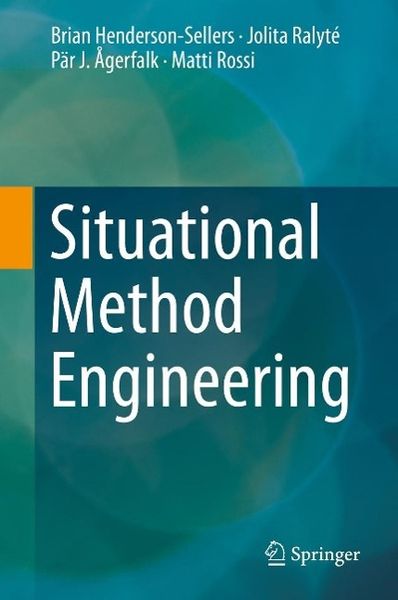
Produktbild: Situational Method Engineering

Situational Method Engineering

54,99 €

inkl. gesetzl. MwSt.

Beschreibung

While previously available methodologies for software - like those published in the early days of object technology - claimed to be appropriate for every conceivable project, situational method engineering (SME) acknowledges that most projects typically have individual characteristics and situations....

Beschreibung

While previously available methodologies for software - like those published in the early days of object technology - claimed to be appropriate for every conceivable project, situational method engineering (SME) acknowledges that most projects typically have individual characteristics and situations. Thus, finding the most effective methodology for a particular project needs specific tailoring to that situation. Such a tailored software development methodology needs to take into account all the bits and pieces needed for an organization to develop software, including the software process, the input and output work products, the people involved, the languages used to describe requirements, design, code, and eventually also measures of success or failure.

The authors have structured the book into three parts. Part I deals with all the basic concepts, terminology and overall ideas underpinning situational method engineering. As a summary of this part, they present a formal meta-model that enables readers to create their own quality methods and supporting tools. In Part II, they explain how to implement SME in practice, i.e., how to find method components and put them together and how to evaluate the resulting method. For illustration, they also include several industry case studies of customized or constructed processes, highlighting the impact that high-quality engineered methods can have on the success of an industrial software development. Finally, Part III summarizes some of the more recent and forward-looking ideas.

This book presents the first summary of the state of the art for SME. For academics, it provides a comprehensive conceptual framework and discusses new research areas. For lecturers, thanks to its step-by-step explanations from basics to the customization and quality assessment of constructed methods, it serves as a solid basis for comprehensive courses on the topic. For industry methodologists, it offers a reference guide onfeatures and technologies to consider when developing in-house software development methods or customising and adopting off-the-shelf ones.

Rezension

"This book offers a comprehensive body of knowledge related to the Method Engineering discipline. It provides a summary and synthesis of all past efforts in this domain and clarifies the domain terminology. I suggest it to every researcher interested in the art of method design, not only in software engineering but also in other fields." Marko Bajec, University of Ljubljana, Slovenia

"I am confident this text will prove an invaluable resource for those interested in improving the standard of software development and the resulting software applications." from the foreword by Mary O'Kane, NSW Chief Scientist & Engineer, Sydney, Australia

"This book deftly balances the advantages of situational method engineering in terms of its practical application, underpinned by the solid theory from worldwide research. I heartily recommend it for both researchers and practitioners." from the foreword by Julian Edwards, Chief Operating Officer, Object Consulting, Sydney, Australia

Produktdetails

Format

PDF

Kopierschutz

Nein

Family Sharing

Nein

Text-to-Speech

Nein

Produktdetails

Format

PDF

Format

eBooks im PDF-Format haben eine festgelegte Seitengröße und eignen sich daher nur bedingt zum Lesen auf einem tolino eReader oder Smartphone. Für den vollen Lesegenuss empfehlen wir Ihnen bei PDF-eBooks die Verwendung eines Tablets oder Computers.

Kopierschutz

Nein

Kopierschutz

Dieses eBook können Sie uneingeschränkt auf allen Geräten der tolino Familie, allen sonstigen eReadern und am PC lesen. Das eBook ist nicht kopiergeschützt und kann ein personalisiertes Wasserzeichen enthalten. Weitere Hinweise zum Lesen von eBooks mit einem personalisierten Wasserzeichen finden Sie unter Hilfe/Downloads.

Family Sharing

Nein

Family Sharing

Mit Family Sharing können Sie eBooks innerhalb Ihrer Familie (max. sechs Mitglieder im gleichen Haushalt) teilen. Sie entscheiden selbst, welches Buch Sie mit welchem Familienmitglied teilen möchten. Auch das parallele Lesen durch verschiedene Familienmitglieder ist durch Family Sharing möglich. Um eBooks zu teilen oder geteilt zu bekommen, muss jedes Familienmitglied ein Konto bei Thalia oder einem anderen tolino-Buchhändler haben. Weitere Informationen finden Sie unter Hilfe/Family-Sharing.

Text-to-Speech

Nein

Text-to-Speech

Bedeutet Ihnen Stimme mehr als Text? Mit der Funktion Text-to-Speech können Sie sich im tolino webReader und in der aktuellen Thalia – Lesen & Hören App das eBook vorlesen lassen. Weitere Informationen finden Sie unter Hilfe/Text-to-Speech.

Erscheinungsdatum

03.06.2014

Verlag Springer
Seitenzahl

310 (Printausgabe)

Dateigröße

8687 KB

Sprache

Englisch

EAN

9783642414671

Barrierefreiheit
  • keine Information zur Barrierefreiheit bekannt

Noch keine Bewertungen vorhanden

Verfassen Sie die erste Bewertung zu diesem Artikel

Helfen Sie anderen Kundinnen und Kunden durch Ihre Meinung.

Kundinnen und Kunden meinen

Bewertungen (0)

Weitere Artikel finden Sie in

  • Produktbild: Situational Method Engineering
  • Part I SME Basics.- Chapter 1 Introduction.- Chapter 2 Method chunks, method fragments and method components.- Chapter 3 Method Engineering as a Social Practice.- Chapter 4 Formal descriptions.- Part II Applying SME in Practice.- Chapter 5 Identification and construction of individual method chunks/fragments.- Chapter 6 Processes for creating a methodology from method parts.- Chapter 7 Tailoring a constructed method.- Chapter 8 Assessing quality.- Chapter 9 Examples of constructed processes.- Part III The Future of SME.- Chapter 10 Recent advances in SME.- Chapter 11 Final summary and future work.