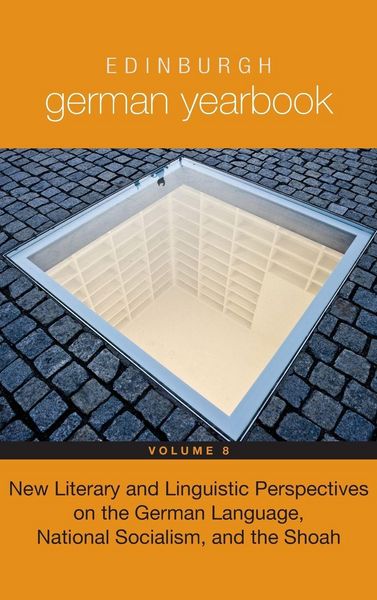
Edinburgh German Yearbook 8 New Literary and Linguistic Perspectives on the German Language, National Socialism, and the Shoah
-
- Englisch ausgewählt
146,99 €
inkl. gesetzl. MwSt.,
Beschreibung
Produktdetails
Einband
Gebundene Ausgabe
Erscheinungsdatum
28.11.2014
Herausgeber
Peter Davies + weitereVerlag
Boydell & BrewerSeitenzahl
256
Maße (L/B/H)
23,6/15,6/3,2 cm
Gewicht
506 g
Sprache
Englisch
ISBN
978-1-57113-597-1
New perspectives on the relationship - or the perceived relationship - between the German language and the causes, nature, and legacy of National Socialism and the Shoah. There is seemingly no escaping the association of the language of Goethe with the language of Hitler: the two leaden clichés seem to be inseparable, suggesting a Sonderweg between enlightened sophistication and subtle beauty on the one hand and linguistic barbarism on the other. Victor Klemperer suggested that the Lingua Tertii Imperii was a perversion of German that needed to be purged from the language, but does the notion of "Nazi language" as an identifiably separate entity really hold water, or does it only reflect a desire to construct a clear demarcation line between "Germans" and "Nazis"? What new linguistic, literary, or historical perspectives are availableon the functioning of language during and after the Third Reich? Must German always be the "language of the perpetrators," entailing a constant state of heightened self-awareness or vigilance against contamination, or is neutral,objective speech about National Socialism possible in German? This collection provides new perspectives on the relationship - or the perceived relationship - between the German language in all its manifestations and the causes, nature, and legacy of National Socialism and the Shoah. Contributors: Ian Biddle and Beate Müller, Mary Cosgrove, Peter Davies, Sylvia Degen, Andrea Hammel, Geraldine Horan, Teresa Ludden, Dora Osborne, Marko Pajevic, James Parsons, Simone Schroth, Arvi Sepp, Simon Ward, Jenny Watson. Peter Davies is Professor of Modern German Studies at the University of Edinburgh. Andrea Hammel is Senior Lecturer in German at Aberystwyth University.
Noch keine Bewertungen vorhanden
Verfassen Sie die erste Bewertung zu diesem Artikel
Helfen Sie anderen Kundinnen und Kunden durch Ihre Meinung.
Kurze Frage zu unserer Seite
Vielen Dank für Ihr Feedback
Wir nutzen Ihr Feedback, um unsere Produktseiten zu verbessern. Bitte haben Sie Verständnis, dass wir Ihnen keine Rückmeldung geben können. Falls Sie Kontakt mit uns aufnehmen möchten, können Sie sich aber gerne an unseren Kund*innenservice wenden.
zum Kundenservice