
Alzheimer's Early Stages First Steps for Family, Friends, and Caregivers, 3rd Edition
-
- Hardcover ausgewählt
- Taschenbuch
-
Sprache:Englisch
28,99 €
inkl. gesetzl. MwSt.,
- Kostenlose Lieferung ab 30 € Einkaufswert
- Versandkostenfrei für Bonuscard-Kund*innen
Beschreibung
Produktdetails
Einband
Gebundene Ausgabe
Erscheinungsdatum
08.10.2013
Verlag
Turner Publishing CompanySeitenzahl
336
Maße (L/B/H)
21,6/14/2,2 cm
Gewicht
544 g
Sprache
Englisch
ISBN
978-1-63026-665-3
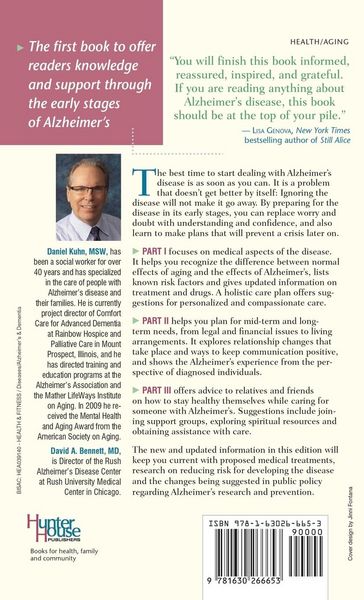
Alzheimer's disease has a beginning, not just an end; and as with all beginnings, one must take the first steps before one takes the last. The problems encountered early in the disease and the advice required then are very different from what is needed later in the disease. This book enlightens us about these early stages. Daniel Kuhn seeks to replace fear with knowledge, in the hope that knowledge will lead to empowerment. What does the disease look like and feel like when it first occurs? What types of problems are encountered first by the person with the disease, and by their family and friends? How can these problems be dealt with most effectively?
This book is also about reversing the dehumanization that unfortunately is now associated with Alzheimer's disease. Although the disease should be feared and respected, it is not a cause for embarrassment or shame.... This book will serve as a discussion tool to encourage open and frank discussions about mild Alzheimer's disease among patients and family members.
In Part One, readers learn about the medical aspects of Alzheimer's through descriptions of diagnosis and the progression of the disease from its earliest origins, and explanations of the current and proposed medical treatments. This section also describes potential non-drug means of treating the disease, such as physical exercise, and speculative treatments, such as coconut oil, that are gaining popularity yet are not strongly supported by scientific evidence.
Part Two addresses the practical aspects of day-to-day care. Here, Kuhn explains the changing world of the diagnosed individual. Communication barriers associated with Alzheimer's disease are described and ways to overcome them are offered. Readers come to understand the change in their relationships due to the nature of the disease as well as how to adjust their expectations as these changes occur. Kuhn also describes the importance of anticipating long-term care needs through legal and financial planning.
In Part Three, caregivers are given steps to care for themselves including how to obtain needed help from professionals and friends. Emphasis is placed on maintaining one's own physical, mental, and social health as an important aspect of ensuring the well-being of someone with Alzheimer's disease.
Among the many topics covered are ways to ensure that people with Alzheimer's maintain a high quality life, such as ways of improving communication, selecting appropriate activities, addressing safety concerns, and including children in patient's lives. The book also includes a discussion of what the experience of having Alzheimer's is like, and an analysis of the slow, but hopeful progress being made in the treatment and prevention of the disease.
In his introduction, Daniel tells us, "This book is not a step-by-step guide to the "correct" or "best" way to manage the inherent challenges of this disease. Rather, throughout this book I address general principles about coping strategies and offer specific suggestions. Whenever possible, I rely on the experiences of people living with Alzheimer's disease to illustrate key points."
This book is practical. It tells you what you can and should do, and in some cases, what you should not do. Like a good cookbook, it provides guidance and advice but leaves room for individuality and experimentation.
Noch keine Bewertungen vorhanden
Verfassen Sie die erste Bewertung zu diesem Artikel
Helfen Sie anderen Kundinnen und Kunden durch Ihre Meinung.
Kurze Frage zu unserer Seite
Vielen Dank für Ihr Feedback
Wir nutzen Ihr Feedback, um unsere Produktseiten zu verbessern. Bitte haben Sie Verständnis, dass wir Ihnen keine Rückmeldung geben können. Falls Sie Kontakt mit uns aufnehmen möchten, können Sie sich aber gerne an unseren Kund*innenservice wenden.
zum Kundenservice