KI-Beratung Beta

Gutscheinbedingungen

**Gültig bis 18.11.2026 auf englischsprachige Klassiker (klassiker-32728) online auf thalia.at und in der Thalia App. Einzelne Artikel können ausgeschlossen sein. Ausgenommen sind preisgebundene Artikel & eBooks. Pro Einkauf einmal einlösbar. Click & Collect nur bei Onlinevorabzahlung möglich. Keine Barauszahlung. Nicht kombinierbar mit anderen Aktionen und Gutscheinen. Gutschein wird auf max. 500€ Bestellwert angerechnet. Nicht gültig für Geschenkkarten, Versandkosten und Services.

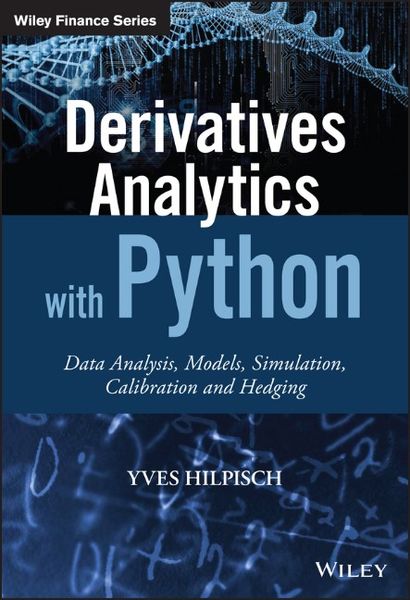
  • Produktbild: Derivatives Analytics with Python
  • Produktbild: Derivatives Analytics with Python

Derivatives Analytics with Python Data Analysis, Models, Simulation, Calibration and Hedging

Aus der Reihe Wiley Finance

118,99 €

inkl. gesetzl. MwSt., Versandkostenfrei


Beschreibung

Supercharge options analytics and hedging using the power of Python   Derivatives Analytics with Python shows you how to implement market-consistent valuation and hedging approaches using advanced financial models, efficient numerical techniques, and the powerful capabilities of the Python programming...

Beschreibung

Supercharge options analytics and hedging using the power of Python
 
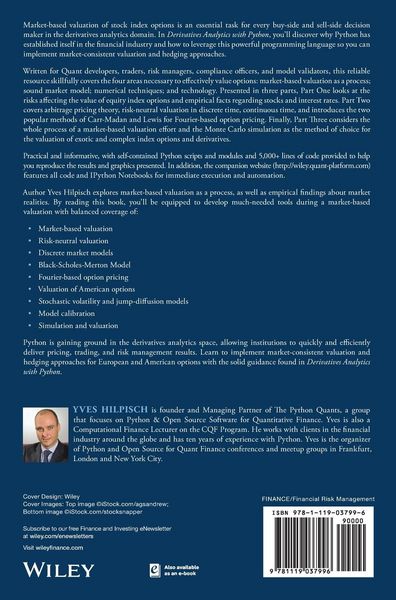
Derivatives Analytics with Python shows you how to implement market-consistent valuation and hedging approaches using advanced financial models, efficient numerical techniques, and the powerful capabilities of the Python programming language. This unique guide offers detailed explanations of all theory, methods, and processes, giving you the background and tools necessary to value stock index options from a sound foundation. You'll find and use self-contained Python scripts and modules and learn how to apply Python to advanced data and derivatives analytics as you benefit from the 5,000+ lines of code that are provided to help you reproduce the results and graphics presented. Coverage includes market data analysis, risk-neutral valuation, Monte Carlo simulation, model calibration, valuation, and dynamic hedging, with models that exhibit stochastic volatility, jump components, stochastic short rates, and more. The companion website features all code and IPython Notebooks for immediate execution and automation.
 
Python is gaining ground in the derivatives analytics space, allowing institutions to quickly and efficiently deliver portfolio, trading, and risk management results. This book is the finance professional's guide to exploiting Python's capabilities for efficient and performing derivatives analytics.
* Reproduce major stylized facts of equity and options markets yourself
* Apply Fourier transform techniques and advanced Monte Carlo pricing
* Calibrate advanced option pricing models to market data
* Integrate advanced models and numeric methods to dynamically hedge options
 
Recent developments in the Python ecosystem enable analysts to implement analytics tasks as performing as with C or C++, but using only about one-tenth of the code or even less. Derivatives Analytics with Python -- Data Analysis, Models, Simulation, Calibration and Hedging shows you what you need to know to supercharge your derivatives and risk analytics efforts.

Produktdetails

Einband

Gebundene Ausgabe

Erscheinungsdatum

10.07.2015

Verlag John Wiley & Sons
Seitenzahl

384

Produktdetails

Einband

Gebundene Ausgabe

Erscheinungsdatum

10.07.2015

Verlag John Wiley & Sons
Seitenzahl

384

Maße (L/B/H)

25/17,5/2,5 cm

Gewicht

829 g

Auflage

1. Auflage

Sprache

Englisch

ISBN

978-1-119-03799-6

Herstelleradresse

Libri GmbH
Europaallee 1
36244 Bad Hersfeld
DE

Email: gpsr@libri.de

Noch keine Bewertungen vorhanden

Verfassen Sie die erste Bewertung zu diesem Artikel

Helfen Sie anderen Kundinnen und Kunden durch Ihre Meinung.

Kundinnen und Kunden meinen

Bewertungen (0)

Die Leseprobe wird geladen.
  • Produktbild: Derivatives Analytics with Python
  • Produktbild: Derivatives Analytics with Python
  • List of Tables xi
     
    List of Figures xiii
     
    Preface xvii
     
    CHAPTER 1 A Quick Tour 1
     
    1.1 Market-Based Valuation 1
     
    1.2 Structure of the Book 2
     
    1.3 Why Python? 3
     
    1.4 Further Reading 4
     
    PART ONE The Market
     
    CHAPTER 2 What is Market-Based Valuation? 9
     
    2.1 Options and their Value 9
     
    2.2 Vanilla vs. Exotic Instruments 13
     
    2.3 Risks Affecting Equity Derivatives 14
     
    2.3.1 Market Risks 14
     
    2.3.2 Other Risks 15
     
    2.4 Hedging 16
     
    2.5 Market-Based Valuation as a Process 17
     
    CHAPTER 3 Market Stylized Facts 19
     
    3.1 Introduction 19
     
    3.2 Volatility, Correlation and Co. 19
     
    3.3 Normal Returns as the Benchmark Case 21
     
    3.4 Indices and Stocks 25
     
    3.4.1 Stylized Facts 25
     
    3.4.2 DAX Index Returns 26
     
    3.5 Option Markets 30
     
    3.5.1 Bid/Ask Spreads 31
     
    3.5.2 Implied Volatility Surface 31
     
    3.6 Short Rates 33
     
    3.7 Conclusions 36
     
    3.8 Python Scripts 37
     
    3.8.1 GBM Analysis 37
     
    3.8.2 DAX Analysis 40
     
    3.8.3 BSM Implied Volatilities 41
     
    3.8.4 EURO STOXX 50 Implied Volatilities 43
     
    3.8.5 Euribor Analysis 45
     
    PART TWO Theoretical Valuation
     
    CHAPTER 4 Risk-Neutral Valuation 49
     
    4.1 Introduction 49
     
    4.2 Discrete-Time Uncertainty 50
     
    4.3 Discrete Market Model 54
     
    4.3.1 Primitives 54
     
    4.3.2 Basic Definitions 55
     
    4.4 Central Results in Discrete Time 57
     
    4.5 Continuous-Time Case 61
     
    4.6 Conclusions 66
     
    4.7 Proofs 66
     
    4.7.1 Proof of Lemma 1 66
     
    4.7.2 Proof of Proposition 1 67
     
    4.7.3 Proof of Theorem 1 68
     
    CHAPTER 5 Complete Market Models 71
     
    5.1 Introduction 71
     
    5.2 Black-Scholes-Merton Model 72
     
    5.2.1 Market Model 72
     
    5.2.2 The Fundamental PDE 72
     
    5.2.3 European Options 74
     
    5.3 Greeks in the BSM Model 76
     
    5.4 Cox-Ross-Rubinstein Model 81
     
    5.5 Conclustions 84
     
    5.6 Proofs and Python Scripts 84
     
    5.6.1 It^o's Lemma 84
     
    5.6.2 Script for BSM Option Valuation 85
     
    5.6.3 Script for BSM Call Greeks 88
     
    5.6.4 Script for CRR Option Valuation 92
     
    CHAPTER 6 Fourier-Based Option Pricing 95
     
    6.1 Introduction 95
     
    6.2 The Pricing Problem 96
     
    6.3 Fourier Transforms 97
     
    6.4 Fourier-Based Option Pricing 98
     
    6.4.1 Lewis (2001) Approach 98
     
    6.4.2 Carr-Madan (1999) Approach 101
     
    6.5 Numerical Evaluation 103
     
    6.5.1 Fourier Series 103
     
    6.5.2 Fast Fourier Transform 105
     
    6.6 Applications 107
     
    6.6.1 Black-Scholes-Merton (1973) Model 107
     
    6.6.2 Merton (1976) Model 108
     
    6.6.3 Discrete Market Model 110
     
    6.7 Conclusions 114
     
    6.8 Python Scripts 114
     
    6.8.1 BSM Call Valuation via Fourier Approach 114
     
    6.8.2 Fourier Series 119
     
    6.8.3 Roots of Unity 120
     
    6.8.4 Convolution 121
     
    6.8.5 Module with Parameters 122
     
    6.8.6 Call Value by Convolution 123
     
    6.8.7 Option Pricing by Convolution 123
     
    6.8.8 Option Pricing by DFT 124
     
    6.8.9 Speed Test of DFT 125
     
    CHAPTER 7 Valuation of American Options by Simulation 127
     
    7.1 Introduction 127
     
    7.2 Financial Model 128
     
    7.3 American Option Valuation 128
     
    7.3.1 Problem Formulations 128
     
    7.3.2 Valuation Algorithms 130
     
    7.4 Numerical Results 132
     
    7.4.1 Ameri