Gutscheinbedingungen

**Gültig bis 17.08.2026 auf Schreibwaren & Office-Artikel online auf thalia.at, in der Thalia App und in teilnehmenden Thalia Buchhandlungen in Österreich mit Schulsortiment. In den Buchhandlungen nur gültig auf lagernde Ware. Einzelne Artikel können ausgeschlossen sein. Ausgenommen sind preisgebundene Artikel. Pro Einkauf einmal einlösbar. Nur gültig gegen Vorlage oder im Onlineshop hinterlegter Bonuscard. Infos zur Einlösung in der Buchhandlung sind auf der Bonuscard-Vorteilspreisseite zu finden. Click & Collect nur bei Onlinevorabzahlung möglich. Keine Einlösung bei Scan & Go-Bezahlung. Keine Barauszahlung. Nicht kombinierbar mit anderen Aktionen und Gutscheinen. Gutschein wird auf max. 500€ Bestellwert angerechnet. Nicht gültig für Geschenkkarten, Versandkosten und Services.

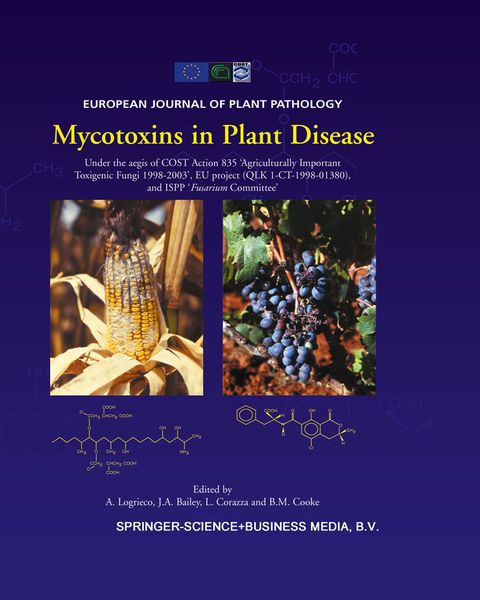
  • Produktbild: Mycotoxins in Plant Disease
  • Produktbild: Mycotoxins in Plant Disease
- 12%

Mycotoxins in Plant Disease Under the aegis of COST Action 835 ‘Agriculturally Important Toxigenic Fungi 1998-2003’, EU project (QLK 1-CT-1998-01380), and ISPP ‘Fusarium Committee’

12% sparen

95,99 € UVP 109,99 €

inkl. gesetzl. MwSt., Versandkostenfrei


Beschreibung

Produktdetails

Einband

Taschenbuch

Erscheinungsdatum

23.08.2014

Abbildungen

1 illus., schwarz-weiss Illustrationen

Herausgeber

A. Logrieco + weitere

Verlag

Springer Netherland

Seitenzahl

734

Maße (L/B/H)

25,4/20,3/0,9 cm

Gewicht

346 g

Auflage

Softcover reprint of the original 1st ed. 2002

Sprache

Englisch

ISBN

978-94-010-3939-0

Beschreibung

Produktdetails

Einband

Taschenbuch

Erscheinungsdatum

23.08.2014

Abbildungen

1 illus., schwarz-weiss Illustrationen

Herausgeber

Verlag

Springer Netherland

Seitenzahl

734

Maße (L/B/H)

25,4/20,3/0,9 cm

Gewicht

346 g

Auflage

Softcover reprint of the original 1st ed. 2002

Sprache

Englisch

ISBN

978-94-010-3939-0

Herstelleradresse

Springer-Verlag KG
Sachsenplatz 4-6
1201 Wien
AT

Email: GPSR Kontakt

Noch keine Bewertungen vorhanden

Verfassen Sie die erste Bewertung zu diesem Artikel

Helfen Sie anderen Kundinnen und Kunden durch Ihre Meinung.

Kundinnen und Kunden meinen

Bewertungen (0)

  • Produktbild: Mycotoxins in Plant Disease
  • Produktbild: Mycotoxins in Plant Disease
  • Foreword; A.F. Logrieco, L. Corazza, A. Bottalico. Toxigenic Fusarium species and mycotoxins associated with maize ear rot in Europe; A. Logrieco, G. Mulè, A. Moretti, A. Bottalico. Toxigenic Fusarium species and mycotoxins associated with head blight in small-gram cereals in Europe; A. Bottalico, G. Perrone. Deoxynivalenol, nivalenol and monififormin in wheat saniples with head blight (scab) symptoms in Poland (1998-2000); M. Tomczak, H. Wisniewska, L. Stepien, M. Kostecki, J. Chelkowski, P. Go1inski. Ochratoxin A in cereals, foodstuffs and human plasma; A. Rizzo, M. Eskola, F. Atroshi. Ochratoxin A in grapes and wine; P. Battilani, A. Pietri. Ear rot susceptibility and mycotoxin contamination of maize hybrids inoculated with Fusarium species under field conditions; M. Pascale, A. Visconti, J. Chelkowski. Studies on the infection process of Fusarium culmorum in wheat spikes: Degradation of host cell wall components and localization of trichothecene toxins in infected tissue; Z. Kang, H. Buchenauer. Production of beauvericin by different races of Fusarium oxysporum f. sp. melonis, the Fusarium wilt agent of muskmelon; A. Moretti, A. Belisario, A. Tafuri, A. Ritieni, L. Corazza, A. Logrieco. Epidemiology of Fusarium infection and deoxynivalenol content in winter wheat in the Rhineland, Germany; B. Birzele, A. Meier, H. Hindorf, J. Krämer, H.-W. Dehne. Role of deoxynivalenol in aggressiveness of Fusarium graminearum and F. culmorum and in resistance to Fusarium head blight; Á. Mesterházy. Relationship between growth and mycotoxin production by Fusarium species, biocides and environment; N. Magan, R. Hope, A. Colleate, E.S. Baxter. Genetic analysis of the role of trichothecene and fumonisinmycotoxins in the virulence of Fusarium; R.H. Proctor, A.E. Desjardins, S.P. McCormick, R.D. Plattner, N.J. Alexander, D.W. Brown. Saccharomyces cerevisae and Arabidopsis thaliana: Useful model systems for the identification of molecular mechanisms involved in resistance of plants to toxins; R. Mitterbauer, G. Adam. Mycotoxin genetics and gene clusters; G.S. Sidhu. Biosynthesis of depsipeptide mycotoxins in Fusarium; T. Hornbogen, M. Glinski, R. Zocher. Secretion of natural and synthetic toxic compounds from filamentous fungi by membrane transporters of the ATP-binding cassette and major facilitator superfamily; L. Stergiopoulos, L.-H. Zwiers, M.A. De Waard.