Gutscheinbedingungen

**Gültig bis 28.07.2026 auf Spielzeug, Schreibwaren, Filme, Geschenke & Trends, Musik, tolino eReader & Zubehör, Hörbücher und Hörbuch-Downloads (außer Abo), nicht preisgebundene Bücher und Kalender in der Thalia App. Einzelne Artikel können ausgeschlossen sein. Aufgrund der Buchpreisbindung sind deutschsprachige Bücher und eBooks ausgenommen. Zusätzlich ausgenommen sind preisgebundene Artikel, Abos & Flatrates, eBooks, Games, Geschenkkarten/-boxen, Shelfies, Software, Zeitschriften sowie einzelne Artikel von tonies®. Pro Einkauf einmal einlösbar. Click & Collect nur bei Onlinevorabzahlung möglich. Keine Barauszahlung. Nicht kombinierbar mit anderen Aktionen und Gutscheinen. Gutschein wird auf max. 500€ Bestellwert angerechnet. Nicht gültig für Versandkosten und Services.

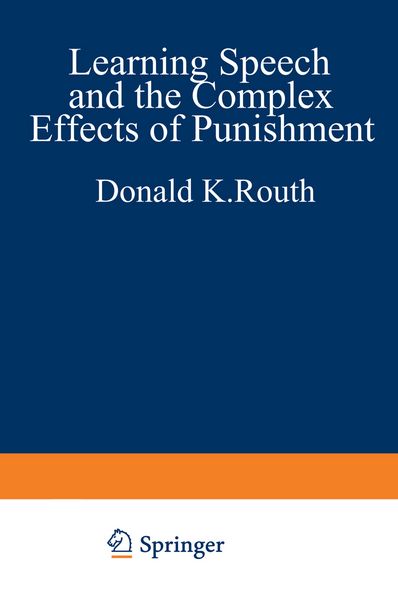
Produktbild: Learning, Speech, and the Complex Effects of Punishment

Learning, Speech, and the Complex Effects of Punishment Essays Honoring George J. Wischner

51,99 €

inkl. gesetzl. MwSt., Versandkostenfrei


Beschreibung

Produktdetails

Einband

Taschenbuch

Erscheinungsdatum

19.03.2012

Verlag

Springer Us

Seitenzahl

248

Maße (L/B/H)

22,9/15,2/1,4 cm

Gewicht

371 g

Auflage

Softcover reprint of the original 1st ed. 1982

Sprache

Englisch

ISBN

978-1-4684-4198-7

Beschreibung

Produktdetails

Einband

Taschenbuch

Erscheinungsdatum

19.03.2012

Verlag

Springer Us

Seitenzahl

248

Maße (L/B/H)

22,9/15,2/1,4 cm

Gewicht

371 g

Auflage

Softcover reprint of the original 1st ed. 1982

Sprache

Englisch

ISBN

978-1-4684-4198-7

Herstelleradresse

Springer-Verlag KG
Sachsenplatz 4-6
1201 Wien
AT

Email: GPSR Kontakt

Noch keine Bewertungen vorhanden

Verfassen Sie die erste Bewertung zu diesem Artikel

Helfen Sie anderen Kundinnen und Kunden durch Ihre Meinung.

Kundinnen und Kunden meinen

Bewertungen (0)

  • Produktbild: Learning, Speech, and the Complex Effects of Punishment
  • 1 Introduction.- What This Book Is About.- Wischner’s Career.- Wischner’s Doctoral Students.- The San Antonio Symposium.- 2 Biological Contributions to the Study of Learning.- Prologue.- Background.- The Biological Analysis of Behavior.- Summary of Points and Issues.- Postlogue.- References.- 3 Cognitive Strategies in the Discrimination Learning of Young Children.- Some Background on Hypothesis Testing in Young Children.- The Blank-Trial Probe.- The Introtact Probe.- Some Considerations in the Study of Hypothesis Testing in Kindergarten Children.- Implications of the Early Research.- Pilot Research in the Authors’ Laboratory.- Estimates of Dimensional Fixation in Kindergarten Children.- Demonstrations of Cognitive Strategies in Younger Children.- The Use of the “Story-and-Game” Context.- The Use of Pretraining and Unidimensional Tasks.- Some Extensions and Limitations of the Methodology.- Some Factors Affecting the Solution of Discrimination Problems.- The Interaction of Age and Probe.- The Story-and-Game Context.- Some Molar Factors Influencing Cognitive Strategies.- The Influence of Task Complexity.- Discussion and Summary.- Summary of Research Findings.- Implications for Further Research.- Implications for Theoretical Formulations.- References.- 4 Learning Sets: The Pittsburgh Studies.- Definition and General Procedures.- Theory.- LS and Species Differences.- LS and Child Development.- LS and Mental Retardation.- The Kaufman and Peterson Studies.- The Pittsburgh Studies by Wischner and His Associates.- Bowes (1959).- Hall.- Patterson.- Hall.- Gerben.- Routh and Wischner.- Bowes (1962).- Wischner, Braun, and Patton.- Wischner and O’Donnell.- deHaan and Wischner.- Hall.- Gerben.- Colletti.- Filicki.- Conclusions and Implications.- References.- 5 Feedback and Motor Control in Stuttering.- Feedback.- Feedback Disruptions in Normal Speakers.- Feedback Processes in Stuttering.- Perceptual Processes in Stutterers.- Feedback Disruptions in Stutterers.- Summary of Feedback Studies.- Motor Control.- Initiation of Voicing.- Physiological Analysis of Laryngeal Movement.- Coordination of Speech Structures.- Summary of Physiological Studies.- Conclusion.- References.- 6 Facilitating Stimulus Effects of Reward and Punishment: Discriminability as a General Principle.- History of Research on Shock-Right Facilitation.- The Muenzinger—Wischner Controversy.- Wischner and Fowler’s Systematic Reassessment.- Resolution of the Correction—Noncorrection Controversy.- The Shock-Right Paradigm as an Experimental Assay.- Variables Affecting Discrimination Difficulty.- Food Reward as a Distinctive Cue.- Discriminability Modulated by Reward.- “Reinforcement” by a Neutral Cue.- Elaboration of the Discriminability Process.- Generality of a Distinctive-Cue Effect.- Formalization of the Discriminability Principle.- Some Applications to Related Phenomena.- References.- 7 The Clinical Uses of Punishment: Bane or Boon?.- Punishment as a Technique to Be Avoided.- Some Personally Unsettling Research Findings.- New Discoveries and Theoretical Advances Concerning Punishment and Aversive Stimulation.- Abuses and Uses of Punishment with Children.- Punishment as a Child-Rearing Technique.- Controversy over the Use of Electric Shock with Children.- Treatment of Self-Injurious Behavior.- Treatment of Ruminative Vomiting.- Use of Time-Out.- Overcorrection.- Treatment of Bed-Wetting.- Some Clinical Uses of Punishment with Adults.- Alcoholism.- Deviant Sexual Behavior.- Obesity.- Smoking.- Stuttering.- Punishment and Information Processing.- Research with Animals.- Research with Humans.- Research with Punishment and Information Processing in Clinical Populations.- Conclusion.- References.- 8 Intellectual Progeny of Seashore and Spence: Iowa Psychologists.- The Guttman Scale of Eminence.- Overall Descriptive Information.- Early History of the Iowa Psychology Department.- Information on Individual Eminent Graduates.- Seashore’s Students.- Ruckmick’s Students.- Knight’s Best-Known Student.- Travis’s Students.- The Child Welfare Research Station and Wellman’s Students.- Tiffin’s Students.- Reger’s Best-Known Student.- A Student of Williams.- A Student of Irwin.- Lewin’s Students.- Spence and His Students.- A Student of Meier.- A Student of Farber.- A Student of Benton.- A Student of McCandless and Spiker.- A Student of Bechtoldt.- Discussion.- References.