
Gutscheinbedingungen

**Gültig von 22.06.2026 ab 19 Uhr bis 23.06.2026 24 Uhr auf Spielzeug, Schreibwaren, Filme, Geschenke & Trends, Musik, tolino eReader & Zubehör, Hörbücher und Hörbuch-Downloads (außer Abo), nicht preisgebundene Bücher und Kalender online auf thalia.at und in der Thalia App. Einzelne Artikel können ausgeschlossen sein. Aufgrund der Buchpreisbindung sind deutschsprachige Bücher und eBooks ausgenommen. Zusätzlich ausgenommen sind preisgebundene Artikel, Abos & Flatrates, eBooks, Games, Geschenkkarten/-boxen, Shelfies, Software, Zeitschriften sowie einzelne Artikel von tonies®. Pro Einkauf einmal einlösbar. Click & Collect nur bei Onlinevorabzahlung möglich. Keine Barauszahlung. Nicht kombinierbar mit anderen Aktionen und Gutscheinen. Gutschein wird auf max. 500€ Bestellwert angerechnet. Nicht gültig für Versandkosten und Services.

  • Produktbild: Rule-Governed Behavior
  • Produktbild: Rule-Governed Behavior
- 16%

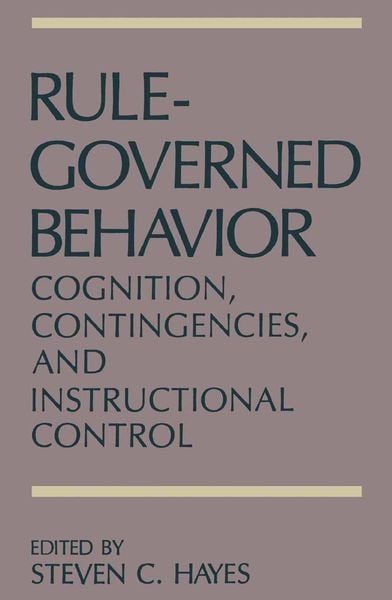
Rule-Governed Behavior Cognition, Contingencies, and Instructional Control

16% sparen

136,99 € UVP 164,99 €

inkl. gesetzl. MwSt., Versandkostenfrei


Beschreibung

Produktdetails

Einband

Taschenbuch

Erscheinungsdatum

02.06.2012

Herausgeber

Steven C. Hayes

Verlag

Springer Us

Seitenzahl

412

Maße (L/B/H)

22,9/15,2/2,3 cm

Gewicht

594 g

Auflage

1989

Sprache

Englisch

ISBN

978-1-4757-0449-5

Beschreibung

Portrait

Steven C. Hayes is a former president of the Association for Advancement of Behavior Therapy and a Foundation Professor of Psychology at the University of Nevada, Reno.

Produktdetails

Einband

Taschenbuch

Erscheinungsdatum

02.06.2012

Herausgeber

Steven C. Hayes

Verlag

Springer Us

Seitenzahl

412

Maße (L/B/H)

22,9/15,2/2,3 cm

Gewicht

594 g

Auflage

1989

Sprache

Englisch

ISBN

978-1-4757-0449-5

Herstelleradresse

Springer-Verlag GmbH
Tiergartenstr. 17
69121 Heidelberg
DE

Email: ProductSafety@springernature.com

Kundinnen und Kunden meinen

0 Bewertungen

Informationen zu Bewertungen

Zur Abgabe einer Bewertung ist eine Anmeldung im Konto notwendig. Die Authentizität der Bewertungen wird von uns nicht überprüft. Wir behalten uns vor, Bewertungstexte, die unseren Richtlinien widersprechen, entsprechend zu kürzen oder zu löschen.

Die Bewertungen sind nach Format, Anzahl Sterne und Datum sortiert.

Verfassen Sie die erste Bewertung zu diesem Artikel

Helfen Sie anderen Kund*innen durch Ihre Meinung

Kundinnen und Kunden meinen

0 Bewertungen filtern

  • Produktbild: Rule-Governed Behavior
  • Produktbild: Rule-Governed Behavior
  • I. The Nature and Place of Behavioral Analyses of Rule-Governed Behavior.- 1. Rules and Rule-Governance: Cognitive and Behavioristic Views.- 1. Introduction.- 2. Why Study Rules?.- 3. The Information-Processing Approach to Rules.- 3.1. Essence of the Approach.- 3.2. “Levels” of Cognitive Models.- 3.3. Productions and Production Systems.- 3.4. Evaluation of Cognitive Theories.- 4. Meanings of “Rule”.- 4.1. Forms of Rules.- 4.2. Knowing Rules.- 5. Rules as Causes.- 5.1. Why Obey Rules?.- 5.2. What Is Controlled?.- 5.3. Are Rule-Governance and Contingency Shaping Different?.- 6. Inferring Rule Use.- 6.1. Inferences and Observations.- 6.2. Criteria for Inferring Rule Use.- 6.3. Spontaneously Learned Rules.- 7. Summary.- 8. References.- 2. The Behavior of the Listener.- 1. Introduction.- 2. The Verbal Operant.- 3. Effects on the Listener.- 3.1. The Listener Is Told.- 3.2. The Listener Is Taught.- 3.3. The Listener Is Advised.- 3.4. The Listener Is Rule-Directed.- 3.5. The Listener Is Law Governed.- 3.6. The Listener Is Governed by the Laws of Science.- 3.7. The Listener as Reader.- 3.8. The Listener Agrees.- 3.9. The Listener and Speaker Think.- 4. References.- 3. Rule-Governed Behavior in Behavior Analysis: A Theoretical and Experimental History.- 1. Introduction.- 2. A Theoretical History of Rule-Governed Behavior.- 2.1. Rule-Governed Behavior: Its Roots in the Analysis of Verbal Behavior.- 2.2. Rule-Governed Behavior: An Elaboration of Its Practical Significance.- 2.3. Rule-Governed Behavior: A Further Elaboration in Light of the Emerging Psychology of Cognition.- 3. An Experimental History of Rule-Governed Behavior.- 3.1. Rule-Governed Behavior: Schedule-Sensitivity Research.- 3.2. Rule-Governed Behavior: Developmental Research.- 3.3. Rule-Governed Behavior: Stimulus-Equivalence Research.- 4. Conclusion.- 5. References.- 4. An Experimental Analysis of Rule-Governed Behavior.- 1. Introduction.- 2. Contingencies and Rules.- 2.1. Descriptions of Performances and of Contingencies.- 3. Experiment 1: Sampling Performance Hypotheses.- 3.1. Method.- 3.2. Results.- 3.3. Discussion.- 4. Experiment 2: Instructing Accurate Performance Hypotheses.- 4.1. Method.- 4.2. Results.- 4.3. Discussion.- 5. Experiment 3: Instructing Inaccurate Performance Hypotheses.- 5.1. Method.- 5.2. Results.- 5.3. Discussion.- 6. Experiment 4: Instructing Schedule Discriminations.- 6.1. Method.- 6.2. Results.- 6.3. Discussion.- 7. Experiment 5: Assessing Sensitivity to Contingencies.- 7.1. Method.- 7.2. Results.- 8. General Discussion.- 9. References.- II. The New Directions in the Analysis of Rule-Governed Behavior.- 5. The Verbal Action of the Listener as a Basis for Rule-Governance.- 1. Introduction.- 2. Experimental Problems Caused by the Deemphasis of the Listener.- 2.1. Is the Analysis of the Listener More Difficult?.- 3. The Listener at the Back Door.- 4. What Is a Verbal Stimulus?.- 4.1. Verbal Stimuli as Products of Verbal Behavior.- 4.2. Verbal Stimulus Functions.- 4.3. Explanations for Stimulus Equivalence.- 4.4. A Relational Account of Verbal Stimulation.- 5. Meaning and Rule-Governance.- 5.1. Speaking with Meaning.- 5.2. Listening with Understanding.- 5.3. Understanding a Rule.- 5.4. Following a Rule.- 6. Verbal Behavior.- 6.1. Why Would Verbal Stimulation Make a Difference?.- 7. Conclusion.- 8. References.- 6. Rule-Following.- 1. Introduction.- 2. The Impact of Rule-Following on Other Psychological Processes.- 2.1. The Early Period.- 2.2. The Period of Stagnation.- 2.3. The Modern Era of Human Operant Research.- 2.4. Theoretical Analysis of Verbal Control.- 3. Understanding.- 3.1. How Can We Assess Understanding?.- 4. Rule-Following.- 4.1. Functional Units of Rule-Following.- 4.2. Rules as Rules for the Listener.- 4.3. Evidence for the Pliance-Tracking Distinction.- 5. Dangers Ahead in the Analysis of Rule-Governed Behavior.- 5.1. Insensitivity.- 5.2. Object-Oriented Accounts.- 6. Future Directions.- 7. Conclusion.- 8. References.- 7. Correlated Hypothesizing and the Distinction between Contingency-Shaped and Rule-Governed Behavior.- 1. Introduction.- 2. Nonmediational versus Mediational, rather than Behaviorist versus Cognitivist.- 2.1. Preliminary Sketch of Behaviorist Positions.- 2.2. Preliminary Sketch of Cognitivist Positions.- 3. Selected Concepts from Behavior-Analytic Theory.- 3.1. Open-Loop Relations.- 3.2. Closed-Loop Relations.- 3.3. Paths Not Taken Here.- 3.4. Elaborated Discriminative Relations.- 3.5. The Origins of Awareness in Behavior-Analytic Terms.- 3.6. Rules and Rule-Governed Behavior.- 3.7. Rules as Defined by Dual, Converging Sets of Contingencies.- 4. Characteristics of Cognitivist Interpretation.- 4.1. Basic Assumptions of Cognitivist Theory.- 4.2. Some Major Distinctions within Cognitivist Theory.- 4.3. Unconscious Functioning, According to Cognitivist Theory.- 4.4. Rules in Cognitivist Theory.- 4.5. Cognitivist Assumptions in Criticisms of Behaviorist Accounts.- 5. Conflicting Interpretations of Conditioning Experiments.- 5.1. A Cognitivist Proposal: Awareness through Correlated Hypothesizing.- 5.2. Behavioral Experiments Minimizing the Role of Awareness.- 5.3. The Continuing Dispute about Awareness.- 6. Correlated Hypotheses as Functional Operants?.- 6.1. Multiple Scales of Analysis.- 6.2. Multiple Converging Relationships: Verbal Behavior, Including Rules.- 7. Detailed Comparison of These Cognitivist and Behaviorist Accounts.- 7.1. Summary of the Cognitivist Account.- 7.2. Summary of the Behaviorist Account.- 7.3. Intersection of the Two Accounts.- 8. Additional Experimental Techniques Addressing Hypotheses and Rules.- 9. Converging but Distinct Interpretations.- 10. References.- 8. The Achievement of Evasive Goals: Control by Rules Describing Contingencies That Are Not Direct Acting.- 1. Introduction.- 2. Contingencies That Are Not Direct Acting.- 3. Delayed Outcomes.- 3.1. Human Behavior.- 3.2. Basic Research.- 3.3. The Natural Environment.- 3.4. Rule-Control.- 4. Improbable Outcomes.- 4.1. Basic Research.- 4.2. The Natural Environment.- 4.3. Human Behavior.- 4.4. Rule-Control.- 5. Cumulating Outcomes.- 5.1. Human Behavior.- 5.2. Basic Research.- 5.3. The Natural Environment.- 5.4. Rule-Control.- 6. Rules Specifying Contingencies That Are Not Direct Acting.- 6.1. How Do Rules Control Behavior?.- 6.2. Prerequisites for Control by Rules Specifying Contingencies That Are Not Direct Acting.- 6.3. How Do Contingencies That Are Not Direct Acting Control Behavior?.- 7. Other Approaches to Self-Management and Rule-Governed Behavior.- 7.1. Environmental Restructuring.- 7.2. Human Operant Research.- 7.3. Animal Operant Research.- 7.4. Public Goal Setting.- 8. Concluding Remarks.- 9. References.- III. Applied Implications of Rule-Governance.- 9. Some Clinical Implications of Rule-Governed Behavior.- 1. Introduction.- 2. The Problem of History.- 3. A Behavioral Taxonomy.- 3.1. Four Modalities of Behavior.- 3.2. Causality.- 3.3. Summary.- 4. Rule-Governed Behavior.- 4.1. Some Examples of Rules.- 4.2. Self-Rule-Governed Behavior.- 5. Rational-Emotive Therapy.- 5.1. Irrational Beliefs as Rules.- 5.2. Changing Rules.- 5.3. Changing Behavior.- 6. Self-Efficacy Theory.- 6.1. A Behavior Chain.- 6.2. Behavior Change.- 6.3. Discussion.- 7. Conclusions.- 8. References.- 10. Avoiding and Altering Rule-Control as a Strategy of Clinical Intervention.- 1. Introduction.- 1.1. Types of Problems in Rule-Control.- 2. Avoiding Rule-Control: The Strategy of Direct Shaping.- 2.1. Social Skills Training.- 2.2. Functional Analytic Psychotherapy.- 3. Alteration of Rule-Control: The Strategy of Recontextualization.- 3.1. Behavior-Behavior Relations.- 3.2. Contexts Relevant to Pathological Self-Rule Control.- 3.3. The Problem and the Solution.- 3.4. Evidence of Efficacy.- 4. Conclusion.- 5. References.