KI-Beratung Beta

  • Produktbild: Methods in Membrane Biology
  • Produktbild: Methods in Membrane Biology

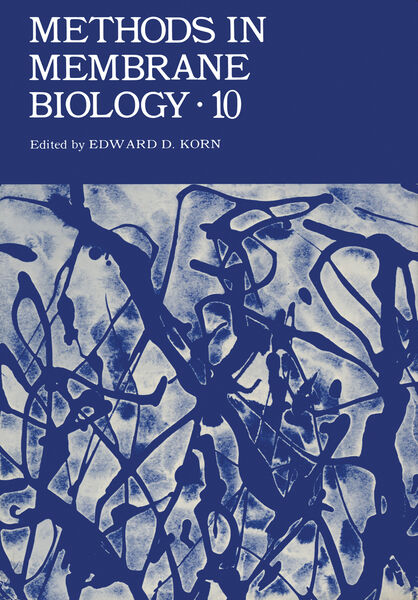
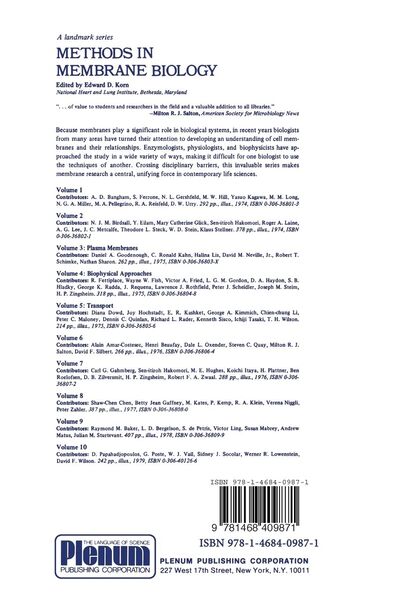
Methods in Membrane Biology Volume 10

49,99 €

inkl. gesetzl. MwSt., Versandkostenfrei


Beschreibung

Three articles make up Volume 10 of Methods in Membrane Biology. In the first of these, Papahadjopoulos, Poste, and Vail extensively review much of the available data on the fusion of natural membranes, model membranes (liposomes), and natural membranes with liposomes. The authors are led by their review...

Beschreibung

Three articles make up Volume 10 of Methods in Membrane Biology. In the first of these, Papahadjopoulos, Poste, and Vail extensively review much of the available data on the fusion of natural membranes, model membranes (liposomes), and natural membranes with liposomes. The authors are led by their review of the experimental methods and their interpretations of the results obtained to a general theory of membrane fusion which they believe is applicable to all systems that have been studied. Arguing that although protein and carbohydrate may serve, in some cases, to bring membranes into sufficiently close proximity for fusion to occur and, in other cases, to remove peripheral and integral proteins from the regions that are to undergo fusion, the authors conclude that membrane fusion per se is solely a property of the lipid bilayer. In their view, all the experimental observations to date can be subsumed under a unifying hypothesis in which membrane fusion is the result of a phase separation in one-half of the membrane bilayer brought about by the interaction - of calcium ions with acidic phospholipids, mostly phosphatidylserine. Where half-membranes already contain sufficient acidic phospholipids, a local increase in calcium ion concentration may suffice to induce fusion (examples might include exocytosis and fusion of intracellular membrane systems). In other cases, natural or experimentally induced events preceding fusion might be necessary to increase the local concentration of the acidic phospholipids in the half-membrane (virus-or fusogenic agent-induced cell-to-cell fusion, or endocytosis, for example).

Produktdetails

Einband

Taschenbuch

Erscheinungsdatum

12.12.2012

Abbildungen

XIV, 227 p. 23 illus.

Verlag Springer Us

Produktdetails

Einband

Taschenbuch

Erscheinungsdatum

12.12.2012

Abbildungen

XIV, 227 p. 23 illus.

Verlag Springer Us
Seitenzahl

227

Maße (L/B/H)

22,9/15,2/1,4 cm

Gewicht

360 g

Auflage

Softcover Reprint of the Original 1st 1979 edition

Sprache

Englisch

ISBN

978-1-4684-0987-1

Herstelleradresse

Libri GmbH
Europaallee 1
36244 Bad Hersfeld
DE

Email: gpsr@libri.de

Noch keine Bewertungen vorhanden

Verfassen Sie die erste Bewertung zu diesem Artikel

Helfen Sie anderen Kundinnen und Kunden durch Ihre Meinung.

Kundinnen und Kunden meinen

Bewertungen (0)

  • Produktbild: Methods in Membrane Biology
  • Produktbild: Methods in Membrane Biology
  • 1 Studies on Membrane Fusion with Natural and Model Membranes.- 1. Introduction.- 2. Spontaneous Cell Fusion.- 3. Virus-Induced Cell Fusion.- 4. Chemically Induced Cell Fusion.- 5. Fusion of Subcellular Membranes.- 6. Interactions and Fusion of Lipid Vesicles with Cultured Cells.- 7. Fusion of Model Lipid Membranes (Vesicles and Black Lipid.- Films).- 8. Similarities between Different Forms of Membrane Fusion: A Possible Unifying Mechanism.- 9. References.- 2 Methods for Studying Transmission through Permeable Cell-to-Cell Junctions.- 1. Introduction.- 2. Measurements of Electrical Coupling.- 3. Measurements of Junctional Conductance.- 4. Tracer Permeation Studies.- 5. Metabolic Cooperation.- 6. Controlling for Misleading Observations.- 7. Comparative Utility of Various Approaches to the Quantitative Characterization of Junctional Transmittance.- 8. Appendixes.- 9. References.- 3 An Approach to the Study of Electron Transport Systems.- 1. General Considerations in the Evaluation of Metabolic Pathways and Their Regulation.- 2. Some Concepts for Experimental Design and Interpretation.- 3. Thermodynamics and Oxidation-Reduction Reactions.- 4. Potentiometric Analysis: Some Technical Considerations.- 5. Mitochondrial Oxidative Phosphorylation.- 6. Energy Transduction Reactions: Identification of Energy-Transducing Components.- 7. Conclusion.- 8. Appendix.- 9. References.