• Produktbild: A Functional Biology of Parasitism
  • Produktbild: A Functional Biology of Parasitism

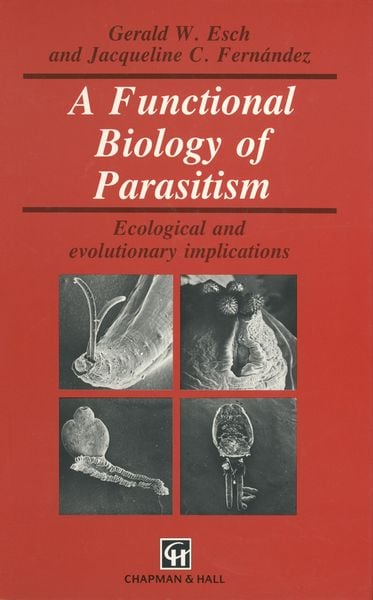
A Functional Biology of Parasitism Ecological and evolutionary implications

49,99 €

inkl. gesetzl. MwSt., Versandkostenfrei


Beschreibung

Produktdetails

Einband

Taschenbuch

Erscheinungsdatum

23.08.2014

Abbildungen

XIII, 337 p.

Herausgeber

G.W. Esch + weitere

Verlag

Springer Netherland

Seitenzahl

337

Maße (L/B/H)

23,5/15,5/2 cm

Gewicht

540 g

Auflage

1993

Sprache

Englisch

ISBN

978-94-010-5039-5

Beschreibung

Produktdetails

Einband

Taschenbuch

Erscheinungsdatum

23.08.2014

Abbildungen

XIII, 337 p.

Herausgeber

Verlag

Springer Netherland

Seitenzahl

337

Maße (L/B/H)

23,5/15,5/2 cm

Gewicht

540 g

Auflage

1993

Sprache

Englisch

ISBN

978-94-010-5039-5

Herstelleradresse

Springer-Verlag KG
Sachsenplatz 4-6
1201 Wien
AT

Email: ProductSafety@springernature.com

Noch keine Bewertungen vorhanden

Verfassen Sie die erste Bewertung zu diesem Artikel

Helfen Sie anderen Kundinnen und Kunden durch Ihre Meinung.

Kundinnen und Kunden meinen

Bewertungen (0)

Die Leseprobe wird geladen.
  • Produktbild: A Functional Biology of Parasitism
  • Produktbild: A Functional Biology of Parasitism
  • 1 Introduction.- 1.1 The extent of parasitism.- 1.2 Definitions.- 1.3 The concept of harm.- 1.4 Some adaptations to parasitism.- 1.5 Life cycle and ecology.- >2 Population concepts.- 2.1 Background.- 2.2 General definitions.- 2.3 Factors affecting parasite populations.- 2.4 The dispersion concept.- 2.5 Dynamics of population growth.- 3 Factors influencing parasite populations.- 3.1 Density-independent factors: introduction.- 3.2 Density-independent factors: case histories.- 3.3 Density-dependent factors: introduction.- 3.4 Density-dependent factors: case histories.- 3.5 Suprapopulation dynamics: introduction.- 3.6 Suprapopulation dynamics: case histories.- 4 Influence of parasites on host populations.- 4.1 Introduction to the concept of regulation.- 4.2 Crofton’s approach.- 4.3 Overdispersion and regulation: introduction.- 4.4 Overdispersion and regulation: case histories.- 4.5 Epidemiological implications.- 4.6 Models.- 5 Life history strategies.- 5.1 Introduction.- 5.2 Reproductive strategies.- 5.3 Colonization strategies.- 5.4 Host behaviour and transmission.- 5.5 Theoretical considerations.- 6 Infracommunity dynamics.- 6.1 Introduction.- 6.2 The evolution of parasite communities.- 6.3 Infracommunity structure.- 6.4 The screen/filter concept.- 7 Component and compound communities.- 7.1 Introduction.- 7.2 Core-satellite and generalist-specialist species concepts.- 7.3 Determinants of component communities.- 7.4 Habitat variability (succession) and parasitism.- 7.5 The biocoenosis and parasite flow.- 7.6 The allogenic-autogenic species concept.- 8 Biogeographical aspects.- 8.1 Introduction.- 8.2 Factors affecting the geographical distribution of parasites.- 8.3 Patterns of distribution.- 8.4 Ecological aspects.- 8.5 Applied aspects of biogeography.- 9 Evolutionaryaspects.- 9.1 Introduction.- 9.2 Microevolution.- 9.3 Evolution of host-parasite interactions.- 9.4 Parasite influence in the evolutionary biology of the host.- 10 Summary.- 10.1 Introduction.- 10.2 Population concepts.- 10.3 Factors influencing parasite populations.- 10.4 Influence of parasites on host populations.- 10.5 Life-history strategies.- 10.6 Infracommunity dynamics.- 10.7 Component and compound communities.- 10.8 Biogeographical aspects.- 10.9 Evolutionary aspects.- 10.10 What next for the evolution and ecology of parasitism?.- References.- Taxonomic host index.- Taxonomic parasite index.