
KI-Beratung Beta

Gutscheinbedingungen

**Gültig am 01.10.2026 ab einem Mindestbestellwert von 30€ auf Spielzeug, Schreibwaren, Filme, Geschenke & Trends, Musik, tolino eReader & Zubehör, Hörbücher und Hörbuch-Downloads, nicht preisgebundene Bücher und Kalender online auf thalia.at und in der Thalia App. Einzelne Artikel können ausgeschlossen sein. Aufgrund der Buchpreisbindung sind deutschsprachige Bücher und eBooks ausgenommen. Zusätzlich ausgenommen sind Abos & Flatrates, Games, Geschenkkarten/-boxen, Shelfies, Software, Zeitschriften sowie einzelne Artikel von tonies®. Pro Einkauf einmal einlösbar. Click & Collect nur bei Onlinevorabzahlung möglich. Keine Barauszahlung. Nicht kombinierbar mit anderen Aktionen und Gutscheinen. Gutschein wird auf max. 500€ Bestellwert angerechnet. Nicht gültig für Versandkosten und Services. Preisgebundene Artikel sind vom Mindestbestellwert ausgeschlossen.

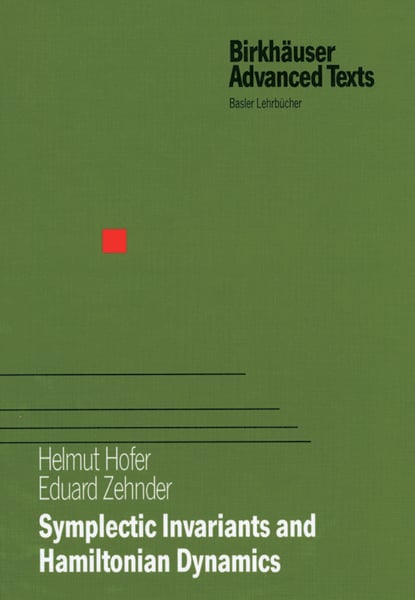
  • Produktbild: Symplectic Invariants and Hamiltonian Dynamics
  • Produktbild: Symplectic Invariants and Hamiltonian Dynamics

Symplectic Invariants and Hamiltonian Dynamics

74,99 €

inkl. gesetzl. MwSt., Versandkostenfrei


Beschreibung

Produktdetails

Einband

Taschenbuch

Erscheinungsdatum

13.10.2012

Abbildungen

XIII, 346 p. 2 illus.

Verlag

Springer Basel

Seitenzahl

346

Maße (L/B/H)

25,4/17,8/2 cm

Gewicht

684 g

Auflage

1994

Sprache

Englisch

ISBN

978-3-0348-9671-9

Beschreibung

Produktdetails

Einband

Taschenbuch

Erscheinungsdatum

13.10.2012

Abbildungen

XIII, 346 p. 2 illus.

Verlag

Springer Basel

Seitenzahl

346

Maße (L/B/H)

25,4/17,8/2 cm

Gewicht

684 g

Auflage

1994

Sprache

Englisch

ISBN

978-3-0348-9671-9

Herstelleradresse

Springer-Verlag GmbH
Tiergartenstr. 17
69121 Heidelberg
DE

Email: ProductSafety@springernature.com

Noch keine Bewertungen vorhanden

Verfassen Sie die erste Bewertung zu diesem Artikel

Helfen Sie anderen Kundinnen und Kunden durch Ihre Meinung.

Kundinnen und Kunden meinen

Bewertungen (0)

  • Produktbild: Symplectic Invariants and Hamiltonian Dynamics
  • Produktbild: Symplectic Invariants and Hamiltonian Dynamics
  • 1 Introduction.- 1.1 Symplectic vector spaces.- 1.2 Symplectic diffeomorphisms and Hamiltonian vector fields.- 1.3 Hamiltonian vector fields and symplectic manifolds.- 1.4 Periodic orbits on energy surfaces.- 1.5 Existence of a periodic orbit on a convex energy surface.- 1.6 The problem of symplectic embeddings.- 1.7 Symplectic classification of positive definite quadratic forms.- 1.8 The orbit structure near an equilibrium, Birkhoff normal form.- 2 Symplectic capacities.- 2.1 Definition and application to embeddings.- 2.2 Rigidity of symplectic diffeomorphisms.- 3 Existence of a capacity.- 3.1 Definition of the capacity c0.- 3.2 The minimax idea.- 3.3 The analytical setting.- 3.4 The existence of a critical point.- 3.5 Examples and illustrations.- 4 Existence of closed characteristics.- 4.1 Periodic solutions on energy surfaces.- 4.2 The characteristic line bundle of a hypersurface.- 4.3 Hypersurfaces of contact type, the Weinstein conjecture.- 4.4 “Classical” Hamiltonian systems.- 4.5 The torus and Herman’s Non-Closing Lemma.- 5 Compactly supported symplectic mappings in ?2n.- 5.1 A special metric d for a group D of Hamiltonian diffeomorphisms.- 5.2 The action spectrum of a Hamiltonian map.- 5.3 A “universal” variational principle.- 5.4 A continuous section of the action spectrum bundle.- 5.5 An inequality between the displacement energy and the capacity.- 5.6 Comparison of the metric d on D with the C0-metric.- 5.7 Fixed points and geodesics on D.- 6 The Arnold conjecture, Floer homology and symplectic homology.- 6.1 The Arnold conjecture on symplectic fixed points.- 6.2 The model case of the torus.- 6.3 Gradient-like flows on compact spaces.- 6.4 Elliptic methods and symplectic fixed points.- 6.5 Floer’s appraoch to Morse theory for the actionfunctional.- 6.6 Symplectic homology.- A.2 Action-angle coordinates, the Theorem of Arnold and Jost.- A.4 The Cauchy-Riemann operator on the sphere.- A.5 Elliptic estimates near the boundary and an application.- A.6 The generalized similarity principle.- A.7 The Brouwer degree.- A.8 Continuity property of the Alexander-Spanier cohomology.