KI-Beratung Beta

Gutscheinbedingungen

**Gültig bis 05.10.2026 ab einem Mindestbestellwert von 30€ auf Spielzeug, Schreibwaren, Filme, Geschenke & Trends, Musik, tolino eReader & Zubehör, Hörbücher und Hörbuch-Downloads, nicht preisgebundene Bücher und Kalender online auf thalia.at und in der Thalia App. Einzelne Artikel können ausgeschlossen sein. Aufgrund der Buchpreisbindung sind deutschsprachige Bücher und eBooks ausgenommen. Zusätzlich ausgenommen sind Abos & Flatrates, Games, Geschenkkarten/-boxen, Shelfies, Software, Zeitschriften sowie einzelne Artikel von tonies®. Pro Einkauf einmal einlösbar. Nur gültig mit im Onlineshop hinterlegter Bonuscard. Click & Collect nur bei Onlinevorabzahlung möglich. Keine Barauszahlung. Nicht kombinierbar mit anderen Aktionen und Gutscheinen. Gutschein wird auf max. 500€ Bestellwert angerechnet. Nicht gültig für Versandkosten und Services. Preisgebundene Artikel sind vom Mindestbestellwert ausgeschlossen.

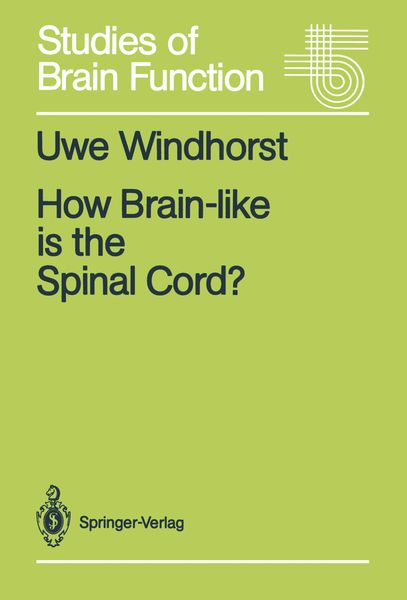
Produktbild: How Brain-like is the Spinal Cord?
Band 15

How Brain-like is the Spinal Cord? Interacting Cell Assemblies in the Nervous System

51,99 €

inkl. gesetzl. MwSt., Versandkostenfrei


Beschreibung

Produktdetails

Einband

Taschenbuch

Erscheinungsdatum

26.05.2012

Abbildungen

XVIII, 334 p.

Verlag

Springer Berlin

Seitenzahl

334

Maße (L/B/H)

24,4/17/2 cm

Gewicht

615 g

Auflage

Softcover reprint of the original 1st ed. 1988

Sprache

Englisch

ISBN

978-3-642-51122-6

Beschreibung

Produktdetails

Einband

Taschenbuch

Erscheinungsdatum

26.05.2012

Abbildungen

XVIII, 334 p.

Verlag

Springer Berlin

Seitenzahl

334

Maße (L/B/H)

24,4/17/2 cm

Gewicht

615 g

Auflage

Softcover reprint of the original 1st ed. 1988

Sprache

Englisch

ISBN

978-3-642-51122-6

Herstelleradresse

Springer-Verlag KG
Sachsenplatz 4-6
1201 Wien
AT

Email: ProductSafety@springernature.com

Noch keine Bewertungen vorhanden

Verfassen Sie die erste Bewertung zu diesem Artikel

Helfen Sie anderen Kundinnen und Kunden durch Ihre Meinung.

Kundinnen und Kunden meinen

Bewertungen (0)

  • Produktbild: How Brain-like is the Spinal Cord?
  • 1 Correlations Between Spike Trains of Supraspinal Neurones.- 1.1 Correlations Between Discharge Patterns of Cortical Neurones.- 1.2 The Basic Method of Cross-Correlating Spike Trains.- 1.3 Correlations Between Discharge Patterns of Cortical Neurones and Their Role in Some Recent Models of Brain function.- 1.4 Brainstem.- 2 Correlations Between Spinal Neurones.- 2.1 Correlations Between ?-Motoneurone Discharges.- 2.2 Correlations Between ?-Motoneurone Discharges.- 2.3 Correlations Between ?-Motoneurone Discharges.- 2.4 Summary.- 2.5 Correlations Between Muscle Afferent Discharges.- 2.6 The Effect of Fusimotor Input on Spindle Afferent Correlations.- 2.7 Summary.- 2.8 Effects of Correlations Between Presynaptic Fibres on Spinal Neurones.- 2.9 Interneuronal Circuits.- 3 Tremor States.- 3.1 Frequency-Displacement Amplitude Relations for Normal Hand Tremor.- 3.2 Muscle Contraction as a Stochastic Process.- 3.3 Localised Stretch Reflexes Acting as a Tremor-Suppressive Mechanism?.- 3.4 Further Feedback Systems.- 3.5 Plasticity in the Spinal Cord.- 3.6 Summary.- 4 Recurrent Inhibition and Proprioceptive Feedback.- 4.1 Fundamental Functions of the Spinal Cord.- 4.2 Specific Functions of Recurrent Inhibition and the Stretch Reflex.- 4.3 Structural and Functional Analogies Between Spinal Recurrent Inhibition and Proprioceptive Feedback.- 4.4 The Reafference Principle.- 4.5 The Renshaw Cell System as an Efference Copy?.- 4.6 Model-Reference Control Systems.- 4.7 Adaptive Control Systems.- 4.8 An Integrated Model Including Proprioceptive Feedback and Recurrent Inhibition.- 4.9 Remarks on the Function of the Integrated System.- 4.10 Are the Inputs to ?-Motoneurones and Renshaw Cells Matched to Each Other?.- 4.11 Relation of Fusi- and Skeletomotor Activation Patterns: TaskDependence.- 4.12 ?-Motoneurones and Renshaw Cells as Integrative Centres.- 4.13 Suggestions for Further Research.- 4.14 Summary.- 5 Problems in Motor Control.- 5.1 On the Modules of Motor Control.- 5.2 The Problem of the Variable(s) Controlled in Motor Acts.- 5.3 Which Are the Measured Variables?.- 5.4 Spatial Transformations.- 5.5 Temporal Aspects.- 5.6 Multimodal Organisation of Spinal Neural Assemblies.- 5.7 Summary.- 5.8 Concluding Remarks.- Appendix A Auto- and Cross-Correlations.- Appendix B Cross-Correlations Between Three Spike Trains.- Appendix C Event-Related Cross-Correlations.- Appendix D Statistical Analysis of Nonlinear Physiological Systems.- Appendix E On Spurious Synchronisation of Two Semiregularly Firing Neurones.- Appendix F Spectral Analysis.- Appendix G A Remark on Correlation Patterns.- References.