
Gutscheinbedingungen

**Gültig bis 06.07.2026 auf fremdsprachige Bücher online auf thalia.at, in der Thalia App ab einem Mindestbestellwert von 30€ und in allen Thalia Buchhandlungen in Österreich. In den Buchhandlungen nur gültig auf lagernde Ware. Einzelne Artikel können ausgeschlossen sein. Ausgenommen sind preisgebundene Artikel & eBooks. Pro Einkauf einmal einlösbar. Nur gültig gegen Vorlage oder im Onlineshop hinterlegter Bonuscard. Infos zur Einlösung in der Buchhandlung sind auf der Bonuscard-Vorteilspreisseite zu finden. Click & Collect nur bei Onlinevorabzahlung möglich. Keine Einlösung bei Scan & Go-Bezahlung. Keine Barauszahlung. Nicht kombinierbar mit anderen Aktionen und Gutscheinen. Gutschein wird auf max. 500€ Bestellwert angerechnet. Nicht gültig für Versandkosten und Services.

Beschreibung

Produktdetails

Einband

Taschenbuch

Erscheinungsdatum

15.06.2012

Abbildungen

XIV, 143 illus., 28 illus. in color., schwarz-weiss Illustrationen, farbige Illustrationen

Verlag

Springer Wien

Seitenzahl

244

Maße (L/B/H)

24,4/17/1,5 cm

Gewicht

475 g

Auflage

Softcover reprint of the original 1st ed. 2002

Sprache

Englisch

ISBN

978-3-7091-3227-2

Beschreibung

Rezension

"The series should be required reading for all neurosurgeons in training and a core part of every neurosurgical departmental library." British Journal of Neurosurgery

Produktdetails

Einband

Taschenbuch

Erscheinungsdatum

15.06.2012

Abbildungen

XIV, 143 illus., 28 illus. in color., schwarz-weiss Illustrationen, farbige Illustrationen

Verlag

Springer Wien

Seitenzahl

244

Maße (L/B/H)

24,4/17/1,5 cm

Gewicht

475 g

Auflage

Softcover reprint of the original 1st ed. 2002

Sprache

Englisch

ISBN

978-3-7091-3227-2

Herstelleradresse

Springer Wien
Prinz-Eugen-Str. 8-10
1040 Wien
AT
buchhandel-buch@springer.com

Noch keine Bewertungen vorhanden

Verfassen Sie die erste Bewertung zu diesem Artikel

Helfen Sie anderen Kundinnen und Kunden durch Ihre Meinung.

Kundinnen und Kunden meinen

Bewertungen (0)

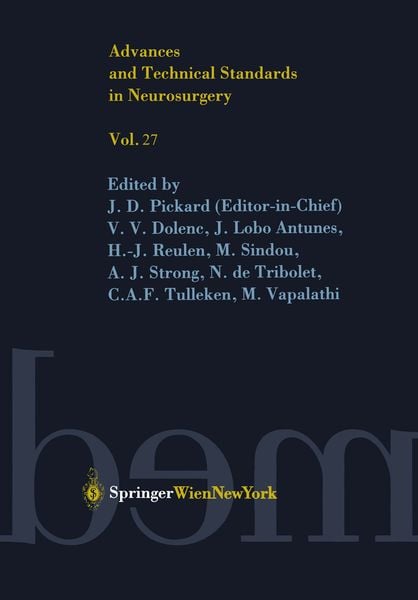
  • Produktbild: Advances and Technical Standards in Neurosurgery
  • Produktbild: Advances and Technical Standards in Neurosurgery
  • A. Advances.- Neurobiology of Epileptogenesis in the Temporal Lobe.- Reorganisation of Neuronal Circuitries Underlying Epileptogenesis in the Hippocampus.- Anatomy.- Neuronal Loss.- Neurogenesis.- Gliosis.- Axonal Plasticity.- Dendritic Plasticity.- Reorganisation of Neuronal Circuitries in the Amygdala.- Anatomy.- Neuronal Loss.- Reorganisation of Neuronal Circuitries in the Entorinal Cortex.- Anatomy.- Neuronal Loss and Sprouting.- Conclusions.- Acknowledgements.- References.- Diffuse Axonal Injury after Head Trauma. A Review.- Fundamental Structure and Function of the Central Nervous System Axon.- The Axonal Membrane (Axolemma).- Microtubules and Neurofilaments. The Neuronal Cytoskeleton.- Axonal Transport and its Mechanisms.- Calcium and Calcium-Dependent Breakdown of Neurofilaments.- Physiopathology of Head Injury. Diffuse Versus Focal Injuries.- Post-Traumatic Cellular Events and the Concept of Traumatic Penumbra.- Classical Definition of Traumatic Diffuse Axonal Injury.- Biomechanics of Diffuse Axonal Injury.- Characteristics of Mechanical Loading.- The Centripetal Theory of Ommaya.- The Centripetal Theory and the Concept of Primary Brainstem Injury.- The Reticular Formation and the Primary Brainstem Damage Saga.- Clinical and Experimental Validation of the Centripetal Theory.- The Neuropathological Spectrum of DAI.- Focal Lesions Observed in the Brain in DAI.- Pathogenesis of the Corpus Callosum Hemorrhages.- Neuropathological Grading of DAI.- Axonal Retraction Balls, Microglial Stars and Wallerian Degeneration.- Axonal Retraction Balls.- Microglial Clusters (Microglial Stars).- Wallerian Degeneration.- Experimental Models of DAI.- Marmarou’s Rodent Model of DAI.- Changing Concepts in Diffuse Axonal Injury. Is DAI Always a Primary Lesion?.- Experimental Evidence of Secondary Axotomy in Closed Head Injuries.- Pathogenesis of Diffuse Axonal Injury.- Stage I: Axonal Membrane Injury and Alterations in Ionic Fluxes.- Stage II: Reversible Cytoskeletal Damage.- Stage III: Secondary Axotomy.- Stage IV: Primary Axotomy.- Mechanoporation, Calcium Influx and Cytoskeletal Abnormalities.- Is Diffuse Axonal Injury a Universal Finding after Severe Head Injury?.- Clinico-Radiological Diagnosis of Diffuse Axonal Injury.- Cranial Fractures in Patients with Diffuse Axonal Injury.- CT Scan Findings.- The Role of MRI in the Study of Postraumatic DAI.- Diffuse Axonal Injury in Minor Head Injuries.- Late Consequences of DAI.- Specific Therapies that may be Effective Against DAI.- Magnesium—the Magic Bullet?.- Neuroprotective Effects of Hypothermia.- Cyclosporin-A and its Effect on DAI.- Hope for the Future.- Acknowledgments.- References.- Multi-Modal Monitoring of Acute Brain Injury.- Abstract.- Aspects of Cerebral Pathophysiology.- Relationships Between ICP, CPP and Cerebral Blood Flow.- Transcranial Doppler Ultrasonography for Assessing Autoregulation.- Static Test of Autoregulation.- TCD Reactivity of Changes in Arterial Carbon PaCO2.- Dynamic Test of Autoregulation.- Transient Hyperaemic Response Test.- Continuous analysis of TCD Using Respiratory Waves.- Continuous analysis of TCD Flow Velocity Waveform.- Non-Invasive Assessment of Brain Perfusion.- Computer Support for Data Analysis.- Continuous EEG monitoring.- Aspects of Cerebral Oxygenation—Brain Gas Analysis.- Jugular Bulb Oximetry.- Normal Values and Ischaemic Thresholds.- Arteriovenous Difference in Oxygen Content.- Factors which Influence SjvO2.- Arterial Oxygen Content.- Cerebral Blood Flow and Perfusion Pressure.- Cerebral Metabolic Rate.- Clinical Use of SjvO2.- Brain Tissue Oxygen Probes.- Normal Values for PtiO2.- Ischaemic Thresholds of PtiO2.- Factors that Influence PtiO2.- Hypoxia.- Cerebral Perfusion Pressure.- Hypocapnia.- Cerebral Blood Flow.- Cerebral Metabolic Rate.- Hyperoxia.- Probe Depth.- Aspects of Cerebral Metabolism—Microdialysis.- Methodology.- Microdialysis Pumps.- Microdialysis Catheters.- Chemical Analysis.- Catheter Fixation.- Clinical Applications.- Conclusion.- Acknowledgements.- References.- B. Technical Standards.- Endoscopic Endonasal Transsphenoidal Surgery.- History.- Pre-Operative Study.- Indications.- Surgical Technique.- Nasal Phase.- Natural Ostium Enlargement.- Preparation of the Sphenoid Sinus and Opening of the Sella.- Tumor Removal.- Clinical Material.- Discussion.- Acknowledgments.- References.- Extracranial Vertebral Artery Anatomy and Surgery.- Surgical Anatomy.- Surgical Exposure.- Anterolateral Approach (ALA).- First Segment.- Second Segment.- Third Segment.- Posterolateral Approach (PLA).- Indications of VA Surgical Exposure.- Intrinsic Lesions.- Extrinsic Lesions.- Intermittent Compression.- Permanent Compression.- Improvement of Exposure.- Anterior Part of the Spinal Canal.- Foramen Magnum.- Jugulare Foramen Tumors — Juxtacondylar Approach.- Personal Experience.- Conclusion.- References.- Neurosurgical Management of Pineal Tumours.- Incidence of Pineal Tumours.- Surgical Strategy with Consideration of Postsurgical Adjuvant Therapies.- Surgical Anatomy.- Selection of Approaches.- Surgical Approaches.- Instrumentation.- Occipital Transtentorial Approach.- Infratentorial Supracerebellar Approach.- Complications.- Conclusion.- Acknowledgment.- References.