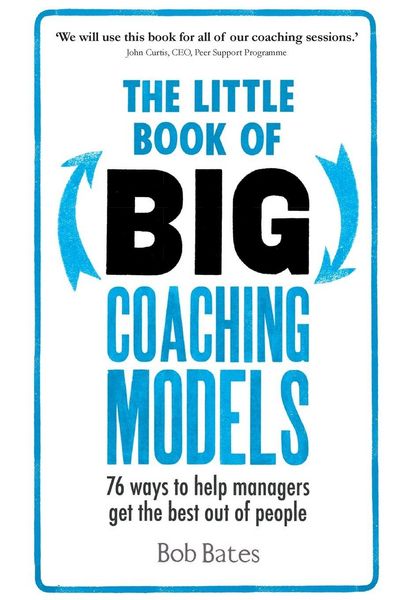
Produktbild: The Little Book of Big Coaching Models

The Little Book of Big Coaching Models 76 ways to help managers get the best out of people

16,50 €

inkl. gesetzl. MwSt., zzgl. Versandkosten


  • Kostenlose Lieferung ab 30 € Einkaufswert
  • Versandkostenfrei für Bonuscard-Kund*innen

Beschreibung

Produktdetails

Einband

Taschenbuch

Erscheinungsdatum

19.02.2015

Verlag

KNV Besorgung

Seitenzahl

272

Maße (L/B/H)

23,4/15,6/1,5 cm

Gewicht

418 g

Sprache

Englisch

ISBN

978-1-292-08149-6

Beschreibung

Produktdetails

Einband

Taschenbuch

Erscheinungsdatum

19.02.2015

Verlag

KNV Besorgung

Seitenzahl

272

Maße (L/B/H)

23,4/15,6/1,5 cm

Gewicht

418 g

Sprache

Englisch

ISBN

978-1-292-08149-6

Herstelleradresse

Libri GmbH
Europaallee 1
36244 Bad Hersfeld
DE

Email: gpsr@libri.de

Kundinnen und Kunden meinen

0 Bewertungen

Informationen zu Bewertungen

Zur Abgabe einer Bewertung ist eine Anmeldung im Konto notwendig. Die Authentizität der Bewertungen wird von uns nicht überprüft. Wir behalten uns vor, Bewertungstexte, die unseren Richtlinien widersprechen, entsprechend zu kürzen oder zu löschen.

Die Bewertungen sind nach Format, Anzahl Sterne und Datum sortiert.

Verfassen Sie die erste Bewertung zu diesem Artikel

Helfen Sie anderen Kund*innen durch Ihre Meinung

Kundinnen und Kunden meinen

0 Bewertungen filtern

  • Produktbild: The Little Book of Big Coaching Models
    • PART 1 MAKING A START  
    • Introduction
    • SECTION 1 UNDERSTAND HOW PEOPLE THINK AND LEARN
    • Introduction
    • 1 Malcolm Knowles: How adults learn
    • 2 Neil Fleming: VAK 
    • 3 David Kolb: Experiential learning cycle
    • 4 Katherine Myers and Isabel Briggs: The Myers-Briggs Type Indicator
    • SECTION 2 UNDERSTAND WHAT MOTIVATES PEOPLE
    • Introduction 
    • 5 John Keller: The ARCS model of motivational design
    • 6 Douglas McGregor: X and Y theory 
    • 7 Frederick Herzberg: Hygiene factors and KITAs 
    • SECTION 3 BE A GOOD COMMUNICATOR
    • Introduction
    • 8 Michael Argyle: The communication cycle model
    • 9 Eric Berne: Transactional analysis
    • 10 Joseph Luft and Harry Ingram: Johari windows
    • SECTION 4 SET THE RIGHT OBJECTIVES
    • Introduction
    • 11 Benjamin Bloom: Levels in the cognitive domain
    • 12 Ravindrakumar Dave: Levels in the psychomotive domain
    • 13 David Krathwol and Benjamin Bloom: Levels in the affective domain
    • SECTION 5 COACHING THROUGH DIRECTING
    • Introduction
    • 14 Ivan Pavlov: Classical conditioning
    • 15 Edwin Guthrie: Contiguity theory
    • 16 Robert Merton: Self-fulfilling prophecy
    • SECTION 6 COACHING THROUGH FACILITATING
    • Introduction
    • 17 Abraham Maslow: Hierarchy of needs
    • 18 Carl Rogers: Facilitation
    • 19 Jack Mezirow: Transformational learning
    • SECTION 7 COACHING THROUGH SHOWING OTHERS HOW TO DO IT
    • Introduction
    • 20 The Gestaltists: Insight theory
    • 21 Karl Pribram, George Miller and Eugene Gallanter: Test-Operate-Test-Exit (TOTE)
    • 22 Albert Bandura: Role modelling
    • SECTION 8 COACHING THROUGH STIMULATING
    • Introduction
    • 23 Donald Hebb: Associative learning
    • 24 Leon Festinger: Cognitive dissonance
    • 25 Michael Merzenich: Neuroplasticity
    • SECTION 9 DEALING WITH CHALLENGING BEHAVIOUR
    • Introduction
    • 26 Kurt Lewin: Reshaping behaviour
    • 27 Peter Honey: Behaviour modification
    • 28 Robert Hare: Psychopathic checklist
    • PART 2 TAKING IT FURTHER
    • Introduction
    • 29 Richard Bandler and John Grinder: Neuro-Linguistic Programming (NLP)
    • 30 Gregory Bateson: Neuro-logical levels
    • 31 Donald Broadbent: Filtering
    • 32 Marty Brounstein: The Five Pillars for Building Commitment
    • 33 Arthur Costa and Bena Kallick: The coach as a critical friend
    • 34 Edward De Bono: The six thinking hats
    • 35 Robert Dilts: The Disney creativity strategy
    • 36 Gerard Egan: The skilled helper model
    • 37 Ferdinand Fournies: Coaching discussion plan
    • 38 Tim Gallwey: The inner game
    • 39 Howard Gardner: Multiple intelligence
    • 40 Andrew Gilbert and Karen Whittleworth: The OSCAR model
    • 41 Daniel Goleman: Emotional intelligence
    • 42 Bruce Grimley: The 7Cs coaching model
    • 43 John Grinder: New Behaviour Generator
    • 44 Richard Hale and Eileen Hutchinson: The INSIGHT coaching cycle
    • 45 Peter Hawkins: The CLEAR model
    • 46 Jon Kabat-Zinn: Mindfulness
    • 47 Max Landsberg: The Tao of coaching
    • 48 David Lane and Sarah Corrie: Purpose, perspectives a