
• Produktbild: A Cultural-Historical Study of Children Learning Science
  • Produktbild: A Cultural-Historical Study of Children Learning Science
Band 11 - 13%

A Cultural-Historical Study of Children Learning Science Foregrounding Affective Imagination in Play-based Settings

13% sparen

123,99 € UVP 142,99 €

inkl. gesetzl. MwSt., Versandkostenfrei


Beschreibung

Produktdetails

Einband

Gebundene Ausgabe

Erscheinungsdatum

14.10.2014

Abbildungen

XIX, 13 illus., 11 illus. in color., farbige Illustrationen, schwarz-weiss Illustrationen

Verlag

Springer Netherland

Seitenzahl

213

Maße (L/B/H)

24,1/16/1,9 cm

Gewicht

493 g

Auflage

1. Auflage

Sprache

Englisch

ISBN

978-94-017-9369-8

Beschreibung

Produktdetails

Einband

Gebundene Ausgabe

Erscheinungsdatum

14.10.2014

Abbildungen

XIX, 13 illus., 11 illus. in color., farbige Illustrationen, schwarz-weiss Illustrationen

Verlag

Springer Netherland

Seitenzahl

213

Maße (L/B/H)

24,1/16/1,9 cm

Gewicht

493 g

Auflage

1. Auflage

Sprache

Englisch

ISBN

978-94-017-9369-8

Herstelleradresse

Springer-Verlag KG
Sachsenplatz 4-6
1201 Wien
AT

Email: GPSR Kontakt

Noch keine Bewertungen vorhanden

Verfassen Sie die erste Bewertung zu diesem Artikel

Helfen Sie anderen Kundinnen und Kunden durch Ihre Meinung.

Kundinnen und Kunden meinen

Bewertungen (0)

Weitere Artikel finden Sie in

Die Leseprobe wird geladen.
  • Produktbild: A Cultural-Historical Study of Children Learning Science
  • Produktbild: A Cultural-Historical Study of Children Learning Science
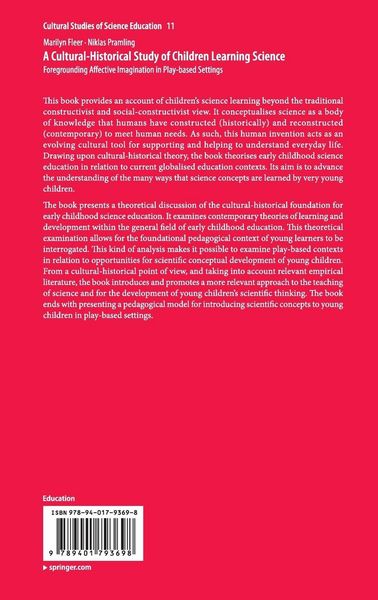
  • Section 1: Theoretical foundations for learning science in early childhood.- Learning science in everyday life – a cultural-historical framework.- How preschools environments afford science learning.- Imagination and its contributions to learning in science.- Theoretical and conceptual insights – the young learner in science.- Section 2: Knowledge construction in science.- Knowledge construction in early childhood science:  The human invention of empirical, narrative and theoretical.- Knowledge construction is culturally situated.- Positioning children in research and the implications for our images of their competence.- Section 3: The pedagogical construction of learning science.- Learning and metaphor: Bridging the gap between the familiar and the unfamiliar .- Simile, metaphor and learning to perceive the world in functional and culturally relevant ways.- Learning to ‘read’ and produce graphical representations.- The nature of educational encounters.- Theoretical and conceptual insights – representations in science.- Section 4: Models of early childhood teaching.- A cultural-historical model of early childhood science education.