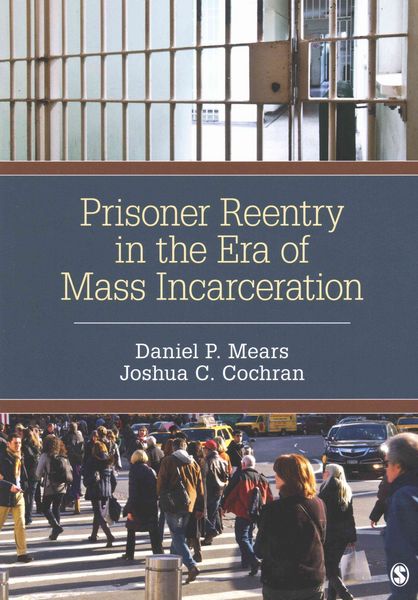
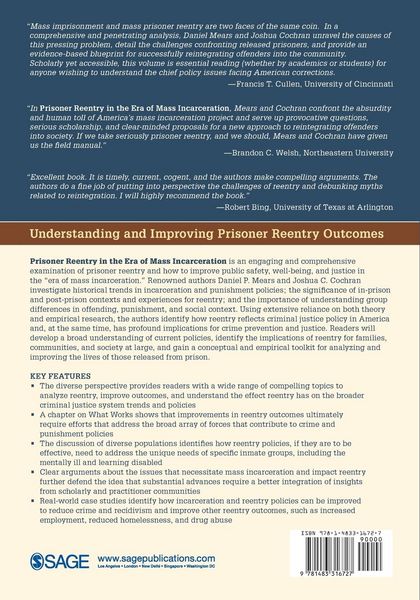
• Produktbild: Prisoner Reentry in the Era of Mass Incarceration
  • Produktbild: Prisoner Reentry in the Era of Mass Incarceration

Prisoner Reentry in the Era of Mass Incarceration

95,99 €

inkl. gesetzl. MwSt., Versandkostenfrei


Beschreibung

Produktdetails

Einband

Taschenbuch

Erscheinungsdatum

30.10.2014

Verlag

Sage Publications

Seitenzahl

344

Maße (L/B/H)

25,4/17,8/1,9 cm

Gewicht

650 g

Sprache

Englisch

ISBN

978-1-4833-1672-7

Beschreibung

Produktdetails

Einband

Taschenbuch

Erscheinungsdatum

30.10.2014

Verlag

Sage Publications

Seitenzahl

344

Maße (L/B/H)

25,4/17,8/1,9 cm

Gewicht

650 g

Sprache

Englisch

ISBN

978-1-4833-1672-7

Herstelleradresse

Libri GmbH
Europaallee 1
36244 Bad Hersfeld
DE

Email: gpsr@libri.de

Noch keine Bewertungen vorhanden

Verfassen Sie die erste Bewertung zu diesem Artikel

Helfen Sie anderen Kundinnen und Kunden durch Ihre Meinung.

Kundinnen und Kunden meinen

Bewertungen (0)

  • Produktbild: Prisoner Reentry in the Era of Mass Incarceration
  • Produktbild: Prisoner Reentry in the Era of Mass Incarceration
  • Chapter 1: Introduction
    Mass Incarceration and Reentry
    The Goals of This Book
    Criminological "Versus" Criminal Justice Theory and Research
    Terminology and Scope
    Organization of the Book
    Chapter 2: Historical Trends in Corrections and Reentry Policy and Practice
    Trends in Correctional Populations: The Era of Mass Corrections
    Trends in Reentry Policy and Practice
    The Theory, or Causal Logic, of the Punitive Turn in Sanctioning Convicted Felons
    Implications of Historical Trends in Incarceration and Reentry Policy and Practice
    Conclusion
    Discussion Questions
    Chapter 3: The Causes of Mass Incarceration and Thus Mass Reentry
    Causal Complexity in Understanding the Punitive Turn
    Cause 1: Not Crime
    Cause 2: Public Demand for Increased Punitive Sanctioning
    Cause 3: Conservatism, Race, Moral Panics, and the Politicization of Crime
    Cause 4: Increased Belief in the Idea That Individual Responsibility Matters Most
    Cause 5: Exaggerated Claims for Incarceration
    Cause 6: Discounting Effectiveness of Non-Incarcerative Sanctions
    Cause 7: Inadequate Research Documenting the Need for Specific Types of Sanctions
    Cause 8: Economics
    Cause 9. Systems-Level Forces and Dynamics
    Causal Complexity Revisited
    Conclusion, or Why Understanding the Punitive Turn Is Relevant for Reentry Policy
    Discussion Questions
    Chapter 4: Profile of the Inmate Population
    Why Inmate and Ex-Prisoner Characteristics Matter
    Inmate and Ex-Prisoner Characteristics
    The "Typical Inmate" Profile
    Why Inmate Profiles Change Over Time
    Conclusion
    Discussion Questions
    Chapter 5: The Prison Experience
    Why What Happens in Prison Is Relevant for Understanding Reentry
    The Implications of In-Prison Crime and Misconduct
    Prison Experiences that May Have Implications for Prisoner Reentry
    How Inmates Perceive Themselves and the Prison Experience and Why It Matters
    The (Lack of) Evidence on the Effectiveness of Incarceration
    Concepts of What the Prison Experience Should Be
    Making Greater Accountability Happen
    Conclusion
    Discussion Questions
    Chapter 6: The Reentry Experience and Reentry Challenges
    The Reentry Process and Experience
    The Logic of "Invisible" Punishments and Their Consequences
    Specific Challenges During Reentry
    Implications of Reentry Challenges for Ex-Prisoners and Families and Communities
    Conclusion
    Discussion Questions
    Chapter 7: Recidivism and Risk Prediction
    The Atheoretical Foundation of Mass Incarceration
    The A Priori, Theoretically Predictable Consequences of Incarceration
    Recidivism Rates-A Depressing Problem
    Risk Prediction Approaches
    Risk Prediction Success
    The Challenges of Risk Prediction
    Approaches to Improve Risk Prediction
    Shifting the Focus of Risk Prediction
    Conclusion
    Discussion Questions
    Chapter 8: Diverse Inmate Populations and Reentry
    The Diversity of the Inmate and Ex-Prisoner Population and Why It Matters
    The Youngest Ex-Prisoners
    Female Ex-Prisoners
    Racial and Ethnic Minority Ex-Prisoners
    Other Groups of Ex-Prisoners
    Super-Maximum Security Ex-Prisoners
    Drug-Abusing Ex-Prisoners
    Mentally Ill or Learning Disabled Ex-Prisoners
    Still Other Groups of Ex-Prisoners
    Revisiting Sanctioning and Reentry
    Conclusion
    Discussion Questions
    Chapter 9: Reentry Policy and What Works to Improve Reentry Outcomes
    The Ineffectiveness of Incarceration in Improving Public Safety or Other Outcomes
    The Ineffectiveness of Incarceration Due to Collateral Consequences
    Corrections Efforts Frequently Rest on Weak Theoretical and Empirical Grounds
    Minimal Evaluation of Most Reentry Policies, Programs, and Practices
    Pre-Prison, In-Prison, and Postrelease Approaches to Successful Reentry
    General Guidelines and Strategies for Improving Reentry
    The Importance of Evidence of Cost-Efficiency, Not Just Impacts
    The Need for an Offender, Victim, and Community Justice System
    Reentry Lessons and Convicted Felons Who Don't Go to Prison
    The Importance of Government Accountability and Evidence-Based Practice
    Conclusion
    Discussion Questions
    Chapter 10: Conclusion