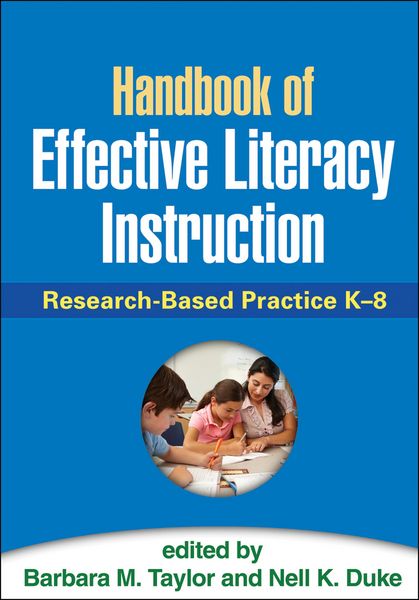
Handbook of Effective Literacy Instruction Research-Based Practice K-8
-
- Taschenbuch ausgewählt
- eBook
-
Sprache:Englisch
76,99 €
inkl. gesetzl. MwSt.,
Portrait
Barbara M. Taylor, EdD, is Professor Emerita of Literacy Education at the University of Minnesota, where she is also founder and past director of the Minnesota Center for Reading Research. A member of the Reading Hall of Fame, she is a recipient of the Oscar S. Causey Award from the National Reading Conference (NRC, now the Literacy Research Association) and the Albert J. Harris Award and the Outstanding Teacher Educator Award from the International Reading Association (IRA). Dr. Taylor's research interests include reading comprehension and high-level talk and writing about text, elementary schoolwide reading improvement, early reading intervention, and the elements of effective instruction that contribute to children's success in reading. She has published numerous books, book chapters, and journal articles.
Nell K. Duke, EdD, is Professor of Language, Literacy, and Culture and an affiliate of the Combined Program in Education and Psychology at the University of Michigan. She is a recipient of honors including early career awards from the American Educational Research Association and the NRC, the Dina Feitelson Research Award from the IRA, and the Promising Researcher Award from the National Council of Teachers of English. Dr. Duke's research interests include the development of informational reading and writing in young children, comprehension development and instruction in early schooling, and issues of equity in literacy education. She is coauthor or coeditor of several books and has published numerous journal articles.
Produktdetails
Einband
Taschenbuch
Erscheinungsdatum
21.07.2014
Herausgeber
Barbara M. Taylor + weitereVerlag
Taylor and FrancisSeitenzahl
625
Maße (L/B/H)
25/16,6/2,9 cm
Gewicht
1021 g
Sprache
Englisch
ISBN
978-1-4625-1924-8
Barbara M. Taylor, EdD, is Professor Emerita of Literacy Education at the University of Minnesota, where she is also founder and past director of the Minnesota Center for Reading Research. A member of the Reading Hall of Fame, she is a recipient of the Oscar S. Causey Award from the National Reading Conference (NRC, now the Literacy Research Association) and the Albert J. Harris Award and the Outstanding Teacher Educator Award from the International Reading Association (IRA). Dr. Taylor's research interests include reading comprehension and high-level talk and writing about text, elementary schoolwide reading improvement, early reading intervention, and the elements of effective instruction that contribute to children's success in reading. She has published numerous books, book chapters, and journal articles.
Nell K. Duke, EdD, is Professor of Language, Literacy, and Culture and an affiliate of the Combined Program in Education and Psychology at the University of Michigan. She is a recipient of honors including early career awards from the American Educational Research Association and the NRC, the Dina Feitelson Research Award from the IRA, and the Promising Researcher Award from the National Council of Teachers of English. Dr. Duke's research interests include the development of informational reading and writing in young children, comprehension development and instruction in early schooling, and issues of equity in literacy education. She is coauthor or coeditor of several books and has published numerous journal articles.
Noch keine Bewertungen vorhanden
Verfassen Sie die erste Bewertung zu diesem Artikel
Helfen Sie anderen Kundinnen und Kunden durch Ihre Meinung.
Kurze Frage zu unserer Seite
Vielen Dank für Ihr Feedback
Wir nutzen Ihr Feedback, um unsere Produktseiten zu verbessern. Bitte haben Sie Verständnis, dass wir Ihnen keine Rückmeldung geben können. Falls Sie Kontakt mit uns aufnehmen möchten, können Sie sich aber gerne an unseren Kund*innenservice wenden.
zum Kundenservice